Shopify SEO: Deciphering Low Clicks – Content Quantity or Search Intent Misalignment?
Hey there, fellow Shopify merchants and store operators! Ever found yourself scratching your head, staring at your analytics, and seeing that frustrating combo: lots of impressions, but barely any clicks? It’s a common dilemma, and it was the exact challenge an original poster brought up in a recent community discussion I followed. They were trying to figure out if their pages needed more content or if they were simply targeting the wrong search intent.
It’s a crucial question, because as they wisely pointed out, if a keyword has an informational intent but your page is primarily commercial, simply adding another 1,000 words probably won't fix the underlying problem. It’s like trying to sell a hammer to someone who’s asking for instructions on how to build a house – you’re close, but not quite hitting the mark!
The Low Clicks, High Impressions Conundrum
So, where do you start? One sharp community member immediately asked a clarifying question: are these impressions on page 10, or are they on page 1 or 2? This distinction is vital:
- If you’re ranking on page 1 or 2 with low clicks: This often points to a metadata problem. Your page is visible, but your title tag and meta description aren't compelling enough to entice users to click. They might not clearly communicate the value or relevance to the searcher's query.
- If you’re not ranking on page 1 or 2: Here, the problem is usually deeper. You need to focus on both search intent and topical completeness. Your page might not be relevant enough, or comprehensive enough, to compete for those top spots.
Search Intent is King (and Queen!)
This was a resounding theme throughout the discussion. Multiple respondents emphasized that search intent is king. As one community member succinctly put it, "If a person is searching to buy an iPhone, a blog won't rank and the other way around. Your pages need to match the search intent."
Think about it: are users looking to learn (informational), buy (transactional/commercial), or find a specific website (navigational)? Your page's purpose must align with what the searcher is trying to achieve. If you have a product page for "organic cotton baby onesies" but you're ranking for "how to choose baby clothes," you've got an intent mismatch. No amount of product description will satisfy someone looking for advice.
Content: Better, Not Just More
Once you’ve nailed the search intent, then you can talk about content. But here’s the kicker: it’s not always about adding more words. As another expert pointed out, "Not necessarily MORE content, but BETTER content. Quite often less is more, context is king here."
The best way to figure out what "better" means? Competitive research. Analyze the top 3 search results for your target keyword. What kind of content do they have? What questions do they answer? How is it structured? If your content doesn't compete in quality, depth, or angle, then you need to produce something superior.
A community member from France even mentioned using a content scoring tool to get an idea of necessary density and search intentions to cover. While specialized tools can help, a manual audit of top-ranking pages is always a great starting point for any Shopify merchant.
Your Action Plan for Shopify Pages:
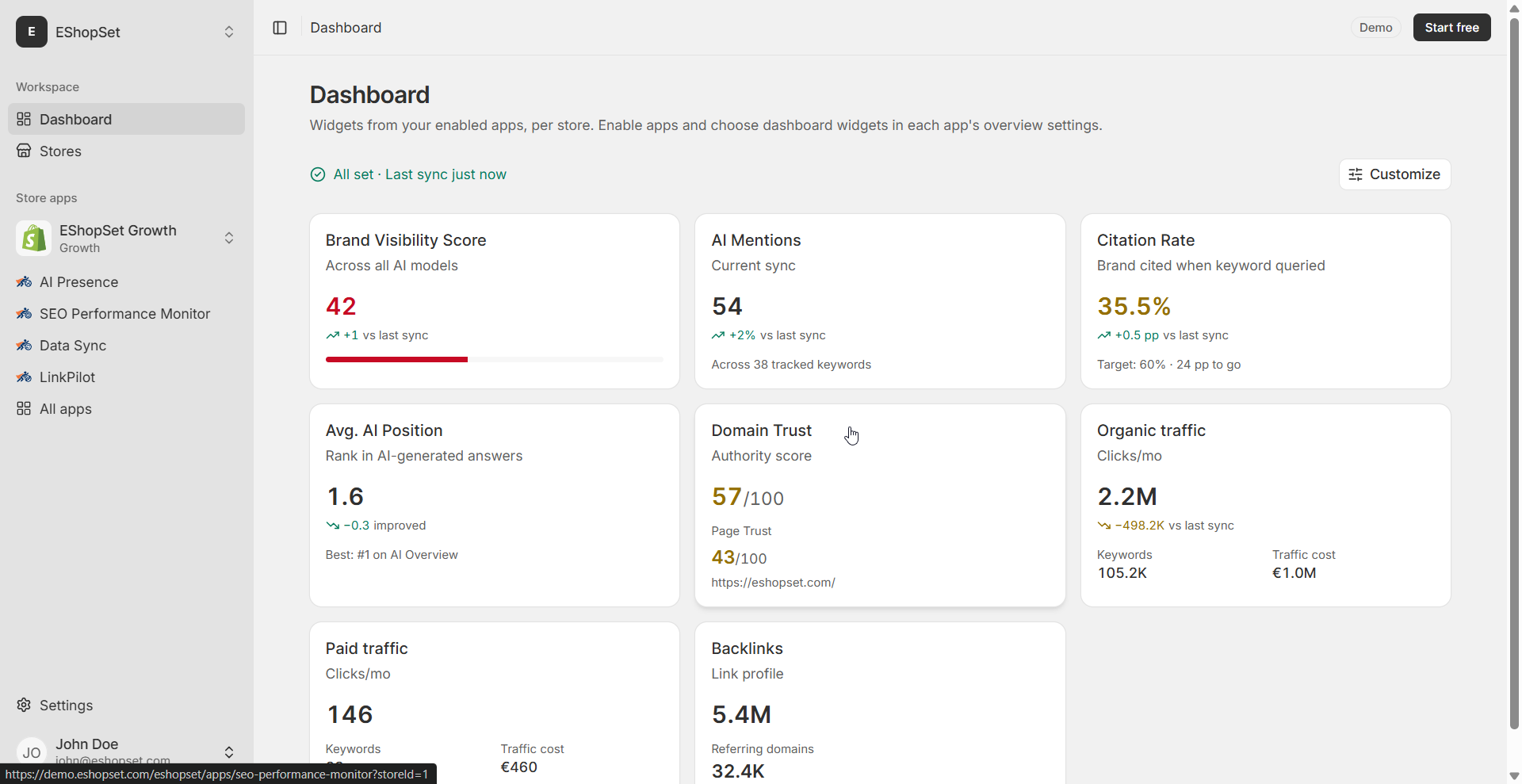
- Review Your Analytics: Use tools like Google Search Console (and EShopSet's SEO Performance Monitor) to identify pages with high impressions but low click-through rates (CTR). Pay attention to their average ranking position.
- Determine Search Intent: For those problematic keywords, manually search them on Google. What kind of results dominate the first page? Are they blog posts, product pages, category pages, or guides? This tells you the prevailing search intent.
- Audit Your Page Content: Compare your page directly against the top 3 results. Does your content match the intent? Is it as comprehensive? Is it well-written, engaging, and easy to understand?
- Optimize Metadata: If you're on page 1 or 2 with low clicks, rewrite your title tags and meta descriptions. Make them more compelling, clearly state the value, and include your primary keyword naturally.
- Refine or Rewrite Content: If there's an intent mismatch, you might need to repurpose the page, create a new page, or significantly rewrite existing content. If it's a content quality issue, focus on making it genuinely better, not just longer. For instance, if you're overhauling product pages based on new intent analysis, tools like Sheet2Cart can be a lifesaver for a Shopify one-time product import Sheets operation, letting you update descriptions, images, and prices efficiently across many SKUs.
- Build Authority: While content and intent are crucial, don't forget the broader SEO picture. As one respondent noted, "when you learn that Google ranks pages on authority and not content analysis, your SEO game improves dramatically." Backlinks and overall site authority still play a significant role.
EShopSet Team Comment
This discussion perfectly highlights the nuanced work involved in daily SEO operations for Shopify stores. We strongly agree that matching search intent is non-negotiable, and content quality trumps mere word count every time. EShopSet's SEO Performance Monitor is built to help merchants identify those high-impression, low-click pages, while AI Presence can then assist in crafting better, intent-aligned content and metadata. For implementing large-scale content updates or creating new, targeted product pages, Sheet2Cart provides the efficiency needed to manage your catalog effectively.
Ultimately, getting those clicks isn't just about showing up; it's about showing up with exactly what your potential customer is looking for. By focusing on search intent and creating genuinely valuable, competitive content, you’ll not only solve the low-click problem but also build a more robust, traffic-driving Shopify store. Happy optimizing!