Navigating High-Volume Payments for High-Risk Shopify Stores: Insights from the Community
Running a Shopify store brings its own set of challenges, from managing inventory to optimizing for search engines. But what happens when the very mechanism that brings in your revenue – your payment processing – becomes a hurdle? We recently stumbled upon a fascinating discussion in an online community that really hit home for many merchants, especially those in niche markets.
The original poster shared a common, yet often unspoken, issue: their UK Shopify store, leveraging an open banking provider for payments, was thriving. Conversion rates were good, and they saw a clear path to significant revenue. The catch? The open banking system sent individual payments directly to their bank account. Receiving ten or more individual transfers daily, as they scaled, caused their banks to repeatedly close their accounts. The payment provider couldn't offer batched payouts or hold funds, leaving the merchant in a tough spot.
The Core Problem: High-Volume, Direct Transfers & Banking Relationships
This scenario highlights a critical operational bottleneck. While the open banking setup offered good conversion, the lack of a batching mechanism created a compliance nightmare for traditional banks. Banks, designed to monitor for unusual activity, flag frequent, small, direct transfers as potentially suspicious, leading to account closures. The original poster was adamant: it wasn't the product itself causing the bank closures, but the sheer volume and pattern of transactions, unlike Shopify Payments which might decline a high-risk product outright.
Community Solutions & Expert Advice
The community discussion brought forth several valuable perspectives:
- Ask Your Provider for Bank Recommendations: A helpful suggestion was to inquire if the open banking provider had any recommended banks accustomed to handling high volumes of merchant transfers. They might have encountered this issue with other clients.
- Shopify Payments & High-Risk Niches: Several respondents initially suggested Shopify Payments. However, the original poster clarified their niche was deemed 'high-risk,' making standard processors, including Shopify Payments, a non-starter. This immediately shifts the focus to specialized solutions.
- Understanding Bank Scrutiny: While the original poster believed banks couldn't see the product, some community members rightly pointed out that banks do care about the source of funds, even if they're not directly processing the transaction via a merchant account. They perform due diligence. However, the primary issue here seemed to be the pattern of transactions triggering flags, regardless of the product's legality.
- Proactive Business Banking & Transparency: The most robust advice was to actively engage with business banking providers. Instead of waiting for accounts to be closed, approach banks upfront. Explain the specific payment flow: high volume of individual customer transfers via an open banking provider. Seek a business account specifically designed to be comfortable with this transaction pattern. This proactive approach significantly reduces risk.
- Exploring Batch Payout Solutions: The original poster mentioned looking into services like Fena for batched payouts. This is a crucial step. Consolidating multiple small payments into a single, larger daily payout (e.g., £1500 once a day instead of ten £100-£150 transfers) can dramatically alter a bank's perception of risk and volume.
- Merchant Accounts vs. Personal Accounts: The discussion implicitly highlighted the need for proper business banking infrastructure. Relying on personal accounts or accounts not set up for high-volume commercial activity is a recipe for trouble. Your payment provider might not offer a merchant account, but they should allow you to route funds to a dedicated business account you've set up yourself.
Practical Takeaways for Shopify Merchants
If you find yourself in a similar situation, especially operating in a niche that standard processors shy away from:
- Be Transparent with Your Bank: Don't hide your payment flow. Find a business bank willing to understand and support your specific operational model.
- Seek Batching Capabilities: Prioritize payment providers or third-party solutions that can consolidate payments into fewer, larger transfers to your bank. This is a game-changer for managing bank relationships.
- Dedicated Business Accounts: Always use a dedicated business bank account. Mixing personal and business finances is problematic for many reasons, including bank compliance.
- Understand Your Risk Profile: While your product might be legal, its classification as 'high-risk' by payment processors means you need specialized financial partners. This extends to your banking relationships.
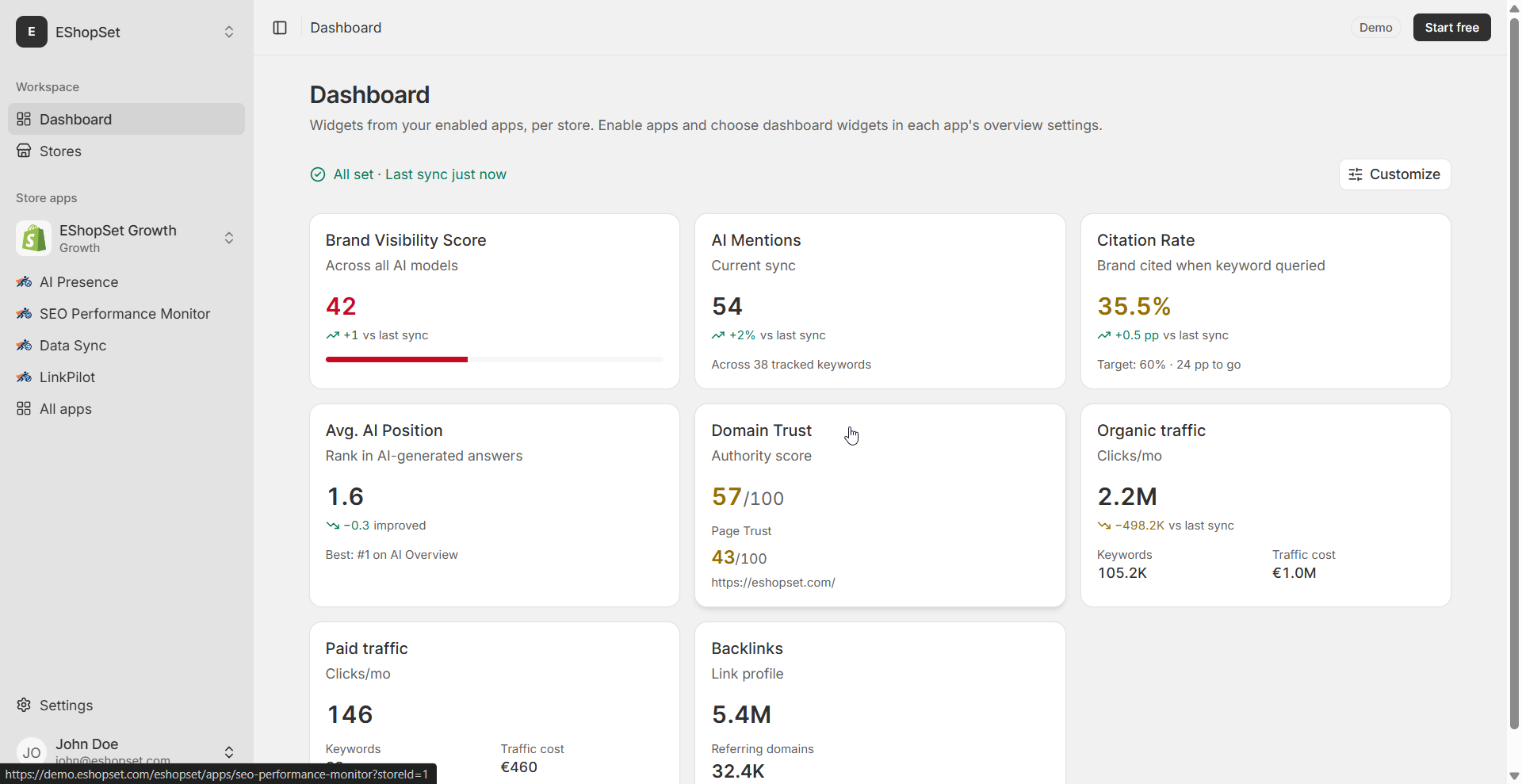
While you're tackling these backend financial hurdles, don't let your frontend visibility suffer. Keeping an eye on your search performance with a reliable Shopify SEO monitoring app like EShopSet's SEO Performance Monitor ensures that customers can still find you, even if your payment infrastructure is undergoing changes. Maintaining strong SEO is critical for consistent organic traffic, regardless of your payment gateway challenges.
EShopSet Team Comment
This discussion perfectly illustrates the complex operational realities many Shopify merchants face beyond just selling products. Solving payment flow issues is paramount for sustainable growth. We believe that while you're navigating these banking complexities, maintaining robust digital operations is non-negotiable. EShopSet's SEO Performance Monitor ensures your store's visibility remains strong, our AI Presence helps maintain consistent brand messaging across channels, and Data Sync can be vital for keeping your product catalog and order information accurate, even when your financial backend is undergoing adjustments.
Ultimately, scaling an ecommerce business means addressing every link in the chain, from product sourcing to payment reconciliation. Proactive communication with your financial partners and leveraging the right tools for your daily operations will pave the way for long-term success, even in challenging niches.