Shopify SEO: Taming Faceted Navigation & Crawl Budget for Better Visibility
Hey Shopify merchants and store operators! Let's talk about something that often keeps us up at night: faceted navigation and its impact on SEO. We recently saw a fantastic discussion in an expert community that really hit home for many of us running ecommerce sites, especially those with smaller catalogs. It's a classic problem: great for users, but a potential headache for search engines.
The original poster in this discussion was grappling with a small ecommerce site, around 600 product pages, but their faceted navigation (think color, size, price filters) was generating thousands of URL variations. Sound familiar? They were seeing Googlebot wasting precious crawl budget on these filtered combos, even those returning zero products. Despite setting URL parameters in Google Search Console and blocking some with robots.txt, new, unwanted URLs kept popping up – a real game of 'whack-a-mole'.
Their main dilemma: Should they use noindex on filtered pages and risk Google still discovering them, or aggressively block them at the robots level and trust Google to figure out the hierarchy? They were leaning towards server-side logic to prevent empty result URLs from generating, but worried it might be too heavy-handed for a small project.
The Community Weighs In: Practical Solutions for Shopify Merchants
The beauty of these discussions is the diverse perspectives. Here's a breakdown of the key takeaways and actionable advice that emerged:
1. The Truth About Crawl Budget for Smaller Sites
One of the most reassuring points came from several community members: for a small site with thousands, not millions, of URLs, 'crawl budget' often isn't the critical factor you might think it is. As one respondent put it directly, "If it's a small site 'crawl budget' is not a factor." Another clarified that dealing with thousands of URLs is "a non-issue" and that once Google sees a noindex tag, it won't crawl those URLs as often anyway.
This is a huge relief for many Shopify merchants! While efficiency is always good, don't let the fear of 'burning crawl budget' paralyze your SEO efforts.
2. Noindex vs. Robots.txt: A Clearer Path
The consensus leaned strongly towards using noindex over aggressive robots.txt blocking for pages you don't want indexed but might still be internally linked. A community member explained that if URLs are already discovered, you need meta robots tags to ensure they fall out of the index. Another expert added, "I'd avoid blocking all filtered URLs in robots.txt because Google can still discover them through internal links." Instead, they suggested letting valuable filter combinations be crawlable and indexable, while using noindex or canonical tags for low-value variations.
Actionable Tip: For filter pages you don't want in search results, implement a tag. This tells Google not to index the page but still allows it to follow links from it, which is crucial for discovery of your actual product pages.
3. Optimizing Pagination and Product Display
A simple yet effective tip came from a respondent who suggested increasing products per page. The original poster was running 12 products per page, which creates a lot of pagination. Increasing this to around 24 (or even more, depending on your store's design and user experience) can significantly reduce the number of pagination pages Google needs to crawl and manage. This also reduces the number of 'deep' category pages that might not bring much search traffic anyway, as their products are visible on parent category pages.
4. Preventing Zero-Result Pages Server-Side
The original poster's gut feeling about preventing zero-result filter pages from being generated wasn't off-base. A community member echoed this, advising to "prevent zero-result filter pages from being generated where possible." This is the most proactive approach. If a filter combination yields no products, your site shouldn't generate a unique URL for it. Instead, it could redirect to the parent category or display a message without changing the URL.
5. The Power of Log File Analysis
Finally, a critical point for validating your efforts: "Regular log file analysis is the best way to validate whether your crawl budget is actually improving." This helps you see exactly what Googlebot is crawling and how often, confirming if your noindex or other strategies are working as intended.
EShopSet Team Comment
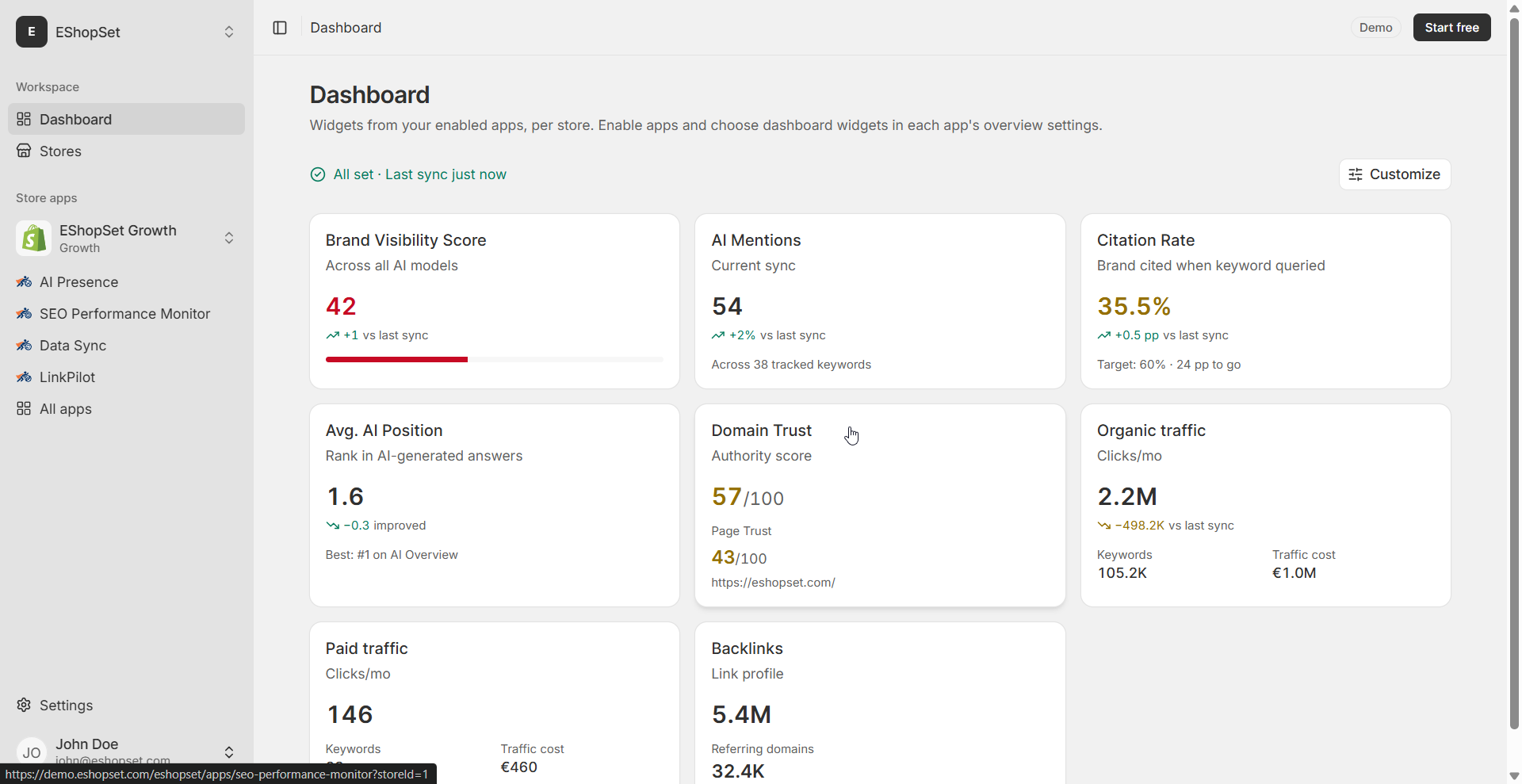
This discussion highlights a universal challenge for ecommerce, and the community's insights are spot-on. For most Shopify stores, hyper-focusing on 'crawl budget' is less important than ensuring search engines efficiently find and understand your valuable content. A messy index with thousands of low-value filter pages can subtly impact your overall AI presence score Shopify store, making it harder for search engines to prioritize your truly valuable content. Our SEO Performance Monitor app can be invaluable here, helping you track index coverage and identify those problematic URLs that are eating up attention. For managing your product data efficiently to prevent empty categories or ensure correct categorization that reduces filter issues, Sheet2Cart can be a game-changer.
In essence, the goal isn't just to save Googlebot's time, but to clearly signal your most important pages. By strategically using noindex for low-value filter combinations, optimizing pagination, and ideally preventing empty filter result pages at the source, you ensure your Shopify store presents its best face to search engines and users alike. Keep an eye on your analytics and Google Search Console to monitor the impact, and remember, a cleaner index leads to a stronger online presence!