Unlock AI Citations: Why Your Shopify Store's Internal Linking is Key to Brand Visibility
Hey fellow Shopify merchants and store operators! We've been seeing a lot of chatter in the community about how to get our stores recognized by the new wave of AI search tools. You know, the ones that summarize answers and often cite sources directly. It's a game-changer for visibility, but many are finding their content isn't getting those coveted citations, even when the quality is top-notch.
Recently, a really insightful discussion popped up, with the original poster making a compelling point: it's probably not your content quality holding you back, but your internal linking strategy. And honestly, as an ecommerce ops expert, this resonates deeply with what we're seeing. It's a fundamental SEO principle that's more critical than ever in the age of AI.
Why Internal Linking Matters More Than Ever for AI Visibility
Think about how AI models 'read' the internet. They crawl and process vast amounts of data, not just individual pages. When an AI tool like Perplexity or a chatbot like ChatGPT tries to understand your brand or a specific product, it's looking for context, authority, and relevance. A robust internal linking structure acts like a roadmap, guiding these AI crawlers through your site, showing them which pages are most important, how different topics relate, and where your expertise lies.
If your internal links are sparse, broken, or illogical, the AI might struggle to connect the dots. It might see individual great articles or product pages, but fail to understand the depth of your site's content or the authority of your brand on a particular topic. This can directly impact your Shopify brand mentions Perplexity and overall ChatGPT Shopping brand visibility Shopify.
Connecting the Dots for AI: Actionable Steps for Shopify Merchants
- Map Your Content Silos: Group related products, categories, blog posts, and informational pages. For example, all your "organic cotton t-shirts" should link to each other, to the main "t-shirts" category, and potentially to a blog post about "sustainable fashion." This creates clear topical authority.
- Prioritize Pillar Content: Identify your most important product categories, evergreen guides, or brand story pages. These should have the most internal links pointing to them from relevant, lower-level pages. They become your site's authoritative hubs.
- Use Descriptive Anchor Text: Instead of generic "click here," use natural, keyword-rich anchor text. If you're linking to a page about "winter boots," the anchor text should be something like "our durable winter boots collection" or "learn about insulated winter boots." This gives AI (and human users) clear context.
- Audit Existing Links: Regularly check for broken internal links or pages that are orphans (no links pointing to them). These are dead ends for both users and AI crawlers. Tools like SEO Performance Monitor can help you identify these issues quickly.
- Contextual Links in Blog Posts: When you write blog content, don't just link to your homepage. Weave in links to specific product pages, category pages, or other relevant blog posts that offer more detail or a solution directly related to the content. This strengthens the entire web of your site.
- Leverage Product Descriptions and Collections: Ensure your product descriptions link to related products, collections, or even care guides. Similarly, collection pages should link to individual products and potentially relevant blog content.
Improving your internal linking isn't just about SEO; it's about creating a better, more navigable experience for your customers and for the advanced algorithms that are increasingly shaping how people discover information and products online. It tells AI, "Hey, we've got a lot more great stuff here, and it's all connected!"
And speaking of connections, for those of you dealing with extensive product catalogs, optimizing how you manage and update your products is crucial for maintaining a healthy site structure. If you're regularly adding new products or updating existing ones, making sure they integrate seamlessly into your internal linking strategy from day one is essential. This is where solutions that streamline your data management can really shine. For instance, if you're looking to Shopify import products from Google Sheets, ensuring those new products are immediately part of a well-linked structure is key to their discovery by both customers and AI search tools.
EShopSet Team Comment
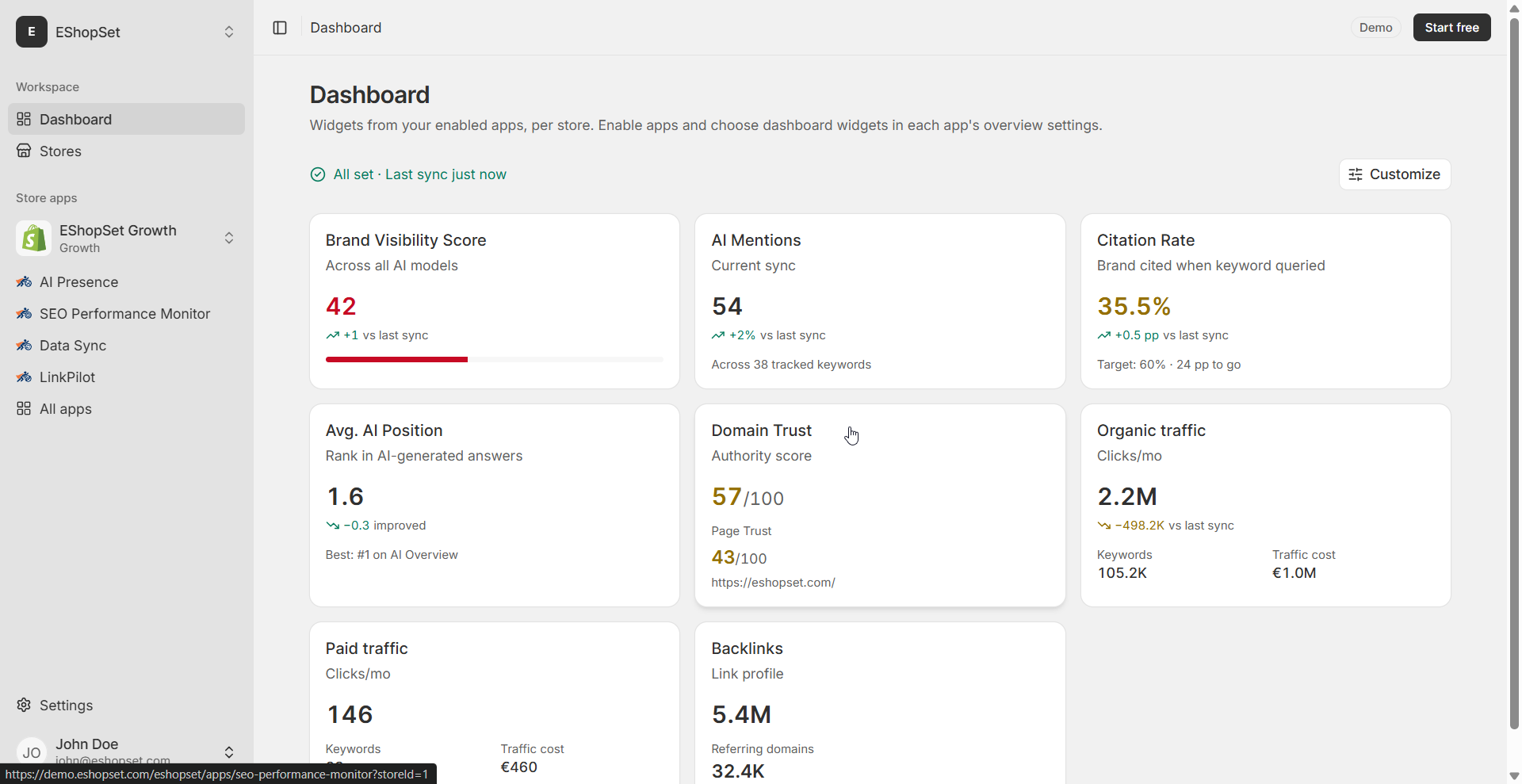
We absolutely agree with the original poster's emphasis on internal linking as a critical, often overlooked, factor for AI citation. It's not just about what you say, but how easily AI can find and contextualize it across your entire store. For Shopify merchants, our SEO Performance Monitor can be invaluable for identifying internal linking gaps and tracking the impact of your improvements, while AI Presence helps you understand how your brand is perceived by AI, highlighting areas where better linking could boost visibility. And for those managing large catalogs, Sheet2Cart ensures new products are efficiently onboarded, allowing you to focus on integrating them into your optimized internal link structure right away.
So, take some time to review your Shopify store's internal linking. It might just be the missing piece in getting your brand the AI search visibility it deserves. Happy linking!