When AI Recommends Discontinued Products: Mastering Your Store's Digital Footprint
Hey everyone, let's talk about something I've seen pop up more and more in our community discussions lately. It's that moment when a customer messages you about a product or price that simply doesn't exist anymore, only to find out they got the info from an AI chatbot like ChatGPT.
One merchant recently shared a frustrating experience: a customer asked about a bundle they discontinued over a year ago, with an old price point to boot. The original poster then checked with other AI models like Perplexity and Claude, finding inconsistencies – one had a different price, another didn't even mention their store, instead listing competitors. What's truly eye-opening is that none of this showed up in their usual Google Analytics or Search Console reports. This critical visibility gap meant they were completely in the dark until a customer flagged it.
The Root of the Problem: AI's Memory & Data Sources
This isn't an isolated incident. Several community members chimed in with similar stories. One respondent mentioned how a client's old 'free setup' offer was still being pushed by ChatGPT, while Perplexity was directing users straight to a competitor. Another shared a story about AI recommending businesses that had been closed for years! So, what's going on?
The consensus from the discussion points to a few key areas:
- Outdated URLs and Cached Pages: As one sharp community member pointed out, the AI isn't necessarily 'reading' your live store. It's likely pulling from an old, cached version of a page, or even a discontinued product URL that might still be live (even if it's a 404, the content could be cached). If that old product page still exists, even without being linked, AI models might have it in their training data.
- AI Training Data Lag: AI models are trained on vast datasets, but these datasets aren't updated in real-time. There's a significant lag between when information changes on your store and when an AI model 'learns' about it. As a respondent noted, they are 'slow to forget.'
- Citation Sources: While not always transparent, AI models often pull from various web pages, forums, and directories. If an old blog post or a third-party review site still references your discontinued product or old pricing, the AI might pick that up.
What Can Shopify Merchants Do? Actionable Steps
The good news is, while you can't control AI's training directly, you can control your store's digital footprint and influence what these models cite. Here are some actionable steps inspired by the community's insights:
-
Audit and Eliminate Old URLs:
- Check if discontinued product pages still exist. If they do, either delete them or set up 301 redirects to a relevant current product, category page, or your homepage. This is crucial for both user experience and SEO.
- Ensure any old pricing or offers are completely removed from all existing pages.
-
Update All Public-Facing Content:
- Beyond your product pages, review blog posts, FAQs, and any other content that might reference products or offers. Update these to reflect your current catalog and pricing.
- Consider using tools like Sheet2Cart to efficiently manage and update your product catalog directly from a spreadsheet, ensuring consistency across your Shopify store.
-
Proactive AI Monitoring:
- The original poster mentioned running checks with Pallas. This highlights the need for dedicated tools to monitor what AI models are saying about your brand.
- Actively search for your brand and products on popular LLMs (ChatGPT, Perplexity, etc.) using various prompts. Look for specific product recommendations, pricing, and offers. This helps you understand your current Shopify LLM citation rate and accuracy.
- If you find outdated information, identify the likely source (an old page, a third-party site) and work to update or remove it.
-
Enhance Your Current Product Visibility:
- While AI visibility is new, traditional SEO still matters immensely. Ensure your current, active products are well-optimized and ranking high on search engines.
- A robust Shopify SERP ranking tracker can help you see where your current products stand, driving organic traffic to accurate information.
EShopSet Team Comment
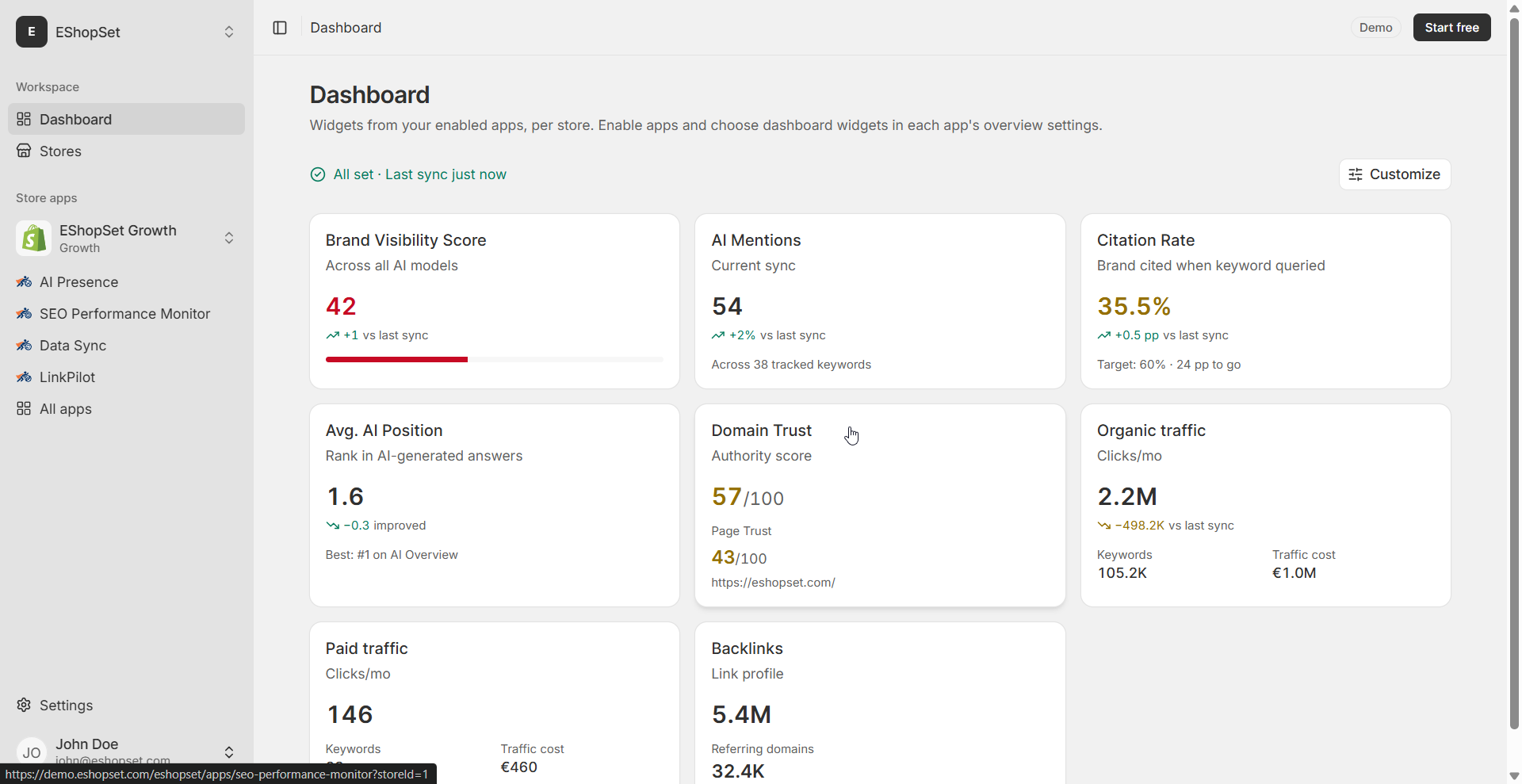
This community discussion perfectly illustrates a growing challenge for Shopify merchants: managing your store's presence not just on traditional search engines, but within the rapidly evolving landscape of AI recommendations. It's clear that relying solely on Google Analytics or Search Console is no longer enough to catch these subtle yet impactful issues. We believe proactive monitoring of your AI presence is as critical as traditional SEO. Our AI Presence app is designed specifically for this, helping you track what LLMs are saying about your brand and products, while SEO Performance Monitor ensures your core search visibility remains strong. Together, they provide a comprehensive view of your digital footprint, helping you maintain accuracy and avoid customer confusion.
The takeaway here is that AI models are becoming significant discovery channels. Just as you optimize for Google, it's becoming essential to optimize for AI. By taking control of your store's data integrity, regularly auditing your online content, and actively monitoring AI citations, you can ensure that when a customer asks an AI for recommendations, they're getting the most current and accurate information about your amazing Shopify store.