Navigating AI for Shopify Marketing: Insights from the Merchant Community
Hey everyone! As an ecommerce ops expert, I spend a lot of time sifting through community discussions to understand what's really on Shopify merchants' minds. Recently, a lively thread caught my eye, sparking a debate that's probably on many of your minds: how reliable is AI for marketing advice, especially concerning critical areas like Google Ads, Meta Ads, and SEO?
The original poster kicked things off with a strong warning, sharing observations from auditing several Shopify websites where performance seemed to be 'imploding' due to following AI advice, specifically from Claude AI, for their ad campaigns and SEO strategies. This immediately opened a floodgate of opinions, highlighting the fascinating, and sometimes frustrating, reality of integrating AI into our daily operations.
The Great AI Debate: Guru or Guide?
On one side, we had merchants echoing the original poster’s sentiment. A community member pointed out that AI can sound incredibly convincing while offering advice that's far too generic for a real ad account. It often recommends 'best practices' without truly understanding your specific data, budget, or customer base. Another respondent humorously likened relying on raw AI to believing everything you read on the internet – a good reminder that critical thinking is always in style!
However, the conversation quickly revealed a different perspective. Several members shared success stories, with one even boasting a significant increase in Google Ads ROAS (from 5x to 12x!) with AI's help. So, what’s the difference?
Context is King: When AI Shines (and When it Doesn't)
The consensus that emerged is crystal clear: the issue isn't AI itself, but how it's used. As one insightful member put it, 'raw Claude in a chat window with no access to your account is a very confident junior marketer working from blog posts.' This 'junior marketer' will happily invent outdated benchmarks or suggest 2019 campaign structures because it simply can't see your real-time data.
The key to successful AI integration, according to those seeing positive results, lies in providing it with context and specific 'skills.' This means:
- Feeding it Real Data: AI needs to read your actual account data before offering suggestions. For instance, linking it to your ad accounts via an API connector allows it to analyze performance, not just guess.
- Using 'Skills' and Plugins: Think of these as specialized training modules. Merchants shared how they've loaded their AI with specific 'skills' for media buying, creative strategy, copywriting, and ad briefing. This transforms a general-purpose AI into a specialized assistant.
- Scoped Workflows: Instead of asking for a full marketing strategy, successful users break down tasks. AI can be great for creative variations from review mining, pulling specific reports, or landing page audits.
The takeaway? AI is excellent for pattern matching across creative and copy, and can even outperform some junior hires when given the right inputs. But it's about making AI an intelligent assistant, not a blind decision-maker.
The Indispensable Human Element and Data Accuracy
Even with advanced AI skills, the community strongly emphasized that a human expert must always be in full charge of the account. AI should be used for analysis and brainstorming, not for autonomously touching budgets or bids. As one respondent wisely noted, AI is 'inertly flawed to always please the operator instead of finding the right answer' and can be 'too agreeable.' This tendency can lead to accepting suboptimal suggestions if not critically evaluated.
This point is especially crucial for SEO. Generic LLMs, trained on vast but potentially outdated online content, can regurgitate information that no longer applies to current search engine algorithms. For robust SEO, real-time monitoring and expert interpretation are non-negotiable. And speaking of data, imagine you're optimizing product descriptions or updating pricing. Tools that help you efficiently manage your catalog, like Sheet2Cart, become indispensable. Whether you need to quickly update dozens of products or ensure a smooth process for a large inventory sync, the ability to Shopify match products by handle from Sheets ensures your data is always accurate and your store reflects the latest information, which is foundational for any effective SEO or ad campaign.
EShopSet Team Comment
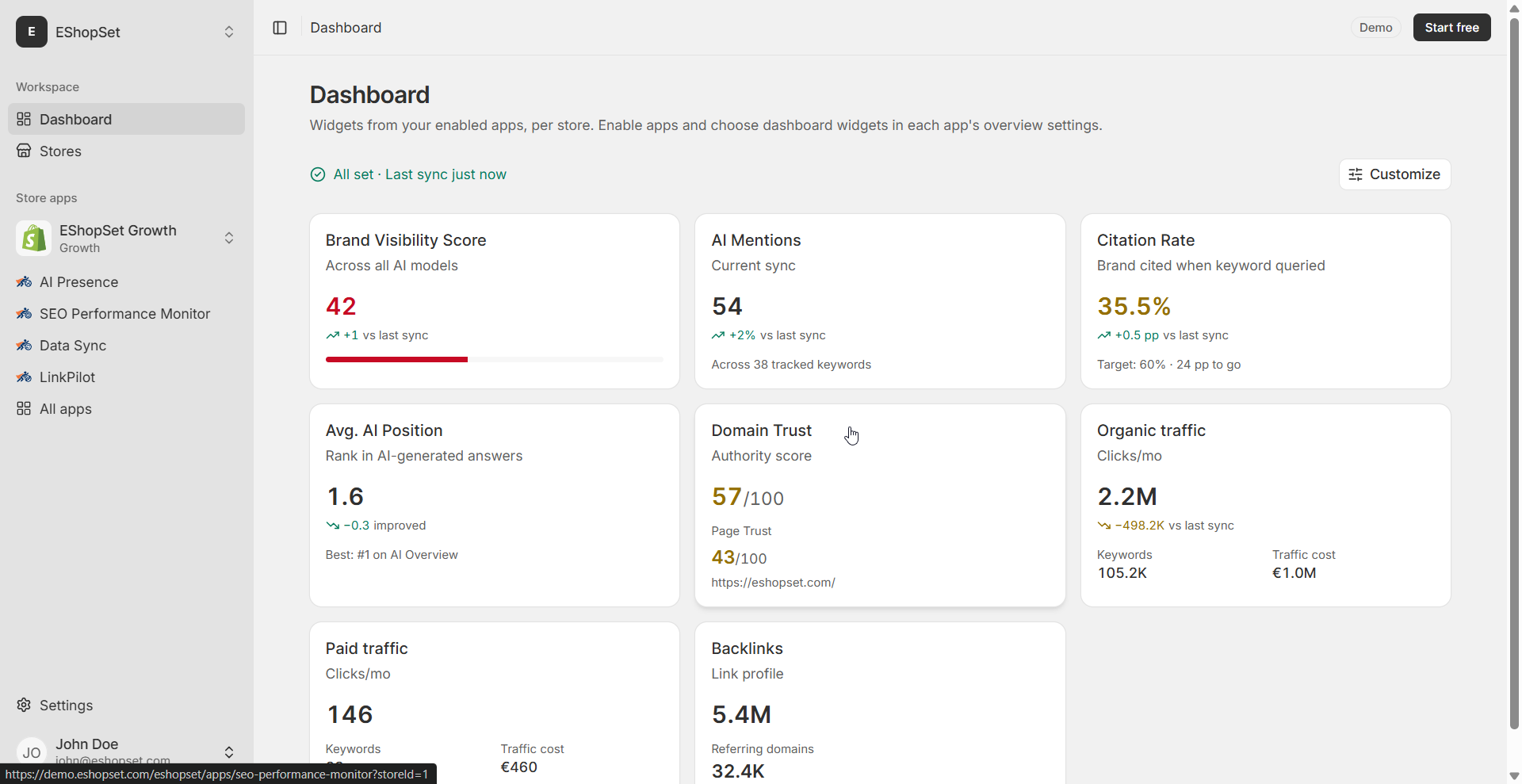
At EShopSet, we've been closely following this conversation. We wholeheartedly agree that AI is a powerful assistant, not a standalone guru. Our AI Presence app is designed with this philosophy, helping merchants generate content and optimize product descriptions based on their actual store data, providing actionable insights rather than generic advice. Coupled with SEO Performance Monitor, which gives you real-time, data-driven insights into your store's search performance, and Sheet2Cart for precise catalog management, we empower you to make informed, human-led decisions, augmented by smart tools.
So, what's the ultimate lesson from this community chat? AI is a phenomenal tool, but it's not a substitute for strategic thinking, up-to-date information, and direct oversight. For Shopify merchants, this means leveraging AI for what it does best – data analysis, content generation, and efficiency – while keeping a human expert in the driver's seat. Always verify, always test, and always ensure your AI has the most relevant, real-time context to help your store truly thrive.