Google Traffic Drops? Why Your Shopify Store Might Be Playing 'Light Switch' SEO
Ever felt like Google is playing a cruel game with your Shopify store's organic traffic, flicking it off and on like a light switch? You're not alone. This exact scenario recently sparked a lively discussion in an online community, and the insights shared are incredibly valuable for any merchant grappling with unpredictable SEO performance.
The original poster described a perplexing situation: a rapidly growing content site, about 1,600 pages strong, experiencing dramatic drops in Google organic clicks—sometimes by 65-75%—only to recover days later, often to new all-time highs. This wasn't a one-off glitch; it had happened four times in a few months. The pattern was consistent: distinct queries and URLs served would plummet, but for the pages Google did keep serving, positions remained stable. Impressions would fall drastically, while CTR (Click-Through Rate) would artificially 'improve' because only the strong head terms were left in the averages. The long tail content, which made up the bulk of the site, was hit hardest.
Beyond the Usual Suspects: What Was Ruled Out?
What made this case particularly puzzling was how thoroughly the original poster had already investigated. They had meticulously ruled out common culprits:
- Manual actions or security issues: Nothing reported in Google Search Console (GSC).
- Technical problems: Site crawled perfectly with Googlebot's user agent, 200 responses, correct canonicals, no stray noindex tags, sitemap was fine, content server-rendered.
- Own changes: Drops didn't align with any deployments; one recovery happened with no changes on their end.
- Tracking issues: Server-side analytics confirmed the traffic drop, and only Google traffic was affected.
- Device/country specificity: Drops were consistent across all segments.
Their working theory involved a domain-level quality threshold being re-evaluated, perhaps due to the volume of long-tail content. But the consistent recovery to new highs contradicted a typical quality demotion, which usually results in a sustained drop.
A Deeper Dive: It's a Retrieval Problem, Not a Scoring Problem
This is where the community really shined. One particularly insightful respondent honed in on a crucial gap in the original poster's ruled-out list: network-level issues like a Web Application Firewall (WAF) or rate limiter. The original poster had crawled their site using Googlebot's user agent from their own IP, but a WAF or rate limiter might be keyed on IP range, Autonomous System Number (ASN), or request rate—things that wouldn't necessarily trigger from a single IP address test.
The data points strongly to this 'retrieval problem' theory. If positions didn't move on the pages Google continued to serve, it suggests the content's quality score wasn't being downgraded. Instead, Google was simply retrieving fewer pages from the site. These rules can trip, clear, and then everything comes back unchanged—explaining the 'new highs' after each recovery. Nothing was truly downgraded; access was just temporarily restricted or throttled.
Actionable Steps for Shopify Merchants Facing Similar Issues
If your Shopify store is experiencing these on/off traffic fluctuations, here’s how to investigate, drawing directly from the expert advice shared:
1. Check Google Search Console (GSC) Crawl Stats
- Navigate to GSC and look at the 'Crawl Stats' report.
- Focus on the periods around your traffic drops.
- Look for spikes in 'Total requests', 'Average response time', and especially 'Host status' errors (e.g., 5xx errors, timeouts, or other client errors). A sudden rise in these before each traffic drop is a strong indicator of a retrieval problem.
2. Analyze Your Server Access Logs
- Filter your access logs to only show requests from verified Googlebot. You can do this by performing a reverse DNS lookup on the IP addresses.
- Count requests and any non-200 (error) responses per hour during your traffic drop windows.
- This will confirm if Googlebot itself is encountering issues reaching your server or if its request volume is being unusually throttled.
3. Use the URL Inspection API (or GSC's URL Inspection Tool)
- During an active traffic drop, use the URL Inspection tool in GSC (or its API if you have many URLs) on a sample of your long-tail URLs that typically lose traffic.
- This helps distinguish between URLs that are simply 'not retrieved' (indexed but not being shown) versus those that might have been 'dropped from the index' entirely.
Crucially, the expert advice was clear: do not prune your long-tail content yet. Pruning won't fix an on/off switch problem, and it removes valuable data for comparison.
While one community member speculated about the original poster 'gaming the system,' the detailed analysis and consistent recovery patterns strongly suggest a technical retrieval issue rather than a quality demotion. It’s always best to follow the data.
EShopSet Team Comment
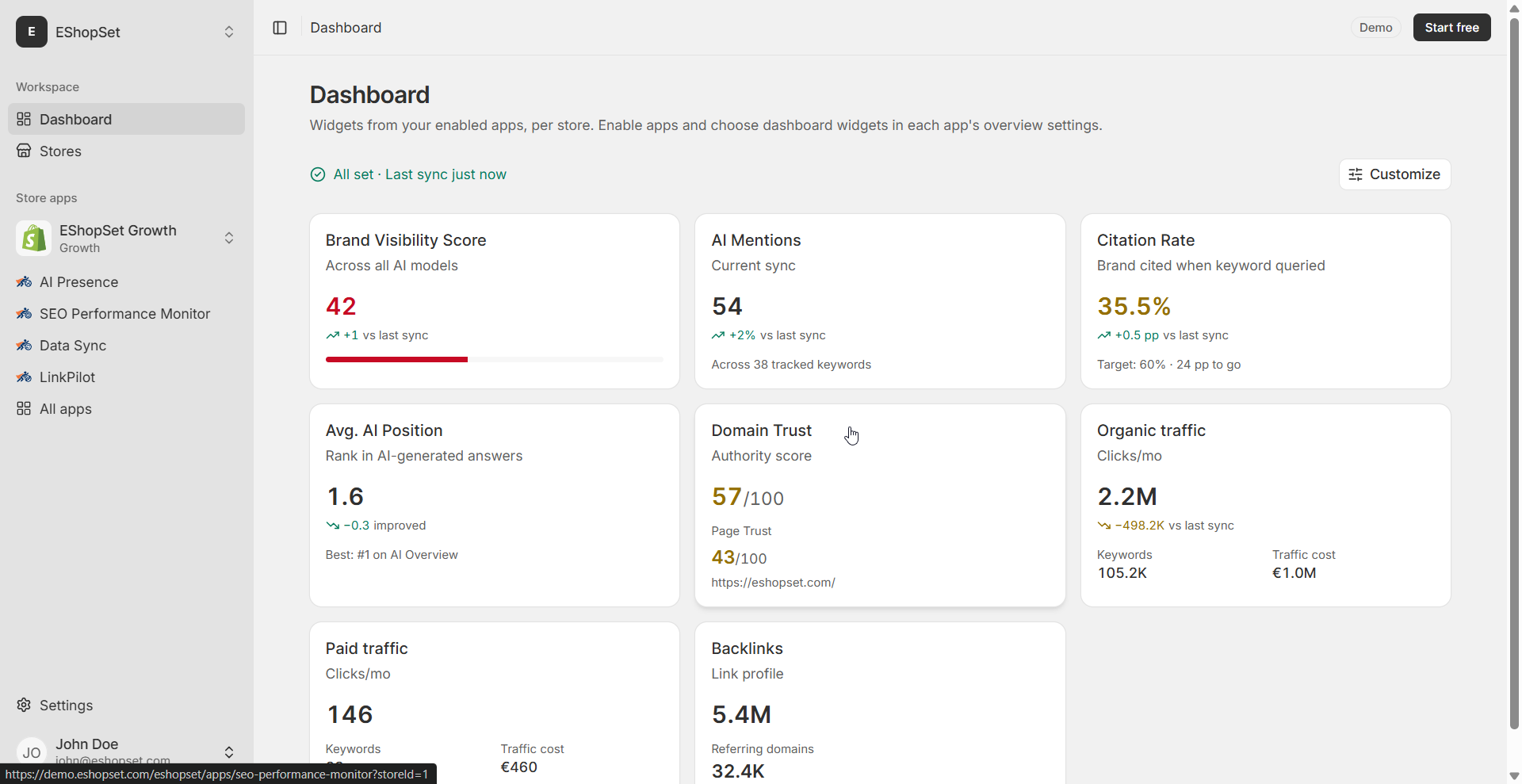
We completely agree with the assessment that this 'light switch' effect is likely a retrieval problem, not a content quality issue. For Shopify merchants, proactive monitoring is key. Our SEO Performance Monitor app can help you keep a vigilant eye on your site's health, tracking key SEO metrics and alerting you to sudden changes that could indicate such issues. Furthermore, if your long-tail content relates to product variations or extensive catalog data, ensuring that data is consistently correct and accessible to crawlers is vital; a robust Sheet2Cart solution functions as a reliable Shopify Data Sync app, helping prevent potential crawlability issues stemming from inconsistent product information. Early detection and precise diagnosis are your best defense against these frustrating traffic fluctuations.
Understanding the nuances of how Google interacts with your site is paramount. While a WAF or rate limiter might sound technical, the underlying principle is simple: sometimes, your site's ability to serve content to Googlebot is temporarily hampered, not because your content isn't good, but because of an external gate. By systematically investigating your server logs and GSC data, you can pinpoint the real cause and get your Shopify store's traffic flowing steadily again. Stay vigilant, use your tools wisely, and remember that community insights can often shed light on the most complex problems.