Decoding Shopify Ranking Drops: Insights from a Real-World SEO Investigation
Ever felt that gut punch when a key product page or collection on your Shopify store, previously a Google darling, suddenly drops off the face of the Earth for your most important keywords? You’re not alone. We recently stumbled upon a fascinating community discussion where a merchant was grappling with a similar issue: a significant ranking loss for specific queries after a website migration, despite other related queries still performing well.
The original poster described a situation where an established B2B services page, after migrating from WordPress to Next.js, saw its visibility for “development-related searches” plummet, while “consulting queries” for the same page remained strong. This isn't just a B2B problem; it's a common challenge for Shopify merchants who might update themes, redesign product pages, or even migrate product data, only to find their SEO performance inexplicably suffering.
The Mystery of the Missing Rankings: Initial Clues
The merchant had done their homework: GSC (Google Search Console) showed the page was indexed, the canonical URL was correct, old URLs redirected properly, and no 'noindex' tags were found. Yet, for crucial development queries, the page averaged position 54, while for consulting queries, it was a solid position 2. This query-specific visibility loss, despite normal indexing, is a head-scratcher.
A community member quickly jumped in, suggesting that if consulting queries still ranked but development ones tanked, the issue might be more about changes on the page itself rather than a pure migration problem. They recalled their own experience moving to Next.js, where new templates silently dropped body copy, rendered sections client-side, or merged components without proper checks. This is a critical insight for Shopify merchants: theme updates, app integrations, or manual content edits can inadvertently strip out key text or change how content is rendered, impacting how Google perceives your page's relevance for certain terms.
The advice? A thorough comparison. "Diff the old WordPress version (Wayback Machine is great for this) against the rendered HTML in URL Inspection," they suggested. Focus specifically on the development-related headings and terms that might have vanished or changed. The original poster agreed, planning to compare content and separate migration-related changes from more recent content revisions.
Technical & Content Deep Dive: What to Check
Beyond content, the community discussion highlighted several technical checks that are vital for any Shopify store owner facing ranking issues:
- Redirects and Canonicals: Double-check that all old
wwwURLs (if you changed) redirect directly to the exact new non-wwwURLs, not through a homepage or a multi-hop chain. Ensure canonicals are correctly pointing to the intended primary URL for each page. - Content Integrity: As mentioned, compare your current page's content with previous versions. Did crucial keyword phrases, detailed descriptions, or project examples for your 'development' services (or specific products) get lost or altered during the migration or theme update?
- Timing is Everything: The drop started before the migration, suggesting a potential Google core update might have been a factor. Always cross-reference your ranking declines with known Google update dates. This helps attribute the cause more accurately.
The Sneaky Culprit: Internal Links & Cannibalization
Another excellent point raised was the impact of internal linking. Often, older sites (like WordPress) have a wealth of contextual internal links from blog posts or sidebars pointing to service or product pages. During a rebuild or theme change on Shopify, these links can quietly vanish. Losing these internal signals can significantly hit rankings, more than many expect. Regularly auditing your internal link structure, especially after major site changes, is crucial.
Perhaps the most insightful clue came from another respondent, who honed in on the original poster's mention of a &filter=0 query surfacing an informational article. This is a big hint towards content cannibalization. If Google Search Console's "Pages" tab shows impressions bouncing between your primary service/product page and a blog post for the same queries, Google might be confused about which page is truly authoritative, potentially tanking both.
The original poster confirmed this: for a commercial query, both the service page and a blog article appeared, with the article performing better. While they didn't see clear switching, the mere appearance of both for the same query is a red flag. When two pages compete for the same keyword, Google often struggles to decide, leading to lower rankings for both or an unexpected page ranking instead of your target.
Actionable Steps for Shopify Merchants
If you're seeing unexpected ranking drops on your Shopify store, here’s a solid plan based on this discussion:
- Deep-Dive into GSC: Use Google Search Console to filter by specific queries that have dropped. Check the "Pages" tab to see which URLs are appearing for those queries. If multiple pages (e.g., a product page and a blog post) are competing, you have a cannibalization issue.
- Content Audit: Compare your current page content with older versions (if available) to identify any missing keywords, headings, or detailed descriptions. Ensure your content clearly communicates the page's primary intent for your target keywords.
- Internal Link Review: Audit your internal link structure. Are your most important product and collection pages receiving sufficient internal links from relevant blog posts, category pages, and other parts of your site?
- Canonical & Redirect Check: Verify that all canonical tags are correctly set and that any old URLs (especially after a migration or URL change) are properly 301-redirected to their current counterparts.
- Monitor Keyword Positions: Continuously track Shopify keyword positions for your critical terms. This helps you spot declines early and correlate them with changes you've made or Google updates.
EShopSet Team Comment
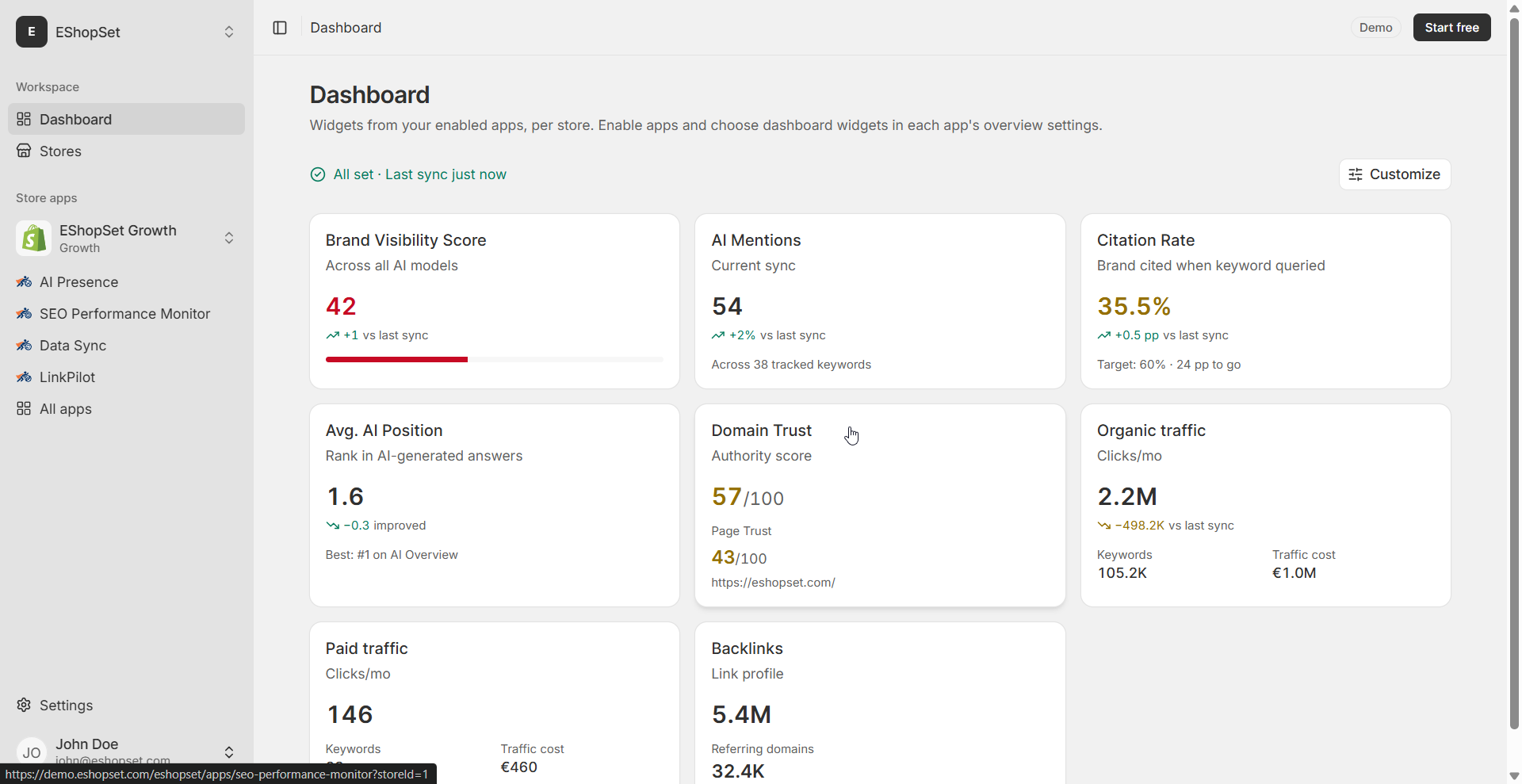
This discussion perfectly illustrates the complex nature of SEO issues, especially after significant site changes like migrations or theme updates. We strongly agree that detailed content comparison, internal link audits, and diligent monitoring in Google Search Console are non-negotiable for recovery. For Shopify merchants, our SEO Performance Monitor app is purpose-built to help you precisely track Shopify keyword positions and identify ranking shifts quickly, alerting you to potential problems before they escalate. While AI Presence helps refine your content strategy to ensure clear page intent, avoiding the content cannibalization seen here, and Sheet2Cart ensures your product data integrity, preventing issues like accidental Shopify zero inventory from sheet sync which could indirectly impact product visibility.
Diagnosing query-specific visibility loss requires patience and a methodical approach. By systematically checking your content, technical SEO, and internal linking, and closely monitoring your performance data, you can uncover the root cause and guide your Shopify store back to its rightful place in search results. It's about being proactive and having the right tools to keep an eye on your store's health.