Cracking the Code: How to Calculate Profitable White Label Margins for Your Shopify Store
Hey there, fellow Shopify merchants and store operators! Let's talk about something that's always on our minds: margins. Specifically, how to ensure you're actually making money when you're diving into the exciting world of white label products. I recently saw a fantastic discussion in an online community that really hit home for anyone looking to launch or scale their own branded goods.
The original poster in this discussion was gearing up to launch a line of white label sports glasses. They had found a manufacturer and were looking at what seemed like a healthy 70-80% gross margin on the product cost, including shipping. Sounds good, right? Well, that's where the community stepped in with some invaluable wisdom.
Beyond the Basic Product Cost: Unpacking Your True Margins
One of the first and most crucial points raised by several community members was to look beyond just the manufacturing and shipping costs. A 70-80% margin on just the product cost might feel great on paper, but it's rarely the full picture. As one respondent wisely put it, you need to calculate your 'true landed cost' and then some. What does that include?
- Import Duties and VAT: Especially important if you're in Europe, like the original poster. These can add a significant chunk to your costs.
- Packaging: Custom packaging, labels, inserts – it all adds up.
- Payment Processing Fees: Every transaction comes with a fee.
- Returns and Replacements: Factor in the cost of handling faulty products or customer returns.
- Warehousing and Fulfillment: Even if you're self-fulfilling, there's a cost for storage and your time.
- Customer Acquisition Costs (CAC): This is a big one, and often underestimated. The cost to get a customer to your store and make a purchase can eat into margins significantly.
Another contributor emphasized focusing on the 'contribution margin' – what's left after fulfilling and acquiring one customer. This figure, they noted, is what truly determines if your business can scale profitably.
The '5x Rule' and Justifying Your Price
A common rule of thumb shared by a seasoned merchant was to aim for at least 5x the landed cost of the product. So, if your true landed cost (including all the above) is €10, you'd aim to sell it for at least €50. Why such a high multiplier?
- Covering CAC: As mentioned, customer acquisition can be your largest spend. This multiplier helps ensure you have room for advertising and marketing.
- Operational Overheads: Beyond direct product costs, you have website hosting, software subscriptions, and other fixed costs.
- Profitability for Growth: You need enough profit to reinvest in your business and grow.
But how do you justify a higher price point if competitors are selling for less? This is where strategic branding and value proposition come in. Community members suggested ways to justify premium pricing:
- Premium Branding: Think Gucci glasses – the product cost is low, but the brand justifies the high price. Your unique story and aesthetic matter.
- Sustainability/Certifications: If your product has eco-friendly features or relevant certifications, highlight them.
- Origin/Quality Perception: 'Made in Portugal/Italy' can command a higher price than 'Made in China' (though quality from any region can be excellent, perception still plays a role).
This is where AI Presence can be a game-changer. It helps you craft compelling, unique product descriptions and brand messaging that resonate with your target audience, making it easier to justify your pricing and stand out in a crowded market.
Working Backwards from the Market and the Power of SEO Monitoring
Perhaps one of the most insightful pieces of advice was to work backwards from a realistic selling price, rather than just adding a percentage to your cost. The original poster later clarified their product cost was €6-8, and they planned to sell at €40-€53, while competitors were at €40-€66.
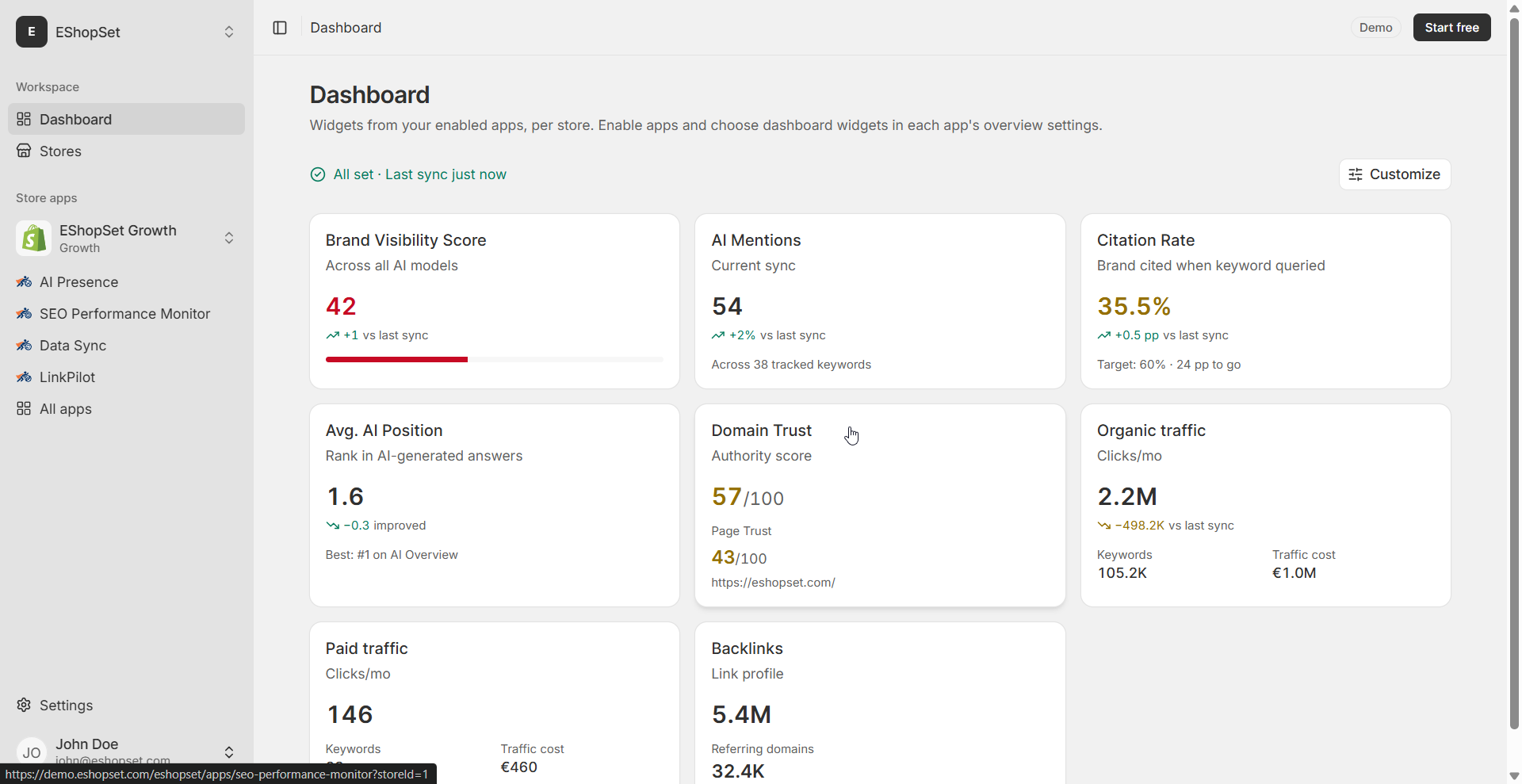
This is where market research becomes non-negotiable. As one respondent urged, check competitor prices on platforms like Google Shopping, Amazon, and other Shopify stores in your target regions. A Shopify SEO overview dashboard can give you a bird's-eye view of your competitors' visibility and pricing strategies. Using a robust Shopify SEO monitoring app like our SEO Performance Monitor helps you keep a pulse on what's working for others and identify opportunities for your own store. If your desired selling price makes customer acquisition much harder because you're significantly more expensive without clear differentiation, you're setting yourself up for a struggle.
Differentiation is Your Secret Weapon
Finally, the consensus was clear: don't compete purely on price. With white label or private label products, your branding, packaging, and the perceived value of the product itself need to give customers a compelling reason to choose you over existing options. What makes your sports glasses better or different than the €40 ones already out there? Is it superior design, unique features, better customer service, or a stronger brand story?
EShopSet Team Comment
The discussion around white label margins is spot on – it's never just about the initial product cost. At EShopSet, we strongly advocate for a holistic view of profitability, integrating market insights and efficient operations. For Shopify merchants, accurately managing product data with an app like Sheet2Cart for Shopify product sync from spreadsheet is crucial for maintaining accurate pricing and inventory. Furthermore, understanding your competitive landscape through a Shopify SEO overview dashboard provided by SEO Performance Monitor, and crafting compelling product narratives with AI Presence, are vital for justifying your pricing and standing out.
So, before you place that big order, take a step back. Crunch all the numbers, not just the obvious ones. Research your market thoroughly, understand your true customer acquisition costs, and build a brand that justifies your pricing. And remember, for seamless management of your product catalog, especially when dealing with new white label items, an app like Sheet2Cart can simplify your Shopify product sync from spreadsheet, ensuring your pricing and product details are always accurate across your store. Happy selling!