Breaking the SEO Plateau: Why Your Shopify Store's Rankings Might Be Stuck (and How to Get Unstuck)
Ever felt like you’re doing all the right things for your Shopify store’s SEO, only to hit a wall? You’ve fixed the technical glitches, cleaned up those thin pages, sorted your internal links, and your content feels solid. For a while, it works – rankings climb, traffic grows. Then, suddenly, everything just… stops.
That’s exactly the sentiment shared by an original poster in a recent community discussion, who described their site hitting a “flat wall” with no drop or penalty, just stalled positions for months. They wondered if they’d run out of levers to pull, or if the entire SEO game had changed.
It’s a familiar feeling for many Shopify merchants, especially with the constant shifts in how search engines work. Let’s dive into what the community had to say about breaking through that SEO plateau.
Are You Measuring the Right Things?
One of the first things several community members pointed out was the importance of distinguishing between different metrics. The original poster mentioned "same positions for months" and "traffic stopped growing" almost interchangeably. But as one respondent aptly put it, if positions are truly holding flat, then the ranking side might be working, and the issue could be with impressions or clicks per impression. If traffic is flat because positions quietly slid, that’s a different problem entirely.
Another member challenged the idea of "same positions according to what?" Google Search Console’s average position can sometimes mask underlying issues. Ten key terms stalling looks similar to a site-wide flatline on a dashboard, but they require different strategies. The advice was clear: dig deeper into your impressions and clicks curve before concluding it’s a market-wide problem.
The Content Conundrum: Beyond "Janitor Work"
Perhaps the most revealing insight came from the original poster themselves. When asked what they’d actually published in the last six months, they admitted, "Honestly not much. Updated a few old posts, didn't really publish anything new. Kind of answers my own question when I say it out loud."
This struck a chord with the community. As one person put it, fixing technical stuff, cleaning thin pages, and sorting internal links is "janitor work." While essential for removing obstacles, it doesn't "put anything new on the site" or "raise the ceiling." To truly grow, especially in a competitive Shopify landscape, you need fresh, valuable content that signals authority and relevance to search engines and users alike. Regularly updating your product catalog or adding new collections, perhaps efficiently managed through a Google Sheets to Shopify sync, is also a form of "new content" for an ecommerce store.
Raising the Ceiling: The Critical Role of Backlinks
Another major theme revolved around off-page SEO. The original poster described their "links are okay, nothing crazy." This was highlighted as a potential tell. "Content and technical work remove obstacles," explained a community member, "they don't raise the ceiling. That ceiling is set by who links to you."
Backlinks are still a powerhouse for SEO. They signal authority and trust to search engines. If your site isn't actively earning or building high-quality, relevant backlinks, you're likely to plateau. A deeper dive into competitive backlink profiles and identifying opportunities for a stronger Shopify referring domains tracker can be a game-changer. It’s not just about quantity, but the quality and relevance of the linking domains.
Navigating the Ever-Shifting SEO Landscape
Several respondents acknowledged that SEO is indeed a game whose rules change constantly. "The only difference now is that it changes faster and more impactful," noted one member. This constant evolution, including Google's core updates and the rise of AI Overviews, means that even if your rankings hold, traffic might still be impacted as users get answers directly on the SERP without clicking through.
This dynamic environment means that what worked two years ago might not be enough today. Continuous learning, adaptation, and leveraging modern tools are crucial. One community member even shared that with current tools, they "can work as if I have 100 people team."
EShopSet Team Comment
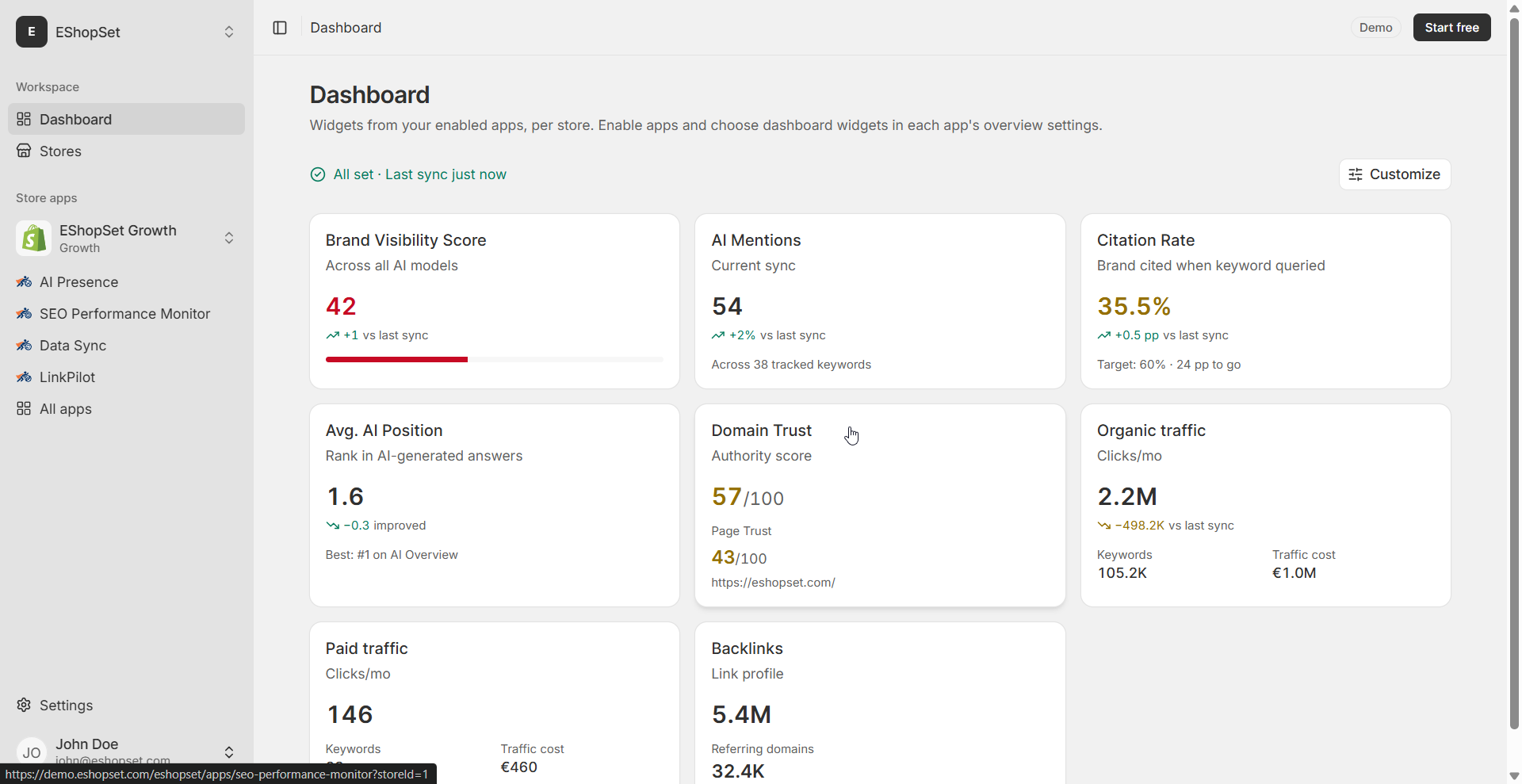
The community discussion perfectly captures the evolving challenge of SEO for Shopify merchants. We wholeheartedly agree that merely maintaining a site isn't enough; continuous, strategic effort in content creation and off-page SEO is vital for growth. Our SEO Performance Monitor app can help you track those crucial metrics and identify opportunities, including monitoring your Shopify referring domains tracker. For adapting to new SERP realities and ensuring your content stands out, AI Presence helps optimize your store's visibility. And to efficiently keep your product catalog fresh, which is a powerful form of "new content," Sheet2Cart simplifies your Google Sheets to Shopify sync.
Getting Unstuck: Your Action Plan
So, if you’re staring at an SEO plateau, here’s a distilled action plan based on these insights:
- Audit Your Metrics Deeply: Don't just look at average positions. Dive into Google Search Console for specific keyword performance, impressions, clicks, and CTR. Understand if the problem is visibility or click-through.
- Prioritize New, Valuable Content: Go beyond updates. Regularly add new product descriptions, blog posts, collection pages, or FAQs that genuinely serve your audience and target new keywords. Consider using tools to streamline your catalog updates, like a robust Google Sheets to Shopify sync solution.
- Elevate Your Off-Page SEO: Actively pursue high-quality, relevant backlinks. This means outreach, creating linkable assets, and monitoring your competitive landscape. Use a Shopify referring domains tracker to spot opportunities.
- Adapt to the New SERP Realities: Understand how AI Overviews and rich snippets impact user behavior. Optimize your content not just for ranking, but for appearing prominently and enticing clicks in these new formats.
SEO isn't a "set it and forget it" task; it's an ongoing journey of adaptation and strategic effort. By moving beyond the basics and embracing a proactive approach, your Shopify store can break through that plateau and continue its growth trajectory.