Beyond Revenue: Decoding True Profitability and Customer Value for Shopify Merchants
Hey everyone! I was recently reflecting on a super insightful question posed by a community member: “What’s the hardest ecommerce number to get a clear answer on?” The original poster rightly pointed out that while revenue is usually straightforward, diving into things like true profitability or customer lifetime value (CLTV) can feel like navigating a maze. And honestly, they hit the nail right on the head – these are precisely the metrics that keep so many Shopify merchants up at night.
It’s a common sentiment across the ecommerce landscape. We all want to know if we’re truly making money and if our customers are sticking around and growing with us, but getting those precise figures often feels like chasing a ghost. Let's break down why these numbers are so tricky and, more importantly, how we can start to demystify them.
The Elusive Truth of Profitability
Why is true profitability so hard to pin down? It’s not just about subtracting your Cost of Goods Sold (COGS) from revenue. Oh no, it’s far more complex. You’ve got to factor in:
- Marketing & Ad Spend: Attributing specific sales to specific campaigns can be a nightmare, especially with multi-touch customer journeys.
- Operational Overheads: Shipping costs, transaction fees, app subscriptions, customer service, returns processing – these all eat into your margins.
- Inventory Costs: Holding costs, spoilage, obsolescence.
- Hidden Fees: Payment gateway fees, chargebacks, packaging, and fulfillment nuances.
Without a crystal-clear view of every single dollar in and out, your 'profit' might just be a hopeful estimate. Many merchants focus on gross profit, but net profit, after all operating expenses, is the real indicator of your business's health.
Understanding Customer Lifetime Value (CLTV)
Then there’s customer lifetime value. This one is crucial because it tells you how much a customer is worth to your business over their entire relationship with you. Knowing your CLTV helps you understand how much you can afford to spend to acquire a new customer (CAC). But calculating it accurately is tough because it requires:
- Accurate Purchase History: Tracking repeat purchases, average order value, and purchase frequency.
- Churn Rate: Knowing when customers stop buying.
- Retention Efforts: How much are you spending to keep customers?
- Referral Value: The indirect value of a loyal customer who brings in new business.
It’s not just about the first sale; it’s about the long game. And without good data, it’s hard to predict or influence that long game effectively.
Bringing Clarity to Your Daily Shopify Operations
So, how do we tackle these formidable numbers? It starts with a commitment to better data, smarter operations, and leveraging the right tools. For Shopify merchants, daily operational excellence directly impacts your ability to get clear answers on profitability and CLTV.
1. Master Your Product Data for Accurate Profitability
The foundation of true profitability is accurate product data. If your COGS are off, or your inventory levels are incorrect, every profitability calculation will be flawed. This is where a tool like Sheet2Cart becomes indispensable. Imagine syncing your product data directly from Google Sheets to your Shopify store. This ensures consistency, reduces manual errors, and provides a single source of truth for your product costs, pricing, and stock levels. When your core product data is precise, calculating COGS and, subsequently, gross profit becomes much more reliable.
2. Elevate Organic Presence for Higher CLTV
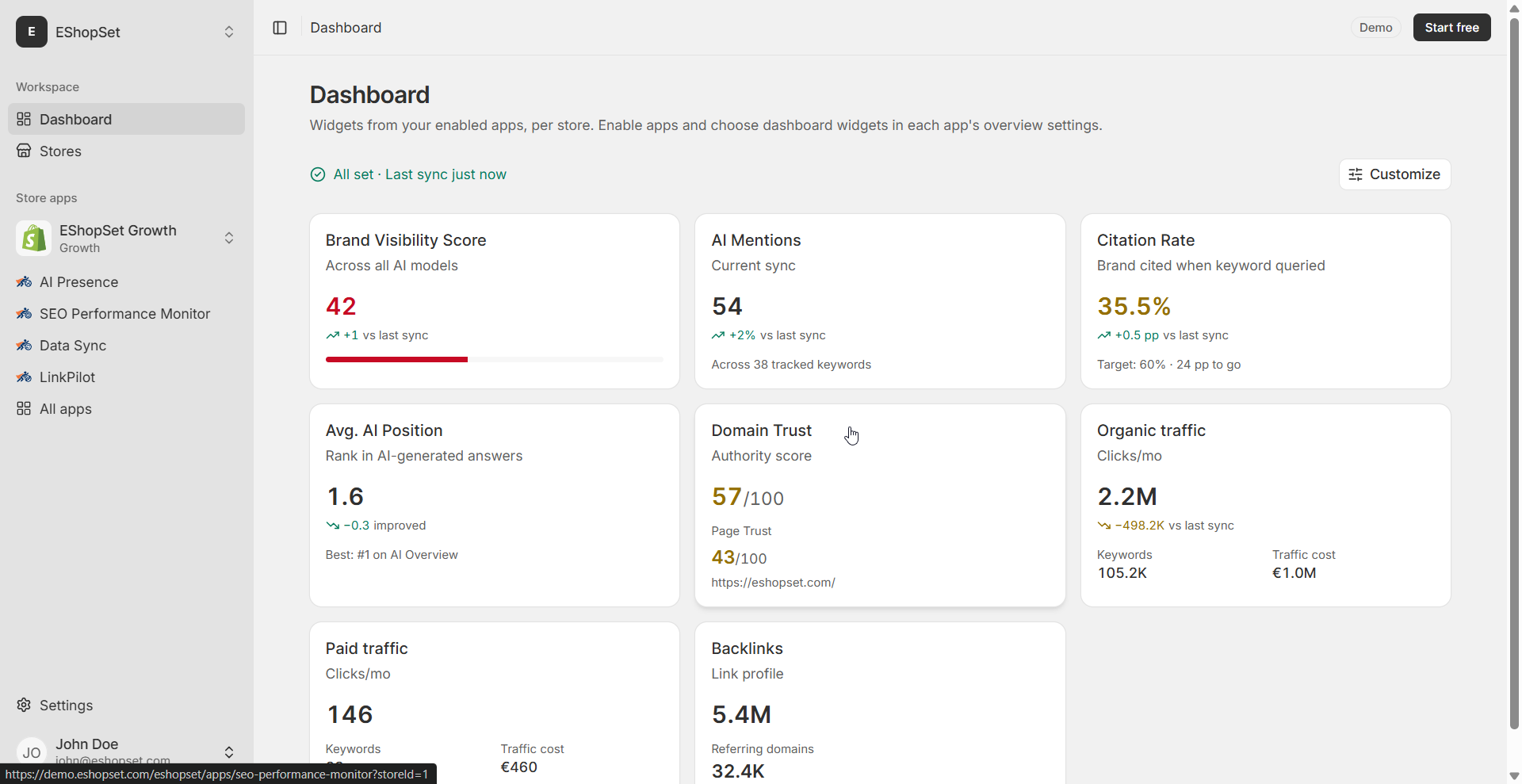
Customer acquisition cost (CAC) significantly impacts CLTV. The lower your CAC, the higher your potential CLTV. Organic traffic, driven by strong SEO, often has a lower CAC and higher conversion rates because customers are actively searching for what you offer. Monitoring your SEO performance is key here. Our SEO Performance Monitor app helps you track keyword rankings, identify opportunities, and keep an eye on your competitors. Understanding your organic search performance, and even leveraging a Shopify backlink monitor feature to track your site's authority, directly contributes to understanding the long-term value of customers acquired through these channels. Better organic visibility means more qualified leads, lower acquisition costs, and ultimately, a higher average CLTV.
3. Build Brand Loyalty with AI Presence
Beyond direct sales and organic search, your brand's overall presence and engagement play a huge role in customer retention and lifetime value. A consistent, compelling brand voice across all touchpoints fosters trust and loyalty. Our AI Presence app helps you maintain that consistent, engaging brand voice, ensuring your store is not just visible but also resonating with your audience. Strong brand presence encourages repeat purchases, reduces churn, and turns one-time buyers into loyal advocates, all contributing to a robust CLTV.
EShopSet Team Comment
The challenge of pinpointing true profitability and customer value is real, and it’s a hurdle many Shopify merchants face daily. We believe the path to clarity lies in operational excellence and leveraging integrated tools. While these numbers can seem daunting, our EShopSet apps — SEO Performance Monitor, AI Presence, and Sheet2Cart — are specifically designed to empower merchants by providing the data accuracy, visibility, and brand consistency needed to get a much clearer picture of these critical metrics. It’s about making your daily operations smarter, so your strategic decisions are better informed.
Ultimately, while revenue is important, focusing solely on it can be misleading. By diving deeper into true profitability and customer lifetime value, and by empowering your daily operations with tools that provide accurate data and insights, you'll be able to make more informed decisions, optimize your spending, and build a truly sustainable and thriving Shopify business. It’s a journey, not a destination, but with the right approach and the right tools, those 'hardest numbers' become a lot less mysterious.