Beyond Google: How Shopify Merchants Can Optimize for AI Search Indexes
Hey fellow Shopify merchants and store operators! I recently stumbled upon a really engaging discussion in a community forum that's been buzzing with activity. The original poster threw out a fascinating question: Do you think LLMs (Large Language Models) are building their own search/web index?
This isn't just a theoretical debate for SEO pros; it has real implications for how we get our products discovered and drive traffic to our Shopify stores. Let's dive into what the community had to say and what it means for your daily operations.
The Shifting Sands of Search: Are New Indexes Emerging?
The short answer from the community? Yes, absolutely. Many respondents believe we are already seeing the early stages of LLMs and AI tools developing their own independent ways of indexing and surfacing information. The original poster highlighted how OpenAI is reportedly building its own index, code-named "Labrador," with specialized indexes for things like news and shopping.
One community member pointed out that they're already seeing pages cited by ChatGPT that simply don't rank on Google. This divergence isn't a future prediction; it's happening now, albeit in a small way. Another respondent shared that their site, invisible on Google for its main topics, shows up surprisingly often in Bing Webmaster Tools' AI reporting. This suggests that whatever feeds those AI answers isn't solely relying on Google's ranking.
The Challenges and Advantages of New Indexes
Building a search index from scratch isn't easy. A community member offered a "hotter take," suggesting that any new index will face a "painful learning curve" because blackhat SEOs have spent decades manipulating search results. Google's sophisticated anti-spam mechanisms, built over years, are a testament to this challenge.
However, the drive for independence is strong. As one expert noted, providers like OpenAI want to wean themselves off third-party results. This independence also allows for better quality control. As more of the web becomes AI-generated, whoever controls the index can decide what gets filtered before it reaches an answer, preventing the "Habsburg AI" problem of models learning from content other models wrote.
Google still holds a massive advantage, though. They have unparalleled user engagement data, decades of experience with link spam, and direct access to product data through Merchant Center. This makes their data sources incredibly rich. Yet, the consensus is that new players like Brave and Bing might be "easier to win" right now, often weighting factors like title/H1 relevance and PageRank more heavily than Google's complex user behavior signals.
What This Means for Your Shopify Store
So, what's the practical takeaway for a Shopify merchant or store operator?
- Beyond Google, Beyond Googlebot: If you're only tracking Google's performance, you're missing a piece of the puzzle. The discussion clearly shows that other bots are crawling and indexing the web differently. This means your content might be discoverable by AI even if it's not topping Google's SERPs.
- Content Accessibility is Key: A respondent highlighted that some pages ranking well on Google never get cited by AI crawlers because they can't be read (e.g., JS-rendered or blocked). Ensure your site architecture and content are easily crawlable by various bots, not just Googlebot. This might involve looking at how your structured data is implemented.
- Structured Data and Entity Relationships: One expert mentioned that LLMs are layering on top of the web index, pulling real-time data via APIs and plugins. This makes optimizing for structured data and clear entity relationships more critical than ever. Think about how your product data and store information are presented.
- "GEO" vs. "New SEO": While some dismiss "Generative Engine Optimization" (GEO) as a rebrand, there's a genuine new discipline emerging. It's not just about traditional SEO tactics in a new hat; it's about understanding how each AI index discovers, evaluates, and cites content. This is especially relevant if you're targeting specific regions, as optimizing for Shopify traffic by country SEO might involve different AI search engines or local data sources.
- Measuring is Harder, But Necessary: Tracking visibility in AI answers is trickier than traditional rank. It's more about a "share of voice" (SoV) type metric, and user behavior might be "air-gapped" (e.g., users search for a brand on Google after seeing it in ChatGPT). This emphasizes the need for robust monitoring tools that can track diverse visibility signals.
EShopSet Team Comment
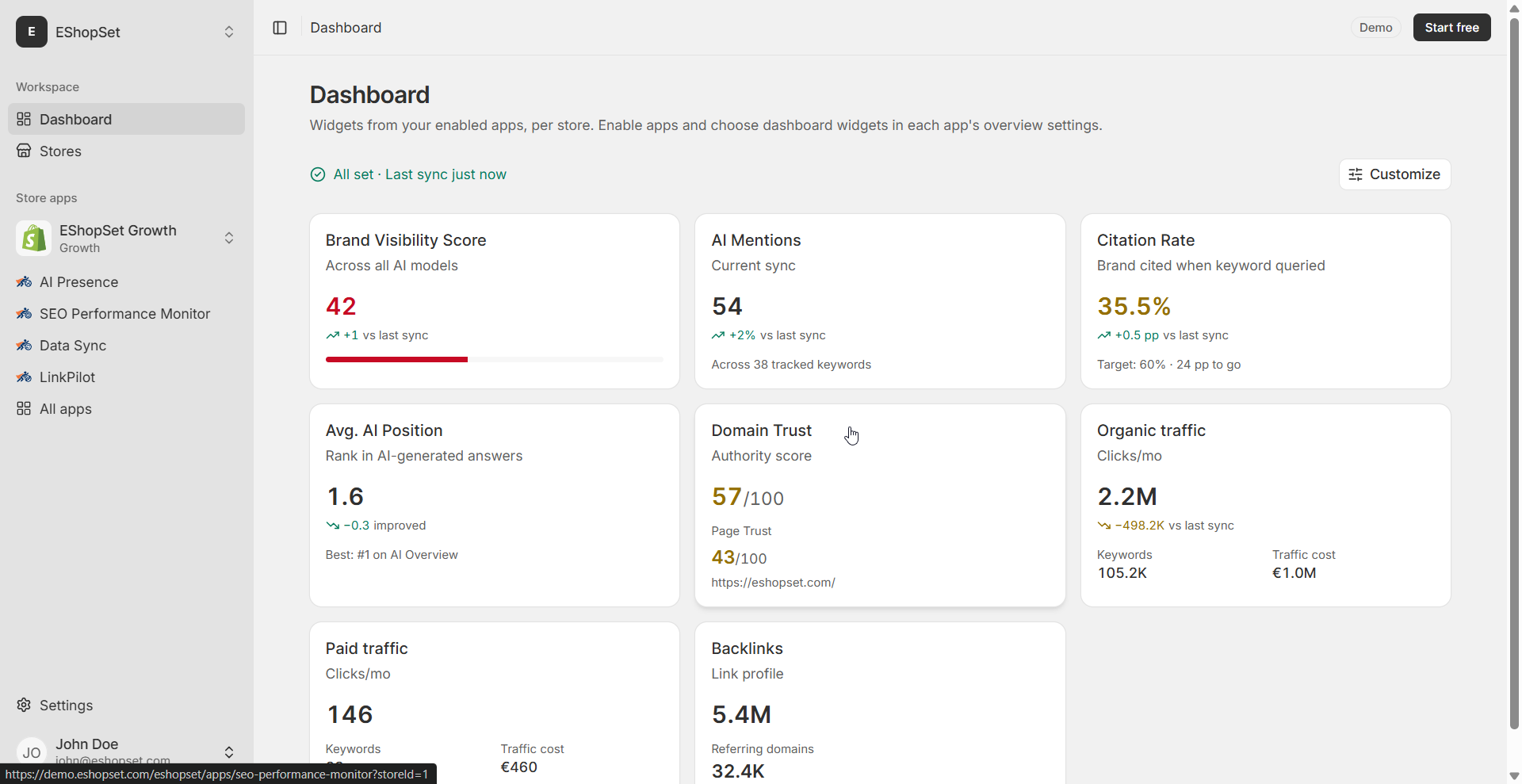
This discussion perfectly encapsulates the evolving landscape of online visibility. As an EShopSet merchant, you absolutely need to broaden your perspective beyond traditional Google SEO. We believe that ignoring these emerging AI indexes is a missed opportunity. Our SEO Performance Monitor helps you track diverse ranking signals, while AI Presence is specifically designed to help your store optimize for AI-driven discovery and citations, ensuring your products are seen wherever customers are searching. Furthermore, ensuring your product data is clean and consistently updated via a Shopify Data Sync app like Sheet2Cart is foundational for any AI index to accurately understand and recommend your offerings.
Adapting Your Strategy for the Future
The takeaway is clear: the future of search isn't a single, monolithic index. We're moving towards a multi-index world where optimizing your Shopify store means considering several different ranking logics and crawlers. It's not just about getting more clicks; it's about ensuring your brand and products are present and accurately represented in the AI-powered conversations that customers are having.
Keep an eye on these developments, and remember that consistent, high-quality content, robust structured data, and a focus on being genuinely helpful to your customers will always be your strongest assets, no matter which index comes out on top. It's an exciting, albeit complex, time to be an ecommerce operator!