The Hidden Impact of Rank Tracking on Your Shopify Store's CTR: A Guide to Smarter SEO
Understanding the Rank Tracker Dilemma: Phantom Impressions and Skewed Data
Hey there, fellow Shopify merchants and store operators! As a Senior Tech Writer at EShopSet, I'm constantly engaging with the challenges you face daily. One topic that frequently surfaces in community discussions, and often causes a headache for anyone deep into SEO, is the peculiar behavior of rank tracking tools and how they can sometimes make your Google Search Console (GSC) data look a little... wonky.
Recently, an insightful conversation in an online community highlighted a problem many of us have likely encountered. An SEO specialist shared their observation that their chosen rank map software was generating thousands of impressions in GSC for keywords they were actively tracking, yet with hardly any corresponding clicks. The consequence? A dismal Click-Through Rate (CTR) that made their performance reports appear less than stellar, even when their average positions were excellent.
The Ghost in Your Google Search Console: How It Happens
The original poster in the community discussion was naturally perplexed, questioning if their tool was faulty or if a more reliable alternative existed. They observed a client's site holding an average position of 1 for thousands of impressions, yet registering minimal clicks. This discrepancy led them to consider reducing scan frequency and filtering out scan days from their GSC data.
This isn't an isolated incident, nor is it a flaw unique to any single tool. As a seasoned community member wisely pointed out, "Every tool that renders a Google results page from a grid point does this." What does this mean for your Shopify store? When a rank tracker scans a grid of locations for a specific keyword, each point in that grid effectively simulates a "real" search. If your store's site appears in the results (even at position 1), it counts as an impression. However, since no human is actually clicking on that simulated search result, you end up with an impression without a corresponding click. Multiply this by dozens of keywords and daily grid scans, and you're looking at thousands of "zero-click impressions" every month. It's like a ghost inflating your GSC data, making your CTR plummet.
Why Phantom Impressions Matter for Your Shopify Store
For Shopify merchants, accurate data is the bedrock of informed decision-making. Skewed CTRs and inflated impression counts can lead to several problems:
- Misleading Performance Reports: Your SEO efforts might look less effective than they truly are, making it harder to justify investments or celebrate genuine wins.
- Poor Decision-Making: If you're basing content strategy or ad spend adjustments on inaccurate CTRs, you might misallocate resources or miss real opportunities to improve your Shopify organic keyword rankings.
- Client Communication Challenges: For agencies or internal teams, explaining why excellent positions don't translate to a good CTR can be a difficult conversation.
Actionable Strategies for Smarter Rank Tracking and Reporting
The good news is that you don't have to abandon rank tracking. Instead, the solution lies in refining your approach to data interpretation and reporting. Here are some actionable strategies:
- Filter Out Scan Days from GSC: As the original poster considered, removing the specific days your rank tracker performs grid scans from your GSC CTR reports is crucial. This gives you a cleaner, more accurate view of how real users are interacting with your search results.
- Focus on Clicks and Position for Scanned Terms: For keywords you're actively tracking with grid-based tools, shift your reporting focus from CTR to absolute clicks and average position. These metrics are less susceptible to phantom impressions and provide a clearer picture of your visibility and traffic generation.
- Strategic Scan Frequency: Consider reducing the frequency of extensive grid scans. For more frequent, lighter checks between comprehensive monthly scans, opt for single SERP pulls per keyword per location. This generates only one impression per check, significantly reducing the "ghost" effect.
- Leverage GSC's Date Comparison: Use Google Search Console's date comparison feature to analyze the impact of your scans. Comparing a scan day against the day before can numerically illustrate the scan's footprint, helping you understand and explain the data anomaly.
EShopSet: Empowering Your Shopify Store with Clearer SEO Insights
At EShopSet, we understand the critical need for accurate, actionable data to drive your Shopify store's success. Our suite of apps is designed to help merchants navigate complex SEO challenges, ensuring you have the tools to interpret your performance effectively and boost your Shopify organic keyword rankings.
SEO Performance Monitor: Your Compass for Organic Growth
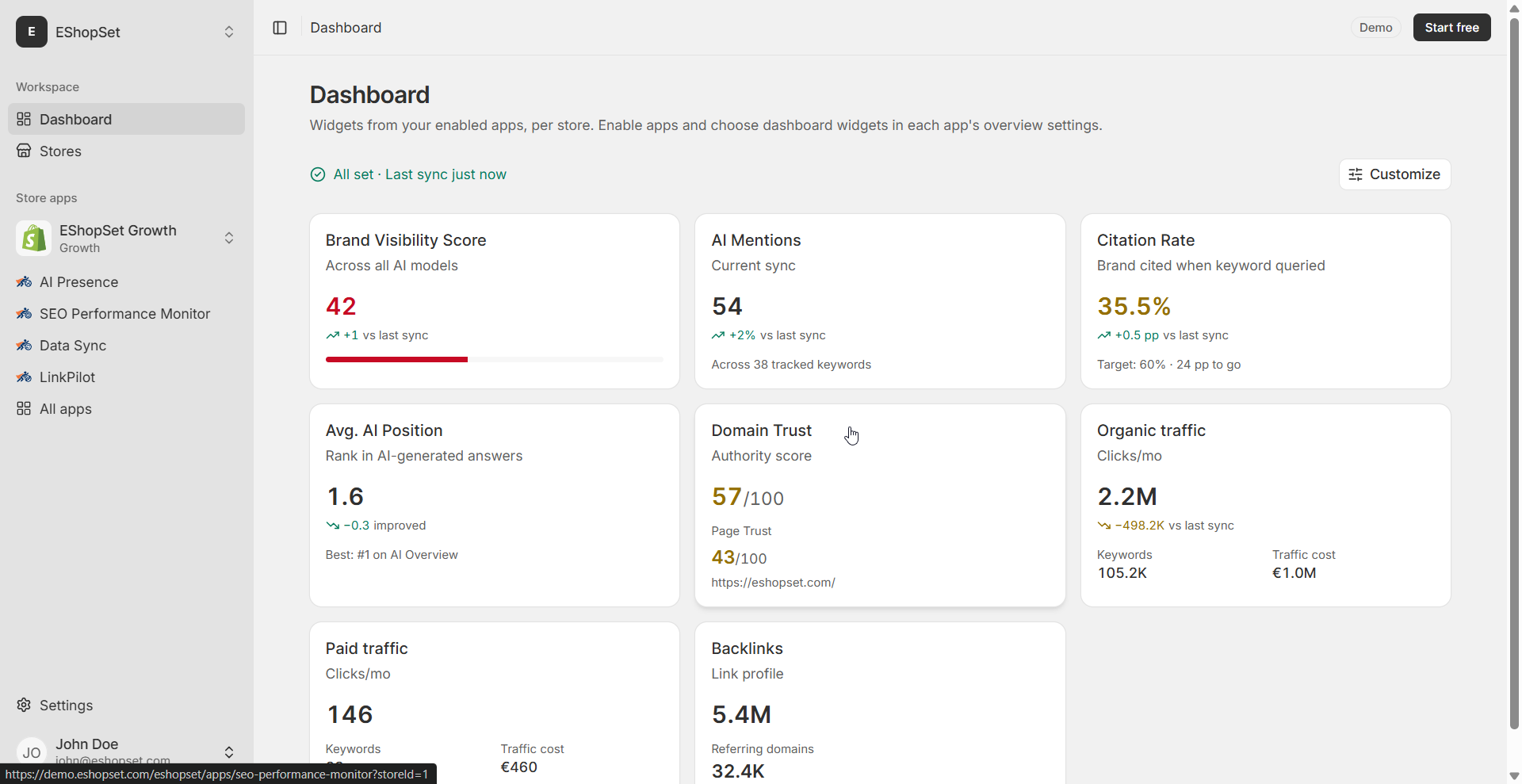
Our SEO Performance Monitor is built to give you a clear, consolidated view of your store's SEO health. While external rank trackers might introduce noise, our monitor helps you focus on what truly matters: real user engagement, traffic trends, and the actual impact of your SEO efforts. It provides the insights you need to understand your true organic performance, helping you identify opportunities and track progress without getting bogged down by phantom data.
AI Presence: Converting Impressions into Engaged Customers
Once you've refined your data interpretation, the next step is to optimize your store to convert those genuine impressions into clicks and sales. Our AI Presence app leverages artificial intelligence to enhance your store's visibility and appeal across search engines and beyond. By optimizing product descriptions, meta content, and overall store presence, AI Presence helps ensure that when real users see your listings, they are compelled to click, driving up your actual CTR and customer engagement.
Sheet2Cart: The Foundation for Flawless SEO
Effective SEO and AI-driven presence start with impeccable data. Our Sheet2Cart app ensures your product catalog is always accurate, consistent, and up-to-date. Clean, well-structured product data is fundamental for search engine crawling, indexing, and ultimately, for achieving high organic rankings. By streamlining your product data management, Sheet2Cart provides the solid foundation upon which all your SEO and AI Presence efforts can thrive.
Conclusion: Smart SEO for Real Results
The world of SEO is dynamic, and understanding the nuances of your data is paramount. While rank tracking tools are invaluable for competitive analysis and local SEO, it's crucial to be aware of their impact on your GSC metrics. By adopting smarter reporting strategies and leveraging powerful tools like EShopSet's suite of Shopify apps, you can cut through the noise, gain accurate insights, and drive genuine growth for your Shopify store.
Don't let phantom impressions obscure your true performance. Empower your store with accurate data and intelligent tools to ensure every SEO effort translates into tangible success.