Beyond Products: Mastering Non-Sellable Inventory in Shopify for Smoother Operations
Running a Shopify store, especially across multiple retail locations, means juggling a lot of moving parts. While managing sellable product inventory often takes center stage, there's a quieter, often messier, challenge lurking in the background: how do you keep tabs on all those non-sellable store supplies? Think checkout bags, toilet paper, receipt rolls, business cards – the essentials that keep your operations humming but aren't for sale.
This very question sparked a lively discussion in a recent online community, where an original poster running several retail stores on Shopify laid out their dilemma. They were already using Shopify's Purchase Orders (POs) and transfers for their actual products and a separate Manufacturing Resource Planning (MRP) system for manufacturing raw materials. But for store supplies, their current method was to add them as products, then simply remove them from all sales channels. It worked for inventory counts and transfers, but as they put it, it 'definitely gets messy.'
The Shopify Conundrum: When Products Aren't For Sale
It's a common pain point because Shopify's core inventory system is, understandably, built around products you intend to sell. Adapting it for internal-use items requires a bit of creative thinking to avoid clutter and ensure accurate reporting. The platform doesn't inherently offer a dedicated 'supplies module,' leaving merchants to devise clever workarounds.
Community Consensus: Leveraging Shopify's Core (with a Twist)
The community quickly chimed in, confirming that there isn't a 'hidden supplies module' in Shopify. Instead, the most practical approach involves a clever adaptation of existing Shopify features. Here's a breakdown of the best strategies:
1. Treat Supplies as Products (But Isolate Them)
- Individual Product Entries: A community member strongly advised against creating a single 'fake supply product' with dozens of unrelated variants. Instead, they recommended using one product per supply type (e.g., 'Receipt Paper,' 'Large Checkout Bags'), with variants only for actual size or pack differences. This keeps receiving and cycle counts manageable.
- No Sales Channels: The core of this strategy is to ensure these 'products' are never visible or purchasable by customers. Remove them from all sales channels immediately upon creation.
- Categorization for Clarity: Use Shopify's product types or tags to clearly label these items as 'Store Supplies' or 'Internal Use.' This allows for easy filtering later.
- Unique Identifiers: Assign separate SKUs or barcodes to each supply item. This is crucial for accurate tracking, especially if staff are using scanners for inventory counts.
2. Managing Consumption and Replenishment
Shopify excels at tracking what's received and transferred, but it doesn't automatically account for the consumption of items like a roll of receipt paper being used. The original poster noted they weren't worried about consumption, only replenishment, which simplifies things significantly.
- Weekly Inventory Counts: As mentioned by the original poster, regular (e.g., weekly) inventory counts are key. If a supply is low, staff simply add it to their next PO or transfer request.
- Internal Adjustment Routines: For more detailed tracking (if needed), stores can implement a simple internal adjustment routine. When a new box of bags is opened, for instance, a staff member could manually reduce the 'on-hand' quantity of the larger pack size and increase the quantity of individual units (if tracked that way). However, for many, this level of detail for non-sellable items is overkill.
3. Filtering, Reporting, and Operational Efficiency
While treating supplies as products works, it can clutter your product lists and inflate inventory value reports if not managed carefully. This is where smart filtering comes in.
- Saved Views: A community member highlighted the significant benefit of creating saved views in the Shopify admin. By filtering out products with the 'Store Supplies' product type or tag, staff can easily toggle between views to see only sellable inventory or only supplies, saving time and reducing scrolling.
- Exclude from Reports: Crucially, filter these non-sellable items out of your inventory value reports. As another community member wisely pointed out, you don't want receipt paper inflating your asset numbers. Ensure your financial reporting accurately reflects your sellable inventory.
For more complex inventory needs, especially when dealing with raw materials or manufacturing, external MRP systems or spreadsheets (like the Google Forms setup described by the original poster) remain viable options. The goal is to find the balance between keeping things consolidated and maintaining clarity.
Beyond Supplies: Optimizing Your Entire Shopify Ecosystem with EShopSet
While meticulously organizing your internal supplies lays a strong foundation for operational efficiency, it's just one piece of the puzzle. A truly optimized Shopify store leverages tools that streamline daily tasks, allowing you to focus on growth and customer experience. This is where EShopSet's bundle of Shopify apps comes into play, enhancing your store's performance from backend data management to frontend visibility.
Streamlining Product Data with Sheet2Cart
If you're already using spreadsheets for tracking some aspects of your store (even non-sellable supplies), you understand the power of organized data. Imagine applying that same efficiency to your sellable products. Our Sheet2Cart app empowers you to manage your product catalog with unprecedented ease. Bulk import, update, and create products directly from Google Sheets or Excel, saving countless hours and reducing errors. This frees up your team to focus on sales and customer service, rather you're managing complex variants or launching new product lines.
Boosting Discoverability with SEO Performance Monitor
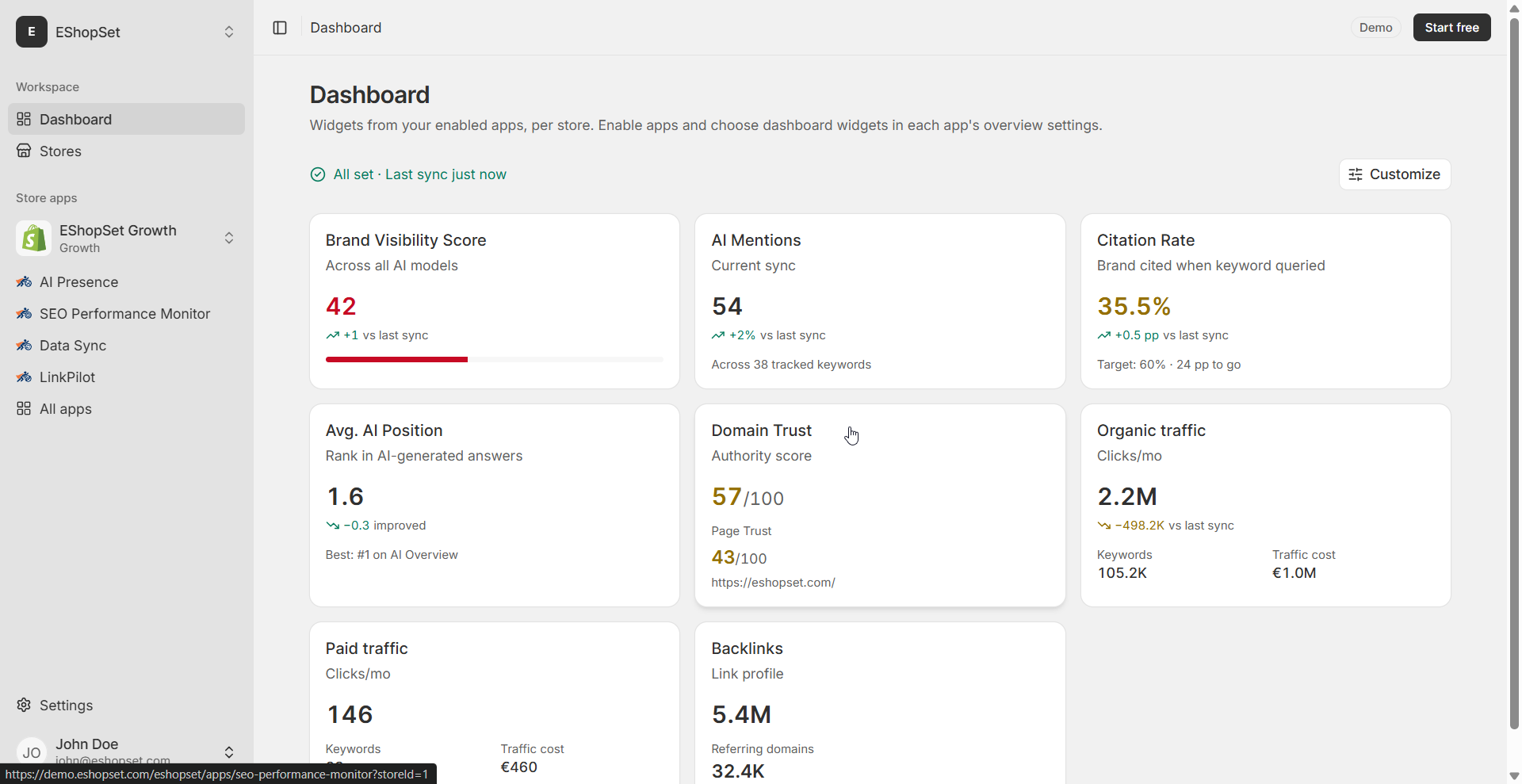
With your internal operations running smoothly, you gain valuable time to focus on external growth. In today's competitive landscape, simply having great products isn't enough; customers need to find them. Our SEO Performance Monitor ensures your Shopify store is not just visible, but ranks high in search results. Track keyword performance, monitor competitor strategies, and identify opportunities to improve your organic traffic. A well-organized store, even internally, contributes to a better overall user experience, which search engines favor. Don't let competing domains in AI answers Shopify search results overshadow your brand; proactively monitor and optimize your SEO.
Enhancing Your Brand's Digital Footprint with AI Presence
The digital landscape is rapidly evolving, with AI playing an increasingly significant role in how customers discover and interact with brands. AI Presence helps you navigate this new frontier, ensuring your brand is accurately represented and discoverable in AI-driven search and recommendation engines. Monitor your brand's mentions and sentiment across various platforms, including new AI-powered search interfaces. Understanding your Shopify brand mentions Perplexity and other AI models is crucial for maintaining a strong and consistent brand image. Elevate your brand's digital footprint and stay ahead of the curve.
Conclusion
Managing non-sellable store supplies in Shopify doesn't have to be a messy ordeal. By adapting Shopify's existing product features with smart categorization, filtering, and reporting, you can maintain order and efficiency. And when you combine these internal best practices with the power of EShopSet's apps – Sheet2Cart for product data, SEO Performance Monitor for discoverability, and AI Presence for cutting-edge brand visibility – you equip your Shopify store for unparalleled operational excellence and growth. Visit eshopset.com/apps/ to explore how our bundle can transform your daily operations.