How Shopify Merchants Can Win with AI Recommendations (Not Just Direct Sales)
Hey everyone! Lately, there's been a buzzing conversation in the ecommerce community about a topic that's on many of our minds: how to actually sell through AI. It kicked off with an original poster, a founder in the food/beverage distribution space, asking if anyone was finding new customers via AI purchasing platforms like ChatGPT or Perplexity. They were curious about integrating catalogs and enabling checkout directly through these AI agents.
It's a fantastic question, and the discussion that followed offered some truly insightful perspectives that every Shopify merchant should pay attention to. While the idea of direct AI checkout is still very much evolving, the consensus quickly shifted to a more immediate and actionable strategy: getting recommended by AI.
Shifting Focus: From Direct AI Sales to AI Recommendations
One community member hit the nail on the head early on, pointing out that for many businesses, especially B2B (like the original poster's distribution model), traditional buying methods still dominate. But even for B2C and SMBs, the real game-changer isn't necessarily AI doing the checkout for a customer today. It's about ensuring your brand is the one AI recommends when a customer asks for a product or service.
As another respondent wisely put it, the strategy is "get recommended by AI" first, "checkout inside AI" second. This means focusing on how AI models like ChatGPT and Perplexity find and surface information. Imagine a customer asking for "best local farm box delivery in NJ" or "wholesale beverage distributors near NYC." Your goal is to be the name that pops up.
Boosting Your ChatGPT Shopping Brand Visibility Shopify Stores Need
So, how do you make sure your Shopify store gets those crucial Shopify brand mentions Perplexity or ChatGPT users are looking for? It boils down to optimizing your online presence in ways that AI models can easily understand and trust. The future of ecommerce isn't just about human search engines; it's about making your content AI-digestible.
Decoding How AI Recommends: What AI Agents Look For
Unlike a human browsing your site, an AI agent isn't necessarily looking for beautiful design or persuasive copy in the traditional sense. It's seeking specific, factual answers to its human's questions. As a community member highlighted, for products like food and beverage, this often includes:
- Allergens, certifications (organic, kosher, etc.), shelf life, storage instructions.
- Where the product is sourced from (crucial for farm brands).
- Case sizes, minimum order quantities, delivery zones, lead times.
- Policies for damaged goods or returns.
If this vital information is buried in PDFs, or worse, only exists in your head, AI agents will either skip your offering or fill in the gaps with less reliable sources. The more context you provide, the better equipped the AI is to make an accurate recommendation.
Actionable Strategies for Shopify Merchants to Win AI Recommendations
Leveraging AI for recommendations requires a multi-pronged approach, focusing on clarity, structure, and visibility. Here's how EShopSet's bundle of Shopify apps can help merchants prepare:
1. Optimize for AI Discoverability with Robust SEO
Before an AI can recommend you, it needs to find and understand your website. This means traditional SEO is more critical than ever. AI models crawl and analyze websites, just like traditional search engines, to gather information. If your site has technical issues, poor structure, or unoptimized content, AI models will struggle to surface it.
- Perform an AI Audit: As suggested in the thread, many ecommerce clients have issues that prevent AI models from effectively indexing and understanding their websites. This includes technical SEO problems, but also content gaps.
- Focus on Contextual Relevance: Ensure your website answers specific queries comprehensively. For example, if you sell artisanal coffee, have detailed pages about your beans' origin, roast profile, and brewing suggestions.
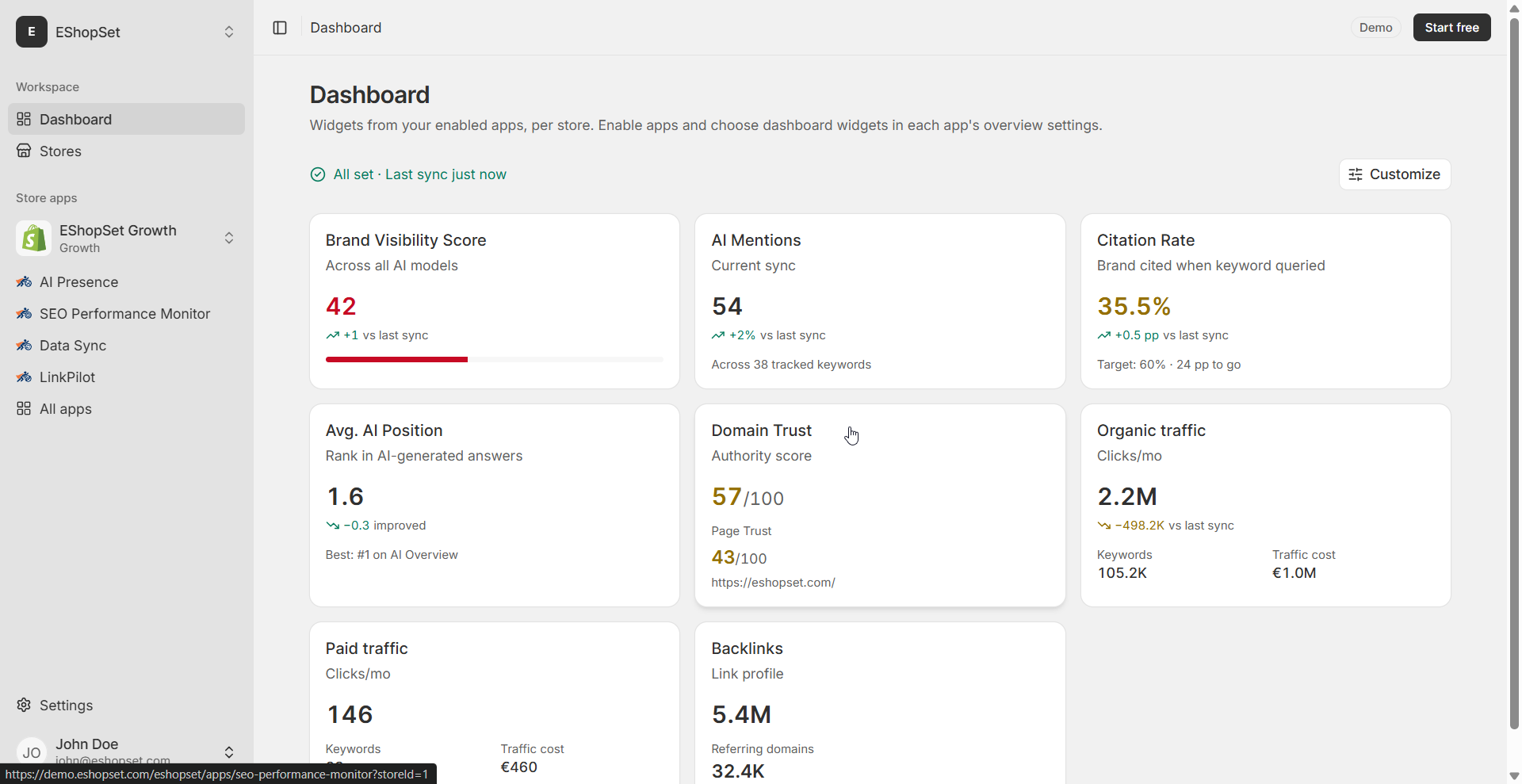
EShopSet's SEO Performance Monitor is your frontline tool here. It helps you identify and fix critical SEO issues that might be hindering AI models from properly understanding and surfacing your website. By ensuring your site is technically sound and well-optimized, you lay the groundwork for AI discoverability.
2. Build a Strong AI Presence with Targeted Content
Beyond traditional SEO, you need to actively cultivate an "AI Presence" – making your content specifically digestible and relevant for AI models. This isn't just about keywords; it's about context and intent.
- Identify Seed Keywords for AI Presence Shopify: These are the foundational terms and phrases that define your brand and products for AI models. Think about how a customer might ask an AI for recommendations related to your niche. For example, for a food distributor, these might include "organic produce supplier NYC," "gluten-free bakery NJ," or "sustainable seafood delivery." Optimizing for these seed keywords for AI Presence Shopify ensures AI models accurately categorize and recommend your offerings.
- Answer Common Questions Directly: A community member brilliantly suggested going through your inbox and pulling out questions buyers ask repeatedly. These are exactly what AI agents will ask. Answer them in plain text on each product page. This might seem "boring" for humans, but AI agents love boring, structured, and explicit information.
- Define What Your Product Is NOT For: Help AI agents match against their human's constraints. Stating "not ideal if you need 6+ month shelf life" can prevent misrecommendations and ensure you're surfaced to the right audience.
EShopSet's AI Presence app is designed to help merchants optimize their content specifically for AI understanding. It helps you craft product descriptions, FAQs, and blog posts that resonate with AI models, increasing the likelihood of your brand being mentioned and recommended in AI-driven interactions.
3. Master Product Data with Structured Information
Accurate, comprehensive, and easily accessible product data is the backbone of AI recommendations. AI agents rely heavily on structured data to provide precise answers and make informed suggestions.
- Detail, Detail, Detail: Ensure every possible detail about your product is available on your Shopify store. This includes not just basic descriptions but also certifications, ingredients, dimensions, weight, usage instructions, and more.
- Consistency is Key: Inconsistent data across your catalog can confuse AI models, leading to inaccurate recommendations or your products being overlooked.
This is where EShopSet's Sheet2Cart becomes indispensable. It simplifies the process of managing and updating your Shopify catalog directly from spreadsheets. For merchants with extensive product lines or frequently changing inventory, Sheet2Cart ensures that all critical product details are accurate, consistent, and readily available for AI models to consume. This app empowers you to maintain the rich, structured data that AI agents crave, making your products more discoverable and recommendable.
The Road Ahead: Preparing for Personal AI Agents
The consensus from the community thread is clear: personal AI agents are absolutely coming. While the "magic bullet" for direct AI sales might not be here yet, preparing your Shopify store for AI recommendations is a strategic imperative. By focusing on robust SEO, building a strong AI Presence, and meticulously structuring your product data, you're not just adapting to the present; you're future-proofing your business for the next wave of ecommerce innovation.
Don't wait for AI to fully transform purchasing behavior. Start optimizing your Shopify store today with EShopSet's powerful bundle of apps – SEO Performance Monitor, AI Presence, and Sheet2Cart – and ensure your brand is always at the top of AI's recommendation list.