To Redirect or Delete? Mastering Old Blog Posts for Shopify SEO Success
Hey there, fellow Shopify merchants and store operators! Let's talk about a common dilemma that pops up in our community discussions – what to do with old blog posts. We recently saw a great question from an original poster asking, '301 Redirection or Permanent Delete blog post?' It's a critical decision, not just for keeping your site tidy, but for your overall SEO health and how search engines perceive your brand.
It's easy to let old content accumulate. Maybe a product is discontinued, an event has passed, or your brand's focus has shifted. But simply letting these pages sit there, or worse, deleting them without a plan, can have real consequences for your store's performance. Let's dive into the nuances.
Understanding the 301 Redirect: Your SEO Lifeline
Think of a 301 redirect as a permanent change of address notice for your website. When a user or a search engine tries to access an old URL, the 301 redirect automatically sends them to a new, relevant page. This is incredibly powerful for SEO because it tells search engines that the page has moved permanently, and more importantly, it passes on most of the 'link equity' or 'SEO juice' from the old URL to the new one.
When to use a 301 Redirect:
- The page has backlinks: If other websites link to your old blog post, a 301 ensures that valuable link equity isn't lost. This is crucial for your search rankings.
- The page receives traffic: Even if it's not a lot, any consistent traffic means people are still looking for that content. Redirecting them to a relevant, updated page maintains a good user experience and prevents a dead end.
- You have a better, more relevant page: If you've updated the topic, created a new product page, or have a general category page that's a good alternative, a 301 is perfect.
- The content is still valuable, just outdated: Perhaps a blog post about 'Summer Trends 2022' can be redirected to 'Current Summer Trends' or a general fashion category.
- Improving your AI search visibility Shopify: A clean site structure with minimal broken links signals quality to search engines, which is increasingly important as AI models like those powering ChatGPT Shopping brand visibility Shopify analyze content for relevance and authority.
On Shopify, implementing a 301 redirect is straightforward. You typically go to your 'Online Store' > 'Navigation' > 'URL Redirects' section. You'll input the old URL and the new URL. It's that simple, but immensely impactful.
Permanent Deletion: When to Hit the Delete Button
Sometimes, a page truly has no value, no traffic, and no backlinks. In these rare cases, permanent deletion might be the right choice. However, this should be your last resort and only after careful consideration.
When to consider permanent deletion:
- No traffic, no backlinks: If an old blog post has zero organic traffic and no external or internal links pointing to it, deleting it might not cause any SEO harm.
- Completely irrelevant or sensitive content: If the content is genuinely obsolete, factually incorrect, or potentially harmful to your brand, and there's no suitable new page to redirect to, deletion is an option.
- Crawl budget optimization: For very large sites with thousands of pages, removing truly useless pages can theoretically help search engines focus their 'crawl budget' on your more important content. For most Shopify stores, this isn't a primary concern.
When you permanently delete a page without a redirect, it results in a 404 'Page Not Found' error. While one or two 404s won't sink your site, a pattern of them can frustrate users and signal to search engines that your site isn't well-maintained, potentially harming your rankings over time. Always check your daily Shopify SEO report for any new 404 errors after content changes.
Making the Right Decision: A Quick Checklist
Before you decide, ask yourself these questions:
- Does the old page receive any traffic? Check your Google Analytics.
- Does the old page have any backlinks (internal or external)? Use tools like Google Search Console or a backlink checker.
- Is there a newer, more relevant page on your site that covers a similar topic or product?
- Is the content still relevant to your brand, even if it needs an update?
If the answer to any of the first three questions is 'yes,' then a 301 redirect is almost always the better choice. If all answers are 'no,' then deletion might be acceptable, but still proceed with caution.
EShopSet Team Comment
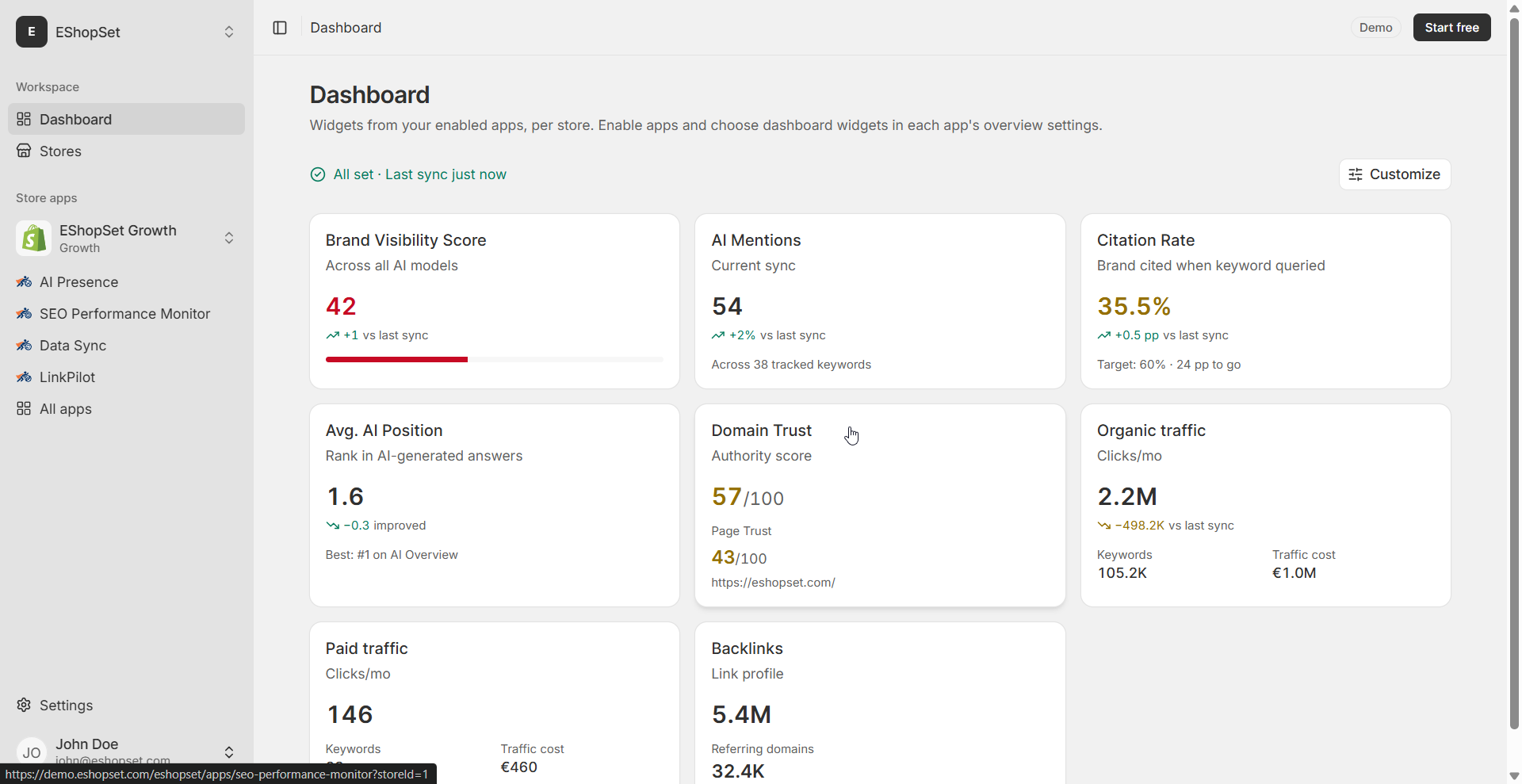
From the EShopSet team's perspective, the decision between a 301 redirect and permanent deletion leans heavily towards redirection in most cases. Preserving link equity and user experience is paramount for sustainable growth. Our SEO Performance Monitor app is designed precisely for situations like this, helping you track traffic changes, identify broken links, and monitor your rankings after making such critical decisions, ensuring your AI Presence remains strong. Don't leave your SEO to chance; always monitor the impact of your content strategy.
Ultimately, maintaining a clean, efficient, and user-friendly website is key to long-term success. Every decision you make about your content, especially old blog posts, has an impact on your SEO. By thoughtfully implementing 301 redirects, you're not just moving a page; you're preserving its value and ensuring a smoother journey for both your customers and search engines. Keep those daily Shopify SEO reports looking healthy!