Shopify URL Migration Woes: Decoding Google's Indexing Mystery
You know, I was scrolling through a community forum the other day, and a discussion caught my eye that's probably hit home for many of you Shopify merchants. It was all about a store owner who, after a significant URL structure change, saw their Google indexing plummet. Imagine changing your store's product page URLs, ensuring all your redirects are perfect, and then Google just... stops indexing your new pages. Frustrating, right?
The Migration Meltdown: A Real-World Problem
The original poster (let's call them OP) detailed a classic technical SEO nightmare. They migrated their 'Question Bank' URLs from a simple structure like /question-bank/... to a more organized /{course}/{subject}/{level}/question-bank/.... They had their 301 redirects in place, new pages returned a 200 status, had self-referencing canonicals, and were server-side rendered – all the technical boxes seemed ticked.
Yet, Google Search Console (GSC) showed a stark reality: out of approximately 10,729 URLs in their sitemap, over 10,500 were 'Discovered – currently not indexed', and 209 were 'Crawled – currently not indexed'. Their site's overall indexed pages dropped from thousands to just 97! Meanwhile, Bing was happily indexing and bringing in traffic. The OP was grappling with whether this was just delayed migration processing, a crawl-priority suppression, or a directory-level quality reassessment by Google.
Community Insights: Deconstructing the Indexing Dilemma
The community discussion that followed was a masterclass in diagnosing complex SEO issues. Here's a breakdown of the key insights:
1. Beyond the 301s: Patience & Initial Checks
Several community members started with the basics: Were the 301s truly ironclad? Were old URLs completely inaccessible? While the OP confirmed their redirects were solid, a common theme emerged: for 10,000+ URLs, Google can indeed take its 'sweet time' to process such a large migration. It's not an instant flip of a switch.
2. The 'Quality Reassessment' Theory Gains Traction
One particularly insightful respondent suggested it might be a 'directory-level quality reassessment'. They theorized that Google might have crawled the new structure, perceived 'thin' or 'duplicate patterns' across thousands of similar question pages, and consequently deprioritized crawl budget rather than penalizing outright. This is a crucial distinction for Shopify stores with extensive product catalogs or content sections.
3. Crawl Budget and Authority Are King
This was perhaps the most emphasized point. Multiple experts highlighted that Google doesn't simply crawl every URL in your sitemap. A sitemap is a suggestion, not a command. As one respondent put it, 'Google doesn't read your whole sitemap.' They explained that crawling is prioritized by authority. 'Crawled and not indexed = authority.' If pages have zero authority or clicks, they might not get crawled or indexed. The idea of 'natural crawling' was debunked; crawling is driven by importance and authority.
This means if your site loses clicks or authority post-migration, Google will allocate less crawl time to it. It's a vicious cycle that many merchants face when a migration goes sideways.
4. Internal Linking: The Unsung Hero
A critical piece of advice that came up was the importance of updating internal links. While 301 redirects pass authority from old URLs to new ones, actively updating internal links throughout your site to point directly to the new URLs is paramount. This signals to Google the importance of these new pages and helps distribute internal 'link juice' and authority more effectively.
5. The AI Content Debate
The discussion briefly touched on whether mass-produced or AI-generated content could be a factor. While some speculated it might make Google 'think twice', a more nuanced view emerged: indexing is a very basic, quick event. Google's 'quality detection' or 'scaled content abuse' algorithms typically kick in *after* indexing, affecting ranking rather than outright preventing a page from entering the index. However, the underlying message remains: unique, valuable content is always preferred.
Actionable Takeaways for Your Shopify Store
So, what can you, a Shopify merchant, do if you find yourself in a similar indexing predicament after a URL migration?
- Verify 301s, Then Verify Again: Ensure every old URL redirects cleanly and permanently to its new counterpart. Check for redirect chains or errors.
- Prioritize Content Quality: A migration is a chance for Google to reassess. Ensure your new pages offer unique, valuable content. Avoid 'thin' content, especially if you have many similar product or category pages.
- Update Internal Links: This is non-negotiable. Go through your site and update all internal links to point to the new URLs directly. This helps Google discover and understand the new structure and pass authority.
- Boost Page Authority: Build internal and external links to your important new pages. The more authority a page has, the more likely Google is to crawl and index it.
- Patience, But Not Passive: While Google takes time, don't just wait. Actively work on the above points. Use GSC's URL Inspection tool for critical pages, but understand it's not a silver bullet for thousands of URLs.
- Monitor Your Shopify organic traffic monitor: Keep a close eye on your Google Search Console data – indexing reports, crawl stats, and performance. Look for trends and specific error types.
EShopSet Team Comment
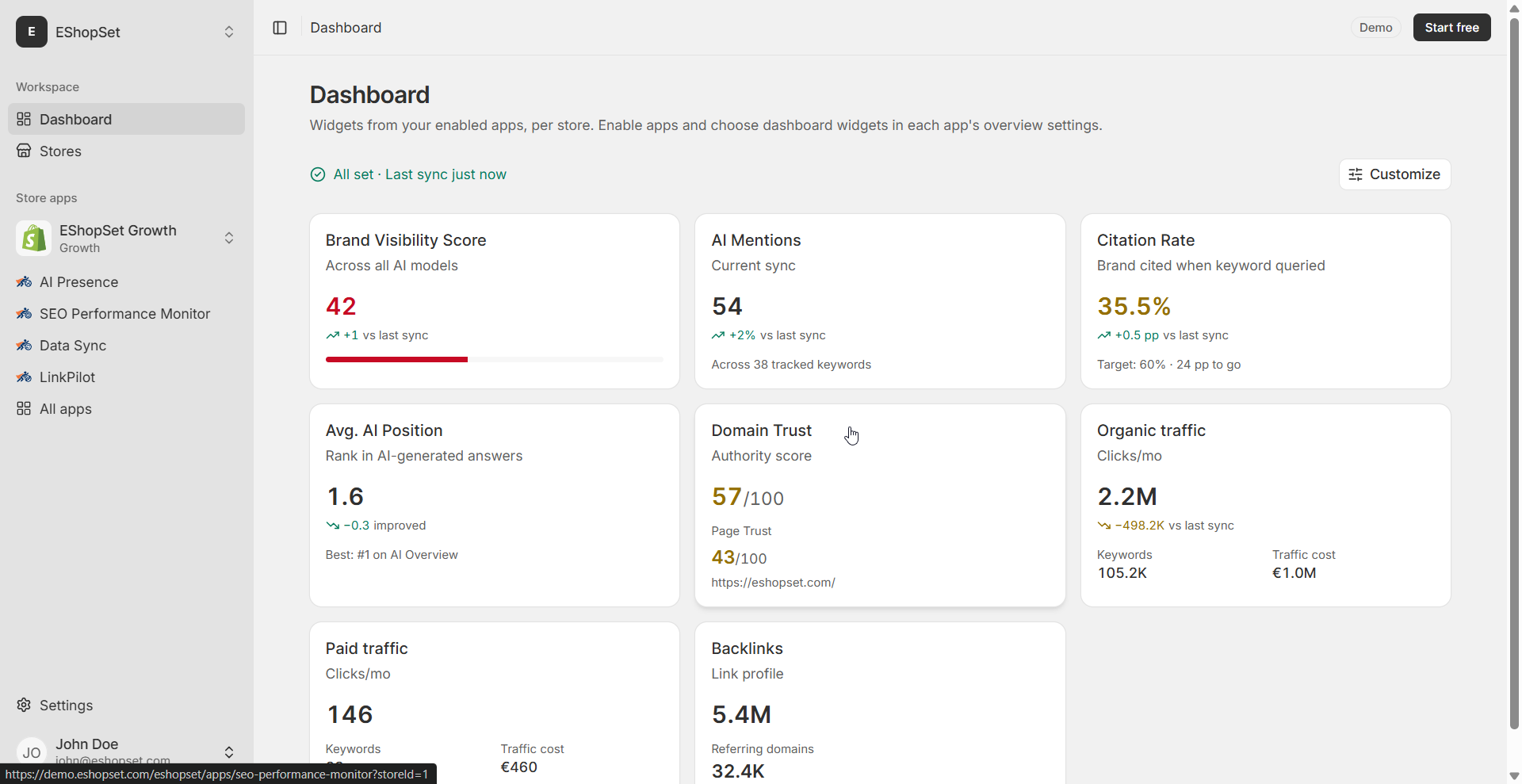
This discussion highlights the often-underestimated complexity of URL migrations and their impact on Google's perception of content quality and authority. We firmly believe that proactive monitoring and data-driven adjustments are crucial for recovery. Our SEO Performance Monitor app is purpose-built to give Shopify merchants clear insights into their indexing status, crawl budget, and overall Shopify organic traffic monitor, helping to quickly identify and address issues like these. Furthermore, ensuring your product content is unique and compelling, which AI Presence can assist with, can prevent Google from deprioritizing your pages due to perceived 'thin' content, while Sheet2Cart helps maintain data consistency across your catalog, reducing potential quality flags.
Recovering from a post-migration indexing drop isn't quick, but it's absolutely possible. It requires a strategic approach that goes beyond just setting up 301s. By understanding how Google prioritizes crawling and indexing – focusing on authority and content quality – you can take targeted actions to regain your visibility and ensure your Shopify store continues to thrive in search results.