Shopify SEO: The Truth About Location Pages for Online Services
Hey there, fellow Shopify merchants and store operators! Let's talk about something that comes up surprisingly often in SEO circles, especially when you're trying to expand your reach or target specific markets: location pages. The question that sparked a lively discussion recently was, "Does Google care if location pages have mostly the same content?"
The original poster in a community forum was building landing pages for an online internship. The core content – curriculum, trainers, duration, fees – was identical across all pages. The only difference was the target city, with plans for some minor city-specific info. They wanted to know if Google would penalize this and how much unique content would be enough.
Spoiler alert: The resounding answer from the community was a clear and emphatic YES, Google absolutely cares!
The Doorway Page Dilemma: A Major SEO Risk
Several community members, including one experienced respondent, highlighted that this scenario isn't just a mild duplicate content issue; it's a significant risk of creating what Google calls "doorway pages." What are doorway pages? They're essentially pages designed to rank for specific search queries (like "online internship in [City]") but offer little to no unique value to the user once they land there. If a user in City B lands on your City A page and finds no real difference, that's a red flag for Google.
This isn't just about a page not ranking well; it's a potential spam policy violation that can affect your entire domain's SEO performance. At scale, a large number of thin, near-duplicate pages can drag down your whole Shopify store's visibility.
When Do Location Pages Make Sense?
The core insight from the discussion is simple: if your offering is truly online and identical across all locations, then dedicated city-specific pages might not be the best strategy. As one community member aptly put it, "Why would you have location pages for this?" Another respondent noted that while location pages work incredibly well for genuine service area businesses (like plumbers or dentists), an online course or product doesn't have that same local intent.
The consensus leaned heavily towards consolidating into one very strong, comprehensive program page that naturally mentions its availability across various cities. This approach carries no doorway risk and often outranks dozens of thin, city-specific clones.
How to Make Location Pages Actually Work (If You Must)
If you genuinely believe city-specific pages are crucial for your Shopify store, even for an online product, the advice from the experts was clear: each page needs a real reason to exist. It's not about swapping out a city name; it's about providing genuinely unique, city-specific substance. Here are some ideas shared in the thread:
- Local Hiring Outcomes: Mention companies in that specific city that hire people with skills gained from your product/service.
- Alumni or Placement Data: Share success stories or statistics relevant to that city.
- City-Specific Cohort Timing: If there are local events or timings for your online offering.
- Local Salary Benchmarks: Data relevant to that city's job market.
- Testimonials: From someone genuinely located in that city.
- Local Partnerships: Any employer partnerships or collaborations in that specific city.
- Cultural Items/Terms: Weave in unique local context that resonates with residents.
There's no magic word count, but respondents suggested aiming for at least 150-400 words of truly unique, valuable content per page. The key isn't just word count, but the quality and relevance of the information for someone in that specific city.
Actionable Takeaways for Shopify Merchants
- Evaluate Necessity: For truly online products or services, ask yourself if location pages genuinely add value for the user beyond just targeting a search term. If the user experience is identical regardless of location, a single, strong page is often superior.
- Prioritize Unique Content: If you do create location pages, commit to making each one substantially unique. Focus on genuine local context, benefits, and proof points. Think about how your offering specifically helps someone in "City X" in a way it doesn't for "City Y."
- Monitor Your SEO Health: Regularly check your site for duplicate content issues. Tools that help you track page performance and identify indexing problems are invaluable. This is also where a good Shopify SEO competitor analysis can come in handy – see how successful online businesses in your niche handle their location targeting.
- Leverage AI (Carefully): While one community member suggested using AI to harvest local city profiles, remember that AI-generated content still needs human review and refinement to ensure it's genuinely unique, accurate, and provides real value, not just spun text.
EShopSet Team Comment
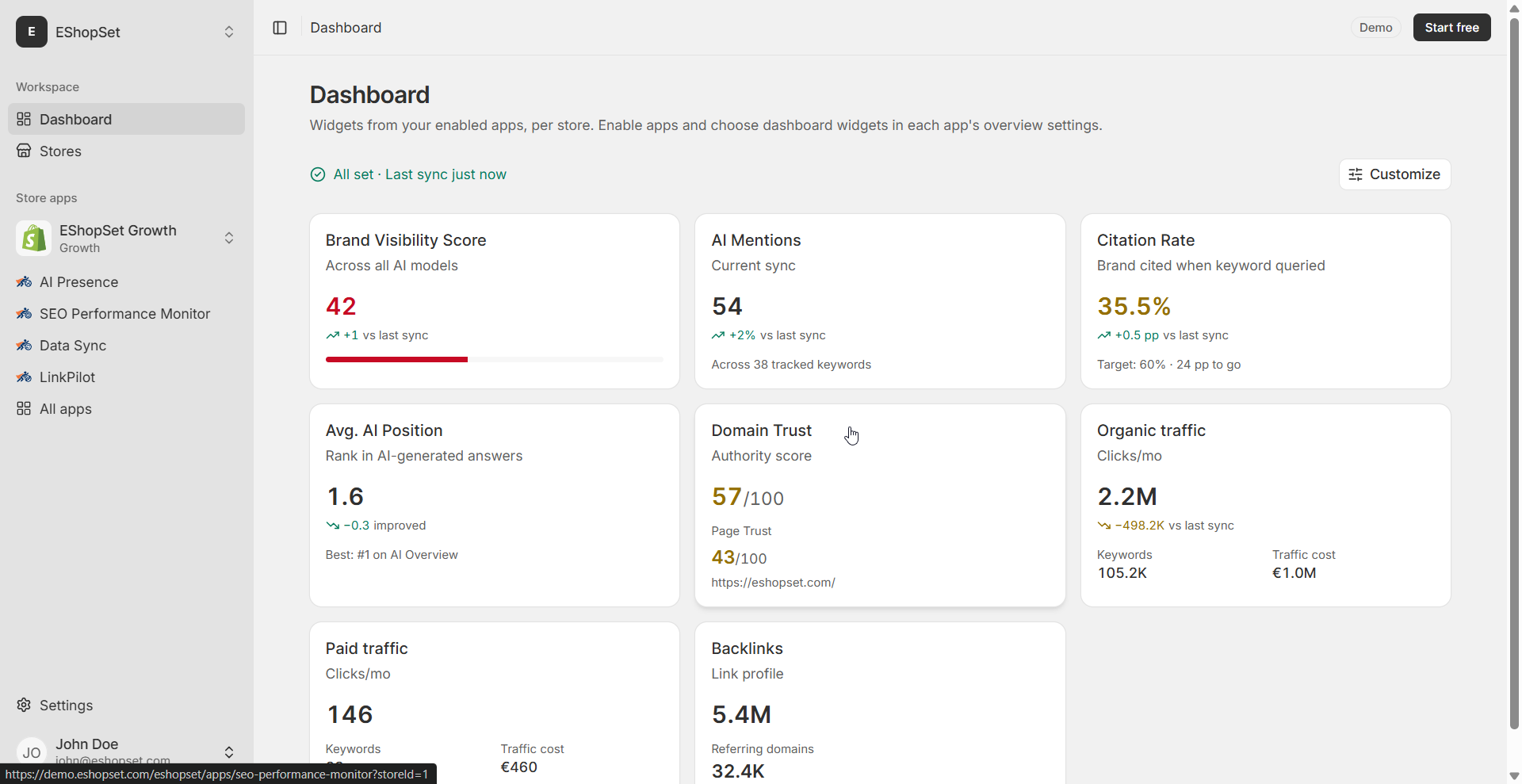
The EShopSet team strongly agrees with the community's consensus: creating thin, near-duplicate location pages for an online service is a high-risk SEO strategy that can severely hurt your Shopify store's visibility. Google prioritizes unique value, and doorway pages are a clear violation. We recommend focusing on building robust, genuinely useful content on your core product pages first. Our SEO Performance Monitor can help you track your site's health, identify potential duplicate content issues, and monitor keyword performance to ensure your pages are ranking effectively. If you do opt for location pages, leverage AI Presence to brainstorm truly unique local content ideas, but always ensure human oversight for quality and relevance.
Ultimately, Google's goal is to provide the best possible answer to a user's query. If your location pages don't offer a genuinely better, more relevant answer for someone in a specific city, they're unlikely to rank well and could even harm your overall SEO. Focus on delivering real value, and Google will reward you for it.