Mastering SEO for Shopify Service Businesses in the AI Era
Hey there, fellow Shopify merchants and store operators! We recently stumbled upon a really insightful community discussion that hits home for many of us navigating the ever-changing landscape of online visibility. The original poster, an SEO veteran with experience in e-commerce, found themselves pondering how to adapt their strategies for a service-based business, especially with the rapid advancements in AI. It’s a question many of you might be asking: how do we cut through the noise and build lasting organic traction when the rules seem to shift daily?
The Nuance of Service Business SEO vs. Product Sales
One of the core distinctions that immediately came up in the discussion was the difference in customer intent between service and product businesses. As one community member wisely pointed out, for services, you're often catching potential clients much earlier in their journey – when they're still diagnosing a problem or trying to understand if they even need professional help. This isn’t like someone ready to "swipe a card" for a specific product.
The original poster echoed this, noting that for products, it's clearer to build pages around specific offers and features. For services, the search intent can feel more "ambiguous." However, the consensus was clear: while the general SEO principles remain the same (Google still treats pages as documents, regardless of content type), the approach to content needs to adapt to this diagnostic phase.
Building Trust, Not Just Pitches: Content That Converts
So, what does this adaptation look like? The key insight from the community was to shift focus from "we are the best" pages to genuinely helpful, problem-solving content. Instead of chasing broad, competitive keywords, one respondent suggested mapping out every question your specific customers ask before they buy. Then, build content that answers those questions honestly, without a hard pitch.
Think "Here's how to fix X problem" articles, comprehensive guides, or even detailed case studies that showcase how you've solved similar issues for others. This positions your Shopify store not just as a vendor, but as a trusted resource. Long-term organic traction, they argued, comes from being the go-to source for pre-purchase information.
Navigating the AI Content Landscape Without "Slop"
Perhaps the biggest "block" for the original poster, and undoubtedly for many of us, is the impact of AI. There's a palpable fear of "pumping out AI slop," low-quality content generated at scale that Google might penalize. Yet, there's also the pressure from "many" online who recommend building hundreds of pages covering all sorts of topics. It’s tough to figure out what actually works right now.
The expert consensus? Quality over quantity, always. While AI can be a powerful tool for content generation, it should be used to enhance human expertise, not replace it with generic, uninspired text. Google's algorithms are increasingly sophisticated at identifying scaled, low-value content. Focus on creating unique, authoritative content that truly serves your audience.
This is also where your brand's overall digital presence becomes paramount. Beyond just traditional search, consider how AI models are consuming and synthesizing information about your brand. Ensuring consistent and accurate information across the web, from your Shopify store to industry directories and social mentions, is vital. This includes monitoring for AI Presence and managing how AI perceives your brand, including tracking Shopify brand aliases AI tracking to ensure your business is represented accurately everywhere AI models are pulling data from. This helps build a robust digital footprint that AI can confidently cite.
Foundational SEO Principles Still Reign Supreme
While the discussion highlighted new challenges, it also reaffirmed the importance of foundational SEO. For service businesses, particular emphasis was placed on:
- Google Business Profile Listings: Optimizing your Google Business Profile is non-negotiable for local service providers. It’s often the first point of contact for local searches.
- Competitor Analysis: Understanding what your competitors are doing well (or poorly) can inform your own content and SEO strategy.
- Industry-Specific Backlinks: Building authority through relevant, high-quality backlinks from reputable industry sites remains a cornerstone of long-term SEO success.
The original poster asked whether to focus on AI articles, case studies, or backlinks. The answer isn't "one or the other." A holistic approach that prioritizes high-quality, intent-driven content (like case studies and helpful articles), optimized local presence, and strategic link building is what truly works for building a strong web presence.
EShopSet Team Comment
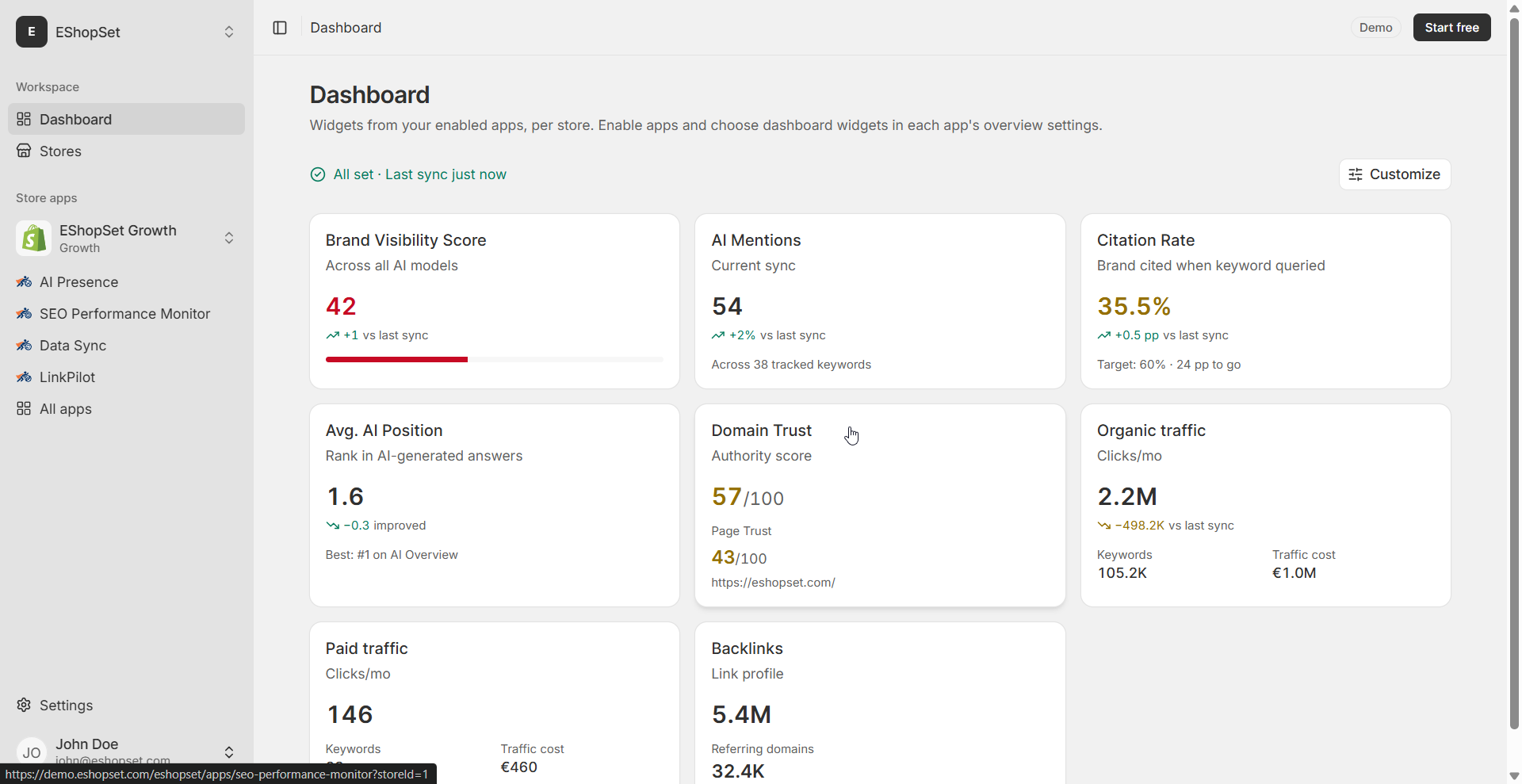
This discussion really nails the core challenge Shopify merchants face when shifting from product-centric SEO to service-based strategies, especially with AI in the mix. We wholeheartedly agree that focusing on genuine customer problems and providing authoritative answers is the bedrock of long-term organic growth. For Shopify store owners, this means leveraging tools like SEO Performance Monitor to track the impact of your helpful content and competitor strategies, ensuring you’re always ahead. Furthermore, our AI Presence app is specifically designed to help you navigate the AI landscape, ensuring your brand's voice and information are accurately represented across AI models, which is critical when people are asking diagnostic questions and AI is providing answers.
Ultimately, getting better at SEO for a service-based business on Shopify isn't about finding a secret new tactic, but about deepening your understanding of your customer's journey and consistently delivering value. Combine that with smart monitoring and a focus on your AI visibility, and you'll be well on your way to robust organic traction.