Beyond Keywords: Unmasking Hidden Technical Issues Tanking Your Shopify Store's SEO
Ever felt like your Shopify store’s SEO was playing hide-and-seek? You’re diligently optimizing keywords, tweaking product descriptions, and building backlinks, but your rankings just aren’t moving – or worse, they’re dropping. It’s frustrating, right?
Turns out, sometimes what looks like a classic SEO problem is actually something completely different, lurking in the shadows of your store’s technical setup. This was exactly the topic of a fascinating community discussion I stumbled upon recently, where an original poster asked fellow experts about the strangest technical SEO issues they’d debugged that had nothing to do with traditional SEO.
The stories shared were eye-opening, revealing just how interconnected everything under your ecommerce hood truly is. Let’s dive into some of these wild tales and see what lessons Shopify merchants can learn.
When Your Server Plays Hard to Get with Googlebot
One of the most mind-boggling issues came from a community member who discovered a reverse proxy was stripping an 'Accept-Encoding' header. The result? Googlebot was receiving massive, uncompressed 8MB HTML pages. Imagine trying to read a phone book when every page is eight times thicker than it should be! Googlebot, understandably, gave up mid-site due to exhausted crawl budget. This wasn't a content issue or a keyword problem; it was a server configuration hiccup that crippled the entire site's visibility.
Another respondent shared a similar server-side nightmare: a client's external development company, in a misguided attempt at GDPR compliance, blocked all traffic except from the US by returning a 500 status code. This wasn't a targeted geo-block for Shopify traffic by country SEO purposes; it was a blanket block that caused Google and Bing to remove the entire website from their index due to server errors. Traffic didn't just go down; it became non-existent!
And then there was the load balancing puzzle. An expert recounted a celebrity website that wasn't getting indexed because Google was treating two load-balanced servers with separate IP addresses as duplicate content. The fix? Directing all Googlebot traffic to a single server. Simple in hindsight, but a huge headache to diagnose.
Hidden Content and Unexpected Penalties
Sometimes, the issues are closer to home, right within your store’s content management. One expert detailed a situation where a YouTube embed failed to load, throwing an error message in an h1 tag. This hidden error, invisible to the naked eye and even developer tools, absolutely tanked a page that had been a dominant #1 ranking for years. It took deep diving into Googlebot’s captured code to uncover the rogue h1.
Another peculiar case involved a "Your Money Your Life" (YMYL) violation. A client unknowingly added a random, inappropriate word to their live site's CMS. This seemingly minor change, barely noticeable to humans, triggered a YMYL alert and tanked the entire site's rank. It highlights how even small, unnoticed content changes can have devastating SEO consequences.
Security Breaches and Plugin Pandemonium
Security is another area where non-SEO issues can wreak havoc. A common problem mentioned was "Japanese SEO attacks" on WordPress sites. Hackers generate thousands of invisible (to admins) pages with structured data, all in Japanese, that get indexed by Google. While this example was WordPress-specific, similar vulnerabilities can exist on any platform if not properly secured. Imagine your Shopify SEO app for merchants showing thousands of irrelevant pages you didn't create!
Plugins, while incredibly useful, can also be culprits. One expert battled a nightmare scenario where a poorly installed plugin caused 5xx errors across an entire site, leading all pages to fall out of the index. With over 50 plugins on the site, tracking it down was a monumental task.
The Human Element and Basic Checks
Finally, some issues stem from surprisingly fundamental oversights. One respondent shared a story about a customer whose flagship product name happened to be the exact name of a transsexual porn star. While not a technical SEO issue per se, it certainly led to "difficult" traffic and the highest bounce rate they'd ever seen! This underlines the importance of thorough market and audience research, even for product naming.
Another expert spent two weeks hunting for a Bing crawl or robots problem, only to discover that the Bing submission API was returning HTTP 400 on every call. The reporting panel they were staring at was simply empty because it had never received any data. The lesson? Always check if the reporting tool itself is receiving data before diving into complex debugging.
EShopSet Team Comment
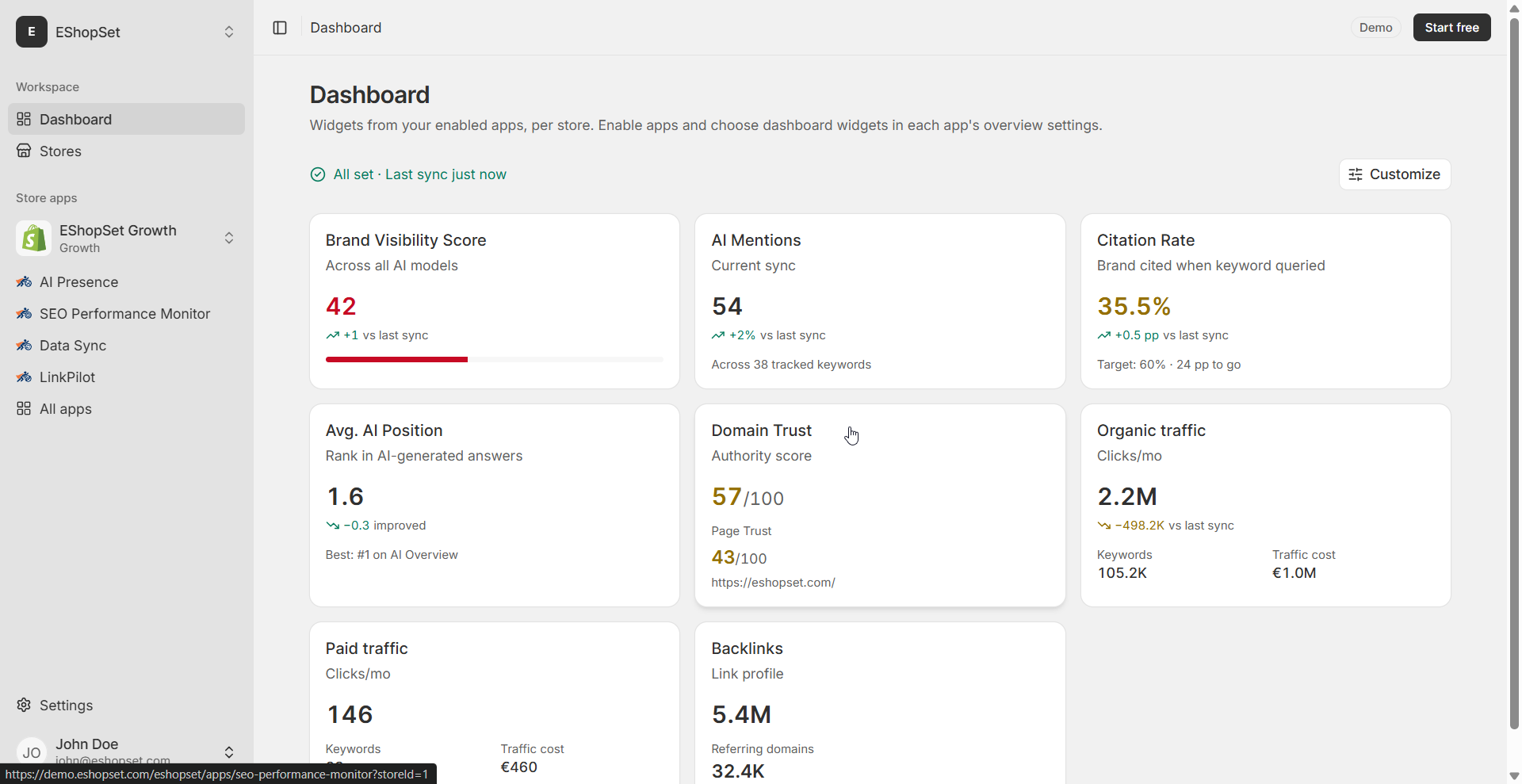
This discussion vividly illustrates that robust SEO isn't just about keywords; it's deeply intertwined with your entire technical infrastructure and content integrity. We strongly believe that Shopify merchants need clear visibility into these often-hidden issues. Our SEO Performance Monitor is designed precisely for this, helping you spot critical technical errors, crawl budget issues, and indexing problems before they become catastrophic. Don't let a rogue plugin or server misconfiguration silently tank your store – proactive monitoring is your best defense.
Key Takeaways for Shopify Merchants
- Look Beyond the Obvious: Don't assume an SEO drop is purely content or link-related. Dig into your server logs, CDN settings, and site configuration.
- Monitor Your Health: Tools like SEO Performance Monitor are invaluable. They can alert you to crawl errors, indexing issues, and performance bottlenecks that might signal deeper technical problems.
- Audit Your Plugins & Apps: While Shopify manages much of the server-side, third-party apps can introduce their own complexities. Regularly review what you have installed and their impact.
- Control Your Assets: Ensure you have full administrative control over your domain, hosting (if applicable), and all digital assets. This prevents potential hostage situations or access issues down the line.
- Check Your Data Sources: Before troubleshooting a "problem" in a report, verify that the report itself is receiving data.
- Content Vigilance: Even small, seemingly innocuous changes to product descriptions or page content can have unintended SEO consequences, especially for sensitive YMYL topics. Our AI Presence app can assist in ensuring content quality and consistency, helping to prevent such accidental violations.
- Consider Geo-Targeting Carefully: If you're looking to optimize Shopify traffic by country SEO, ensure any geo-blocking or redirection is implemented correctly and doesn't accidentally block search engine crawlers.
The world of ecommerce SEO is complex, and sometimes the most impactful issues are the ones you least expect. By understanding the breadth of potential problems and arming yourself with the right monitoring tools and a proactive mindset, you can keep your Shopify store healthy and visible, no matter what technical curveballs come your way.