Unlock Shopify Visibility: The Schema Markup Types That Truly Move the Needle
Hey there, fellow Shopify store operators! We've all been there, scratching our heads over the ever-evolving world of SEO. Recently, I stumbled upon a fantastic community discussion that really hit home for anyone trying to get a leg up in Google's search results. The original poster asked a brilliant question that many of us ponder: "Which type of schema can add more value to Google search engine?"
Their initial thought, which is a solid baseline, was to implement schema based on content relevancy. And you know what? That's fundamentally correct. But as the conversation unfolded, some truly insightful points emerged about how certain schema types can create a much bigger splash.
Schema: The Indirect Ranking Powerhouse
Let's clear up a common misconception right away. As one community member aptly put it, valid structured data doesn't directly make Google rank a page higher. Google itself has stated this repeatedly. So, the original poster's understanding that schema doesn't directly prioritize results in SERP was spot on.
However, that's not the full story. Schema's real power lies in its indirect influence. It helps Google interpret entities on your pages, giving the search engine a clearer context about your content. More importantly, it can make your page eligible for those eye-catching rich results – think star ratings, product prices, and availability directly in the search results.
And this is where the magic happens for your Shopify store. Rich results significantly influence your Click-Through Rate (CTR). If your listing stands out with stars, prices, or other snippets, users are more likely to click on it. This increased CTR sends positive behavioral signals to Google (sometimes referred to as NavBoost), which can, over time, indirectly contribute to better visibility.
The Schema Types That Truly Move the Needle for Shopify Merchants
So, if 'content relevancy' is the principle, what's the follow-up question? One respondent nailed it: "does this schema type make my result look different in the SERP?" If the answer is yes, then prioritize it! Here are the schema types that consistently deliver measurable value for ecommerce:
- Product Schema: This is non-negotiable for any Shopify store. It allows Google to display critical information like price, availability (in stock/sold out), and even aggregated ratings directly in the SERP. Imagine a customer searching for a specific product and seeing your store's price and 'in stock' status right there. This is huge for driving qualified traffic. Most Shopify themes handle basic product schema, but always double-check its accuracy, especially after theme updates or custom code changes.
- Review / AggregateRating Schema: Those shiny star ratings next to your product or service in the search results? That's this schema at work. Star ratings provide immediate social proof and trust, leading to a measurable lift in CTR. If your Shopify store collects reviews, ensuring this schema is correctly implemented is a low-hanging fruit for better visibility.
- FAQ / Q&A Schema: This one is increasingly important, especially with the rise of AI Overviews and generative AI in search. FAQ schema can be used to generate snippets in AI Overviews and helps with entity disambiguation. For Shopify merchants, this means that structured questions and answers on your product pages or dedicated FAQ pages can directly feed into how AI models understand and potentially cite your content. This is a critical component for effective Shopify AI citation tracking, ensuring your brand gets the recognition it deserves in these new search formats.
- Article + Author (Person) Schema: While not always directly tied to product pages, if your Shopify store has a blog or publishes informational content, this is vital for building E-E-A-T (Experience, Expertise, Authoritativeness, Trustworthiness). Linking authors to their social profiles (
sameAsproperty) helps Google understand the credibility behind your content. This can significantly boost your brand's authority and visibility, improving the likelihood of Shopify brand mentions Perplexity AI or similar platforms.
While some discussion points questioned the direct impact of FAQ schema on AI visibility, the consensus remains that providing structured data directly aids Google's understanding, which is paramount in the age of AI-powered search.
The Takeaway for Your Shopify Store
Your original instinct to implement schema based on content relevancy is a strong foundation. But to truly maximize your impact, shift your focus to schema types that visibly transform your search listing. These are the ones that capture user attention, boost your CTR, and ultimately, drive more relevant traffic to your Shopify store.
EShopSet Team Comment
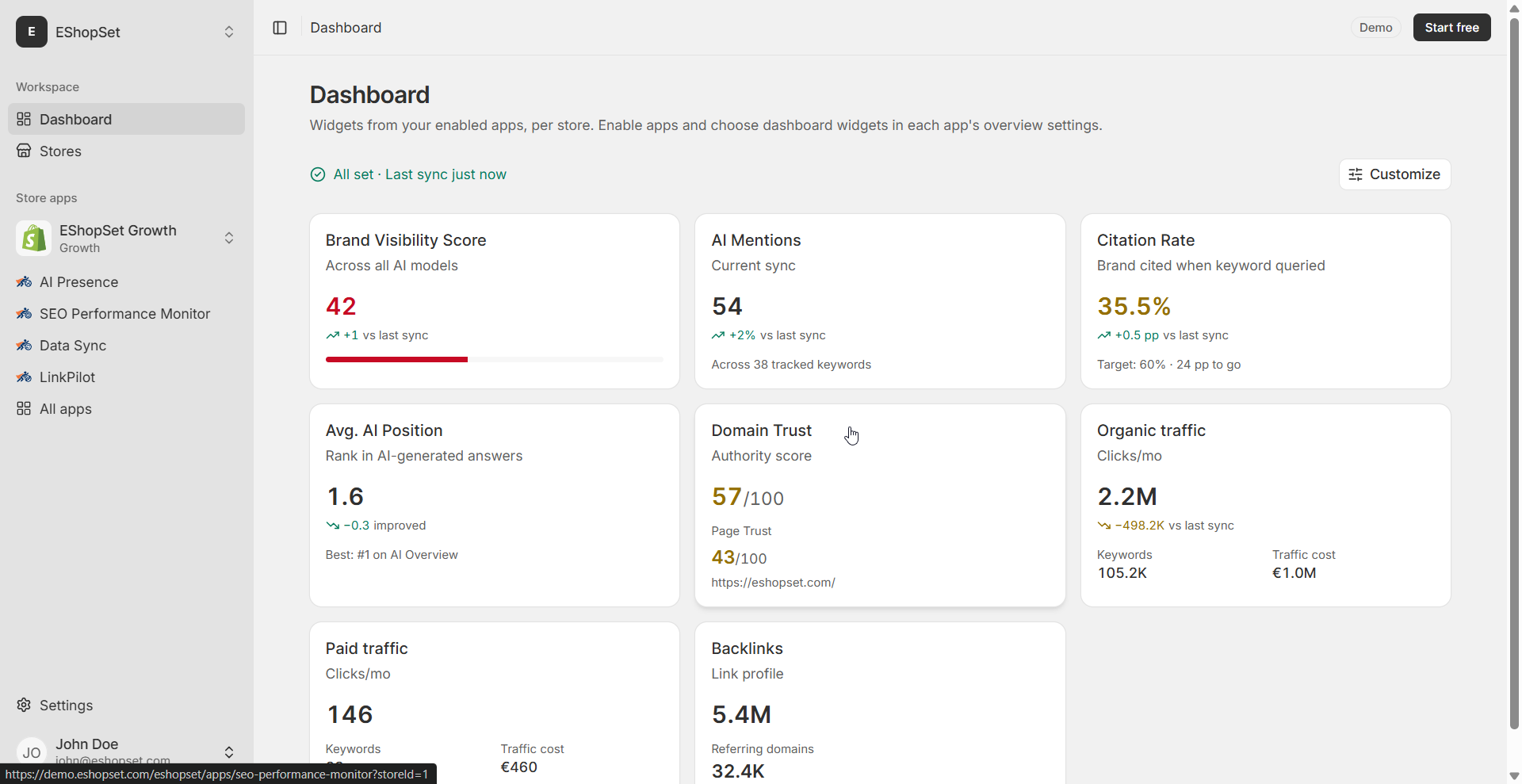
We absolutely agree with the emphasis on schema types that influence SERP appearance and user behavior. For Shopify merchants, this means prioritizing Product and Review schema for direct sales impact, and leveraging FAQ and Article schema to build authority and ensure your brand is accurately represented in AI-powered search results. Our SEO Performance Monitor can help you track the visibility of your rich results and analyze their impact on your organic traffic, while AI Presence is specifically designed to help you optimize for and monitor your brand's visibility in AI Overviews and generative AI, ensuring proper citation and understanding.
Implementing schema isn't a shortcut, but it's a fundamental 'proper way' to build a robust online presence. It’s about giving search engines every possible clue to understand your valuable content and showcase it effectively. So, go forth, audit your schema, and make those rich results work harder for your Shopify store!