Decoding AI Citations: Is Schema a Secret Weapon or Just Table Stakes for Your Shopify Store?
Hey there, fellow Shopify merchants and store operators! Let's pull up a chair and talk about something that's been buzzing in the tech SEO community: structured data, or schema, and its role in getting your content cited by AI models. It's a topic that sparks a lot of debate, and I recently stumbled upon a fascinating discussion that really breaks down the nuances.
The original poster kicked things off, noting how schema is often the first thing people reach for when optimizing for AI-answer readiness. Think Article, FAQ, Author, Organization schema – the usual suspects. It's relatively easy to add, and generally, it won't hurt. So, the advice often boils down to: "just add it." But the big question they posed was, does it actually move the needle for AI citations, or is it just something every serious site already has, making it less of a differentiator?
The Great Schema Debate: Lever or Table Stakes?
The community's responses were a real mixed bag, highlighting just how complex this area is. One respondent felt that for most sites, outside of specific niches like Merchant Center, local SEO, or recipe sites, schema largely falls into the "can't hurt, can't prove it helps" category for AI citations. Another community member cut straight to the chase, suggesting that schema might be more of a "clarity layer" than a direct ranking lever, helping machines understand content without necessarily guaranteeing it gets chosen as a source.
However, the conversation quickly revealed that schema's value might extend beyond just Google and ChatGPT. As one expert pointed out, platforms like Pinterest and various voice assistants also read structured data. So, for broader digital presence, adding schema is almost always a good idea. This same expert even cited studies showing a 20-30% correlation between schema usage and increased AI citations, though acknowledging it's correlation, not direct causation from isolated tests.
Beyond the Markup: What Really Moves the Needle?
Several contributors emphasized that while schema is important, it's increasingly becoming "table stakes." Meaning, it's expected, but not the magic bullet. One experienced operator shared that they saw zero difference on some pages after fixing schema, but significant jumps on others where content clarity and context were improved. They highlighted that understanding which pieces of content AI models like ChatGPT or Gemini actually pick up is far more crucial than just having the markup.
This brings us to the core. Another community member articulated it perfectly: schema helps AI interpret content more reliably, but the biggest improvements often come from:
- Strong entities: Clear, well-defined subjects and topics.
- Answer-first content: Directly addressing user queries.
- Topical authority: Establishing your site as a go-to source on a subject.
- Clear E-E-A-T (Experience, Expertise, Authoritativeness, Trustworthiness): Demonstrating your brand's credibility.
While E-E-A-T itself sparked a side debate on its direct impact, the consensus gravitated towards holistic content quality.
The Skeptic's Corner: Is Schema "Alchemy"?
Not everyone is convinced of schema's power for AI citations. A vocal respondent strongly argued that schema is "0 requirement" for AI citations, calling it the "alchemy of SEO." They backed this up by quoting Google's own guidance: "Structured data isn't required for generative AI search, and there's no special schema.org markup you need to add. However, it's a good idea to continue using it as part of your overall SEO strategy, as it helps with being eligible for rich results on Google Search."
This perspective suggests that AI models primarily scan pages as humans see them, giving more importance to natural language understanding and mentions on other sites. The takeaway here is clear: don't rely solely on schema to get cited; focus on being an authoritative, clear, and well-referenced source.
Practical Takeaways for Your Shopify Store
So, where does this leave you, the Shopify merchant? My advice, synthesized from this insightful discussion, is balanced:
- Implement Schema Consistently: It's widely considered table stakes for overall SEO and rich results. Even if it's not the primary lever for AI citations, it helps search engines and other platforms understand your content better. Use Article, Product, FAQ, Organization schema where appropriate on your Shopify store pages.
- Prioritize Content Quality and Clarity: This is the real needle-mover. Ensure your product descriptions, blog posts, and informational pages are clear, comprehensive, and directly answer potential customer questions. Build topical authority.
- Focus on E-E-A-T: Showcase your brand's expertise, trustworthiness, and unique value. This could be through customer reviews, 'About Us' pages, expert authorship for blog content, and high-quality product information.
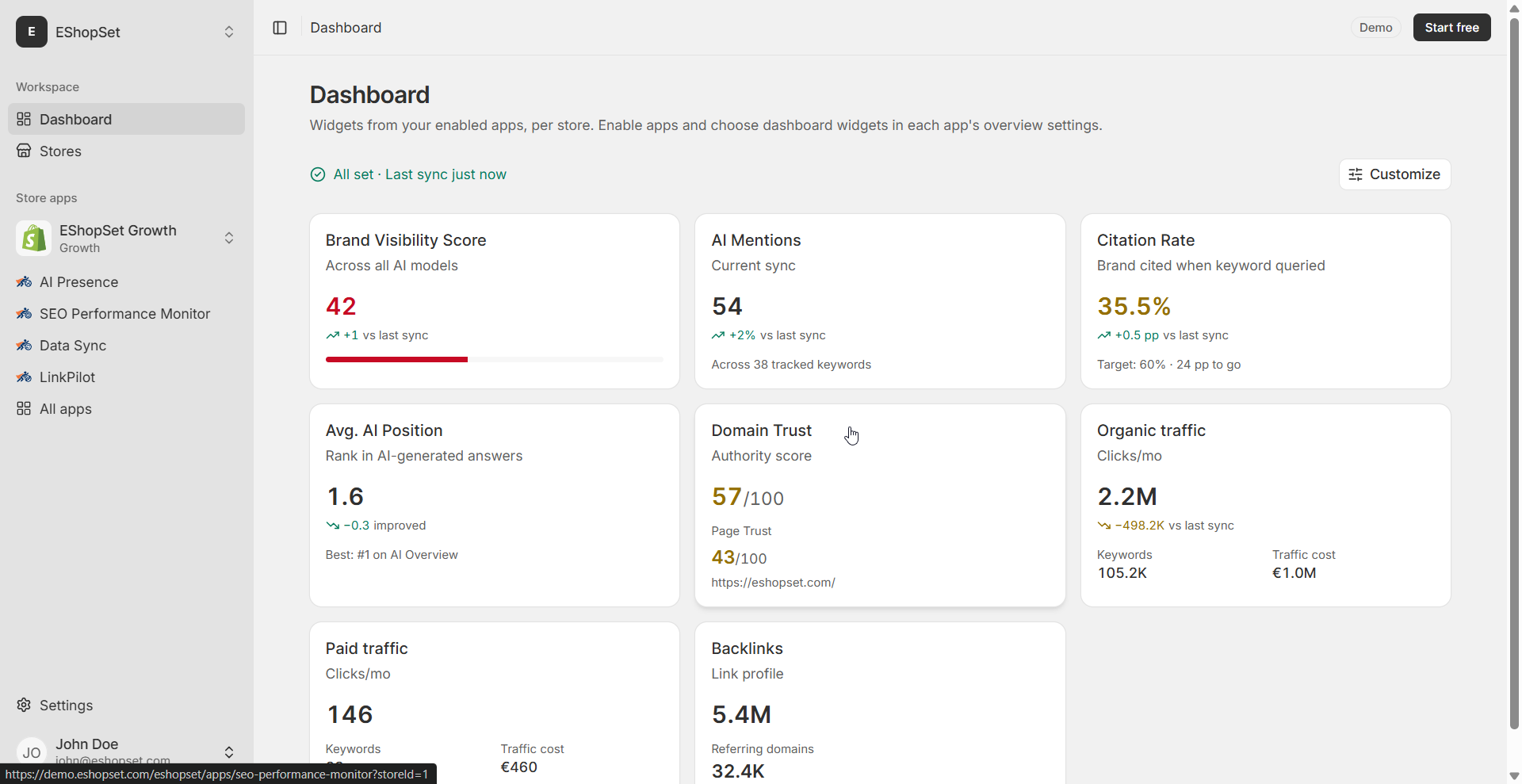
- Monitor Your AI Presence: Don't just guess. Track how AI models are citing your site. Understanding these patterns is key to refining your strategy. This helps you see where you're getting Shopify brand mentions Perplexity or other AI platforms.
While schema might not be the magic bullet for direct AI citations, it's a foundational element of good SEO. Think of it as ensuring your content is easily digestible for all machines, human and AI alike. The real differentiation comes from the quality and authority of the content itself.
EShopSet Team Comment
We believe structured data is a non-negotiable baseline for any serious Shopify store. While it might not single-handedly guarantee AI citations, it significantly enhances how search engines and AI models comprehend your content, making it eligible for rich results and improving overall discoverability. Our SEO Performance Monitor helps ensure your schema is correctly implemented and tracks its impact, while AI Presence directly helps you understand and improve how your brand is cited by AI. For agencies looking to help their clients, we encourage you to refer Shopify merchants EShopSet to leverage these tools for holistic growth.
Ultimately, a strong SEO foundation, coupled with stellar, authoritative content, is your best bet for standing out in today's AI-driven search landscape. Keep testing, keep optimizing, and keep delivering value to your customers!