AI Content vs. Expert Writers: Cracking the SEO Code for Shopify Stores
Hey fellow Shopify merchants! Let’s talk about something fascinating that’s been stirring up conversations in the SEO community – something that could really change how you approach content on your store. Imagine spending years honing your craft, writing compelling product descriptions, blog posts, and category pages, only to find out that content rewritten by an AI tool might actually perform better in search rankings. Sounds wild, right?
That’s exactly the dilemma one community member recently shared. They had pages crafted by seasoned content writers, which saw decent ranking improvements. But then, almost as an experiment, they took existing content and had an AI tool rewrite it, keeping the core information and keywords similar. The surprising result? The AI-rewritten versions saw significantly more improvement in rankings.
The original poster was naturally puzzled: Is AI somehow structuring or phrasing content in a way that Google’s systems understand better, even when the underlying information hasn’t really changed? Or is there another variable at play?
The AI Advantage: More Than Just Freshness?
One respondent in the discussion quickly chimed in with a common theory: “freshness bias.” It’s true that search engines often give a temporary boost to recently updated content. This ‘freshness’ signal can sometimes lead to improved rankings, regardless of the content's quality or how it was produced. However, the original poster’s observation suggested something potentially deeper than just a temporary bump.
So, what could be going on? While freshness bias certainly plays a role, there’s a strong argument to be made for AI’s inherent optimization capabilities. Think about it: Large Language Models (LLMs) are trained on vast amounts of internet text. They learn patterns, structures, and phrasing that are common in highly-ranked content. When an AI rewrites something, it tends to:
- Improve Readability: AI often simplifies complex sentences, uses clearer language, and breaks down paragraphs, making content easier for both humans and search engine algorithms to digest.
- Optimize for Scannability: It might instinctively introduce more headings, subheadings, bullet points, and numbered lists, which are all excellent for user experience and SEO.
- Subtle Keyword Integration: While not intentionally adding new keywords, AI can subtly rephrase sentences to naturally incorporate target keywords and related terms, often improving semantic relevance without keyword stuffing.
- Adherence to Common Structures: AI tends to produce content that follows conventional article or product description structures, which search engines are well-trained to understand and prioritize. This might even contribute to a higher Shopify LLM citation rate, meaning AI models used in search results (like those powering AI Overviews) might find it easier to extract and feature snippets from well-structured AI-generated text.
This isn't to say expert writers are obsolete – far from it! Human expertise provides unique insights, storytelling, and brand voice that AI can't replicate. But AI can act as a powerful optimization layer, taking that expert knowledge and packaging it in a way that search engines are more likely to reward. It's about combining the best of both worlds.
Putting AI to Work for Your Shopify Store
For Shopify merchants, this insight is incredibly actionable. Instead of seeing AI as a replacement, view it as an assistant that can help you refine and optimize your existing content, or even kickstart new content creation. Here’s how you can leverage this:
- Identify Underperforming Content: Use an SEO tool to pinpoint product pages, blog posts, or collection descriptions that aren’t ranking as well as they could be.
- AI-Enhance Your Text: Feed these pieces into an AI tool and ask it to rewrite them for clarity, readability, and SEO optimization. Always review and edit the AI output to ensure it maintains your brand voice and accuracy.
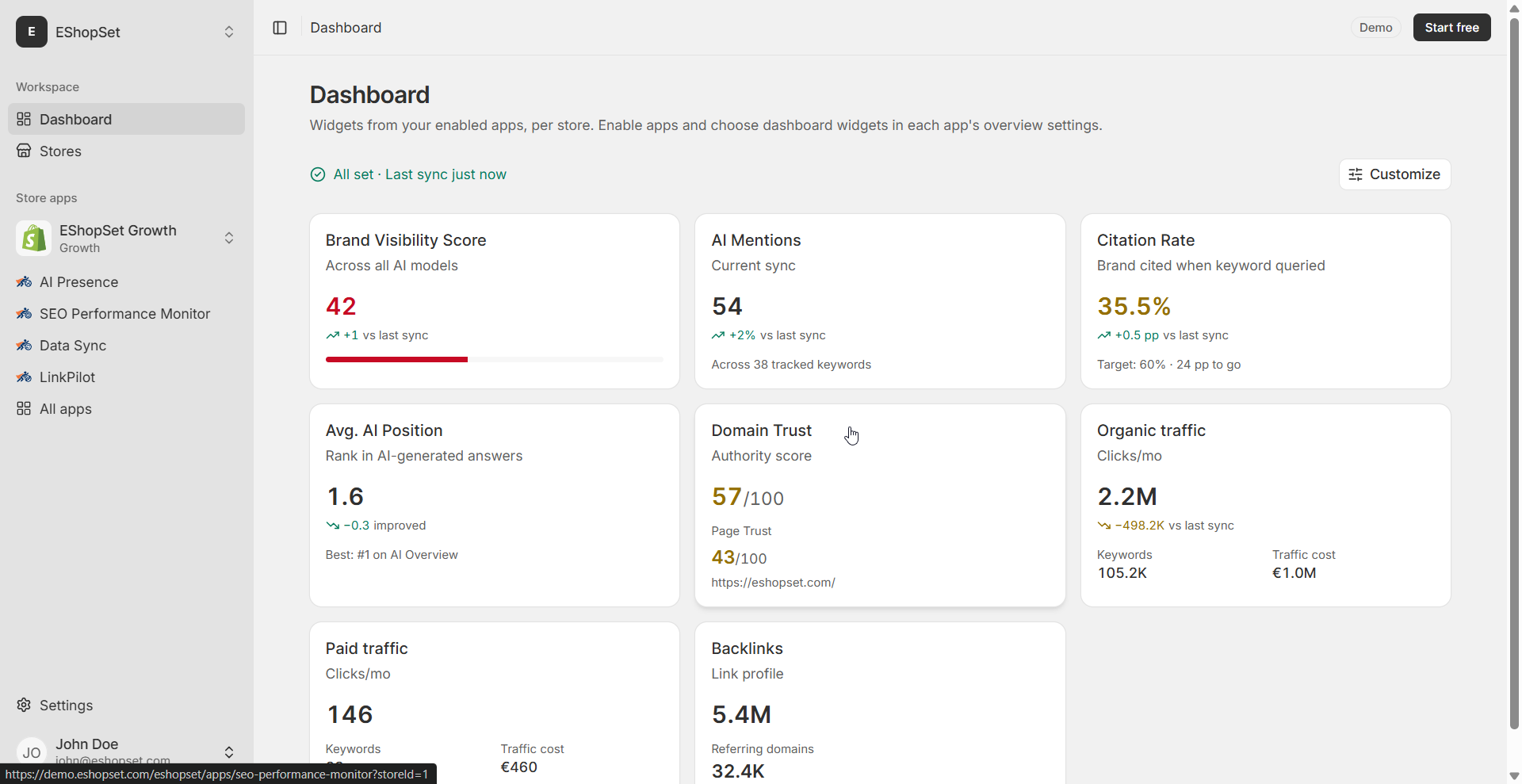
- Monitor & Track: This is crucial. After publishing AI-enhanced content, closely monitor its performance. Tools like EShopSet’s SEO Performance Monitor are invaluable here, allowing you to track keyword rankings, organic traffic changes, and other key metrics. This helps you understand if your AI efforts are truly making a difference and provides data to refine your strategy.
- Balance with Human Touch: Remember that AI is a tool. Use it to enhance, but always infuse your unique brand voice and expert insights. The goal isn't just rankings, but also converting visitors into customers.
By effectively using AI to optimize your content, you can significantly boost your Shopify paid vs organic traffic efforts. While paid ads offer immediate visibility, a strong organic presence built on well-optimized content delivers sustainable, cost-effective growth and strengthens your brand authority in the long run.
EShopSet Team Comment
We believe this discussion highlights a crucial shift in ecommerce SEO. While human expertise provides invaluable depth and authenticity, AI tools are becoming indispensable for optimizing content for search engine consumption. The 'freshness bias' is a factor, but AI's ability to structure content in a search-engine-friendly way is a powerful, often overlooked advantage. Shopify merchants should leverage EShopSet's AI Presence to refine their content and ensure it aligns with search engine expectations, while using SEO Performance Monitor to diligently track the impact of these changes on their rankings and organic visibility.
Beyond Content: Holistic Store Operations
Of course, content is just one piece of the puzzle for a thriving Shopify store. Daily operations involve so much more. For instance, managing your product catalog efficiently is paramount. If you're dealing with inventory across multiple channels or need to quickly update product details, tools like EShopSet's Sheet2Cart can be a lifesaver. Imagine preventing stockouts and ensuring accurate product information across your store with seamless spreadsheet synchronization. This is where features like Shopify oversell prevention sheet sync become critical, ensuring your inventory is always up-to-date and preventing frustrating customer experiences.
Ultimately, the goal is to create a robust, efficient, and highly visible Shopify store. By embracing tools that enhance both your content strategy and your operational efficiency, you're setting your business up for sustained success. Keep experimenting, keep monitoring, and keep learning from the dynamic world of ecommerce!