Beyond the Human Eye: Why AI Assistants Struggle to 'Read' Your Shopify Store (and How to Fix It)
Hey fellow Shopify merchants and store operators! I recently stumbled upon a fascinating discussion in an online community that really got me thinking about how AI assistants interact with our stores. The original poster shared some eye-opening data from crawling over 20,000 online stores, and the findings are a huge wake-up call for anyone relying on digital visibility.
The big takeaway? Most AI assistants, the ones customers use every day, can't actually 'read' your store's most important information, even when it's right there for a human to see. And no, it's not usually because of complex JavaScript, which is a common misconception. The data showed that 93% of stores serve their main content without JavaScript, meaning crawlers are getting in just fine. The real problem lies in understanding what they find.
The Hidden Problem: Your Store's Markup
Imagine a customer asking an AI assistant, "What's the price of X product from Y store?" You'd expect the AI to find it easily, right? Well, the study found that while 77% of stores visually display a price on their product pages, only 56% actually declare it in the underlying technical markup. That's a huge gap! For almost one in five stores, a human can see the price, but a machine can't state it.
As one community member wisely put it, "The template decides what gets read before any copy does. If your ad format hides the offer in a visual shell, no rewrite will fix it. The container is the creative decision, not the text inside it." This really highlights that it's often a "template problem," not a "content problem." Your Shopify theme, or rather, the structured data (Schema markup) embedded within it, dictates how well AI (and search engines) understand your products.
The study also broke down performance by platform, and while Shopify did better than some (68% of Shopify stores marked a page as a product, compared to 32% for Magento or 11% for WordPress without WooCommerce), there's still significant room for improvement. The platform often ships the default settings, like a valid llms.txt file (which Shopify does for 98% of its stores), but the nuances of product data markup often come down to theme implementation and merchant diligence.
What AI Assistants Are Missing (and Why it Matters for Shopify Product SEO Rankings)
The biggest gaps identified in the study were almost all related to product data:
- Marking the page as a product: 62%
- Attaching an offer: 60%
- Stating a price in markup: 56%
- Declaring in-stock status: 55%
- Having a product code: 42%
When AI can't grasp these fundamental details, it directly impacts your visibility in AI-powered search results and rich snippets. This isn't just about future AI; it affects current Shopify product SEO rankings too. Google and other search engines rely heavily on structured data to understand your products and display rich results, which can significantly boost click-through rates.
Actionable Steps for Your Shopify Store
So, what can you do about it? Here are a few practical steps inspired by the discussion:
- Check Your Product Page Markup: A community member suggested a simple test: go to a product page on your store, right-click, and select "View Page Source" (or similar, depending on your browser). Then, search for the word "offers." This should reveal if your product's price and availability are properly marked up using Schema.org's Offer type. If you don't see clear structured data for price, currency, and availability, your theme might be the culprit.
- Review Your Product Data Completeness: Ensure all critical product attributes – price, stock status, product codes (SKUs/GTINs), and any special offers – are consistently present and accurate in your Shopify catalog. Incomplete data makes it impossible for even a perfect theme to output the right markup.
- Audit Your Robots.txt/LLMs.txt: The study found that 10.7% of stores accidentally block all AI crawlers, often with an old
Disallow: /directive. While Shopify generally handlesllms.txtwell, it's worth a quick check to ensure you're not unintentionally excluding AI assistants from crawling your site.
EShopSet Team Comment
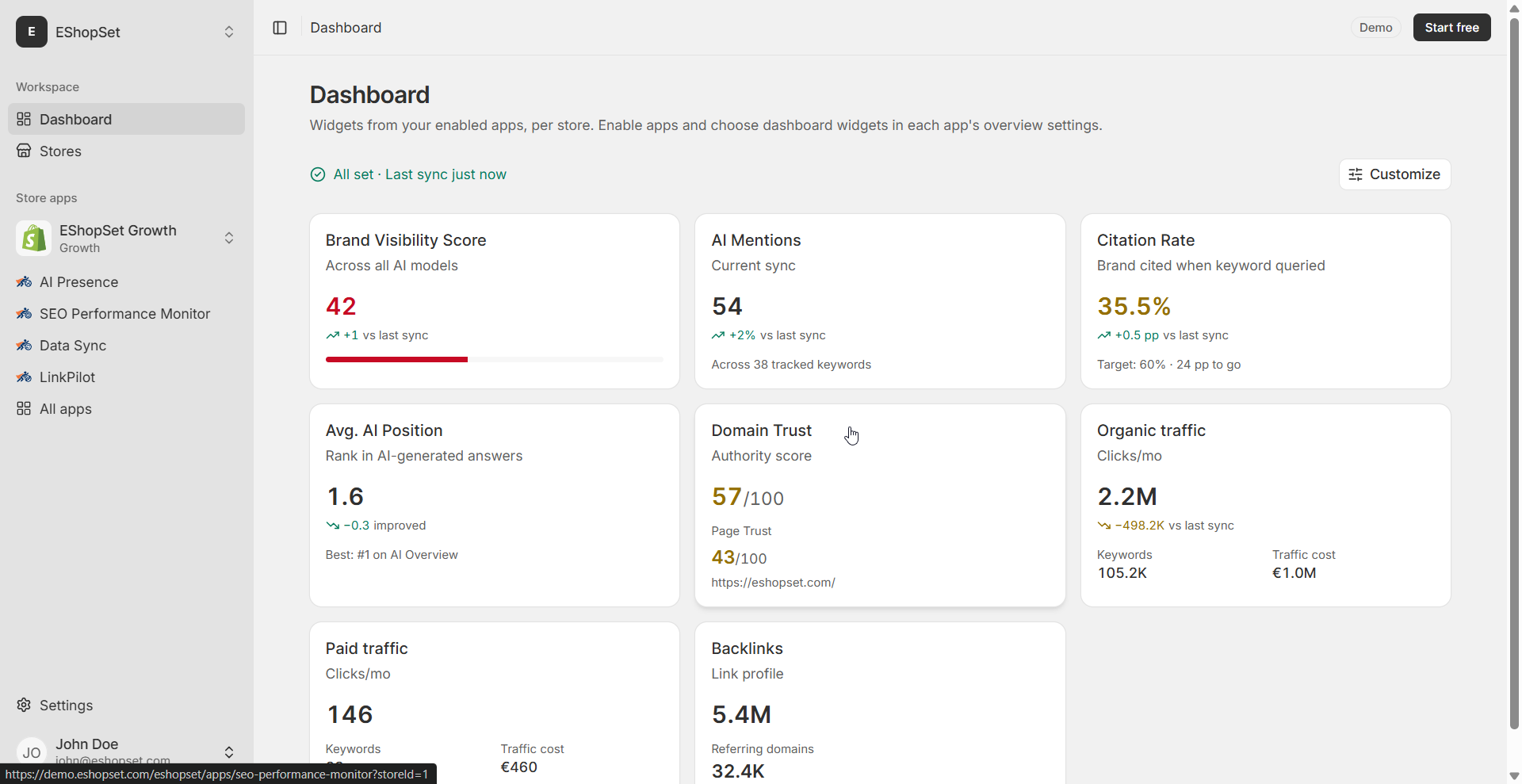
This community discussion perfectly highlights the critical need for Shopify merchants to prioritize structured data and AI readiness. It's not enough for your store to look good; it must be machine-readable. We strongly agree that a robust approach to product data and SEO is essential for future visibility. Our AI Presence app is specifically designed to help merchants ensure their stores are understood by AI, while SEO Performance Monitor keeps your search visibility on track. For merchants struggling with comprehensive product data, our Sheet2Cart Shopify Data Sync app can be a game-changer, ensuring that complete and accurate product details from your Google Sheets seamlessly update your Shopify catalog, laying the foundation for perfect structured data.
In today's evolving digital landscape, where AI assistants are becoming an increasingly common way for customers to discover products and stores, ensuring your Shopify store is 'AI-ready' isn't just a technicality – it's a competitive advantage. Focusing on the underlying structure of your product information, rather than just the visible content, will improve your Shopify product SEO rankings and ensure your store can be accurately read by the machines that guide your customers. Tools like a solid Google Sheets to Shopify sync become indispensable for maintaining that data integrity. Don't let your store be one of the many that machines struggle to understand; take control of your digital presence today.