Stop SEO Penalties: How to Avoid Keyword Stuffing on Your Shopify Store
Ever felt that nagging doubt after hiring an 'SEO expert,' only to find their tactics feel... off? You're not alone. Recently, a fascinating discussion popped up in an online community, where a Shopify merchant was grappling with exactly this feeling after their agency delivered a website with what looked suspiciously like keyword stuffing.
The original poster shared a startling example: image alt text that read something like, "roof repair {city & state} commercial roof repair {city & state} commercial roofing {city & state} commercial roof replacement {city & state} commercial roof maintenance {city & state}...." and so on for a dozen more roofing keywords. If your gut is telling you that's not right, you're on the money. Let's dive into why this old-school tactic is a huge red flag and what you, as a Shopify store operator, can do to protect your business and foster genuine growth.
The Blatant Red Flag: What is Keyword Stuffing?
When the original poster questioned their agency, they were met with a dismissive, "I know more than you; it's not keyword stuffing." But the community quickly chimed in with a resounding "Yes, it absolutely is!" As one respondent put it, it's "textbook keyword stuffing." Google's spam policies literally use lists of keywords and blocks of text repeating city and state names as examples of what not to do.
Think about it from a user's perspective, especially for accessibility. Alt text is designed to describe an image for people using screen readers. Imagine a blind visitor listening to 17 roofing keywords in a row. It's not helpful; it's frustrating. Another community member highlighted this perfectly: "Alt text is supposed to be for accessibility, to describe the image. It’s not the place for a list of keywords." This isn't just bad practice; it could even open your store to legal issues related to accessibility.
Beyond Alt Text: The Doorway Page Dilemma
The agency's questionable tactics didn't stop at alt text. The original poster also mentioned "doorway pages"—multiple pages created for slight variations of a service (e.g., city+roof+repair, city+roof+replacement). While city-specific pages can be legitimate for local SEO, they become problematic when they offer little unique value. As a community member explained, if these pages are "the same text with the city name swapped," they are precisely what Google describes as doorway pages. These are designed purely to manipulate search rankings by creating numerous entry points, rather than providing distinct, valuable content to users.
Several community members pointed out that Google has recently rolled out spam updates specifically targeting such aggressive and manipulative SEO tactics. Engaging in these practices puts your Shopify store at serious risk of a ranking drop or even deindexing. One contributor recounted a client who saw their long-term ranking location pages plummet from #1 to #100+ or full removal overnight after employing similar strategies.
Why Old-School SEO Tactics Fail Today
The consensus from the community was clear: these are tactics from 15 years ago, and even then, they were considered amateurish. Search engines have evolved dramatically. Google's algorithms are sophisticated, prioritizing user experience, natural language, and genuine value. Keyword stuffing and doorway pages are easily detected as attempts to game the system, leading to penalties rather than improved visibility.
Modern SEO is about relevance, authority, and user satisfaction. It's about creating content that genuinely answers user queries, provides helpful information, and offers a smooth, accessible experience. Relying on outdated, spammy methods not only wastes your investment but actively harms your brand's online reputation and search performance.
Protecting Your Shopify Store with EShopSet
As a Shopify merchant, you need reliable tools to navigate the complexities of SEO and ensure your store is set up for sustainable success. EShopSet provides powerful tools as embedded Shopify Admin apps, making it easy for merchants to manage their SEO, AI content, and product data directly within their familiar Shopify environment.
1. Monitor Your Performance with SEO Performance Monitor
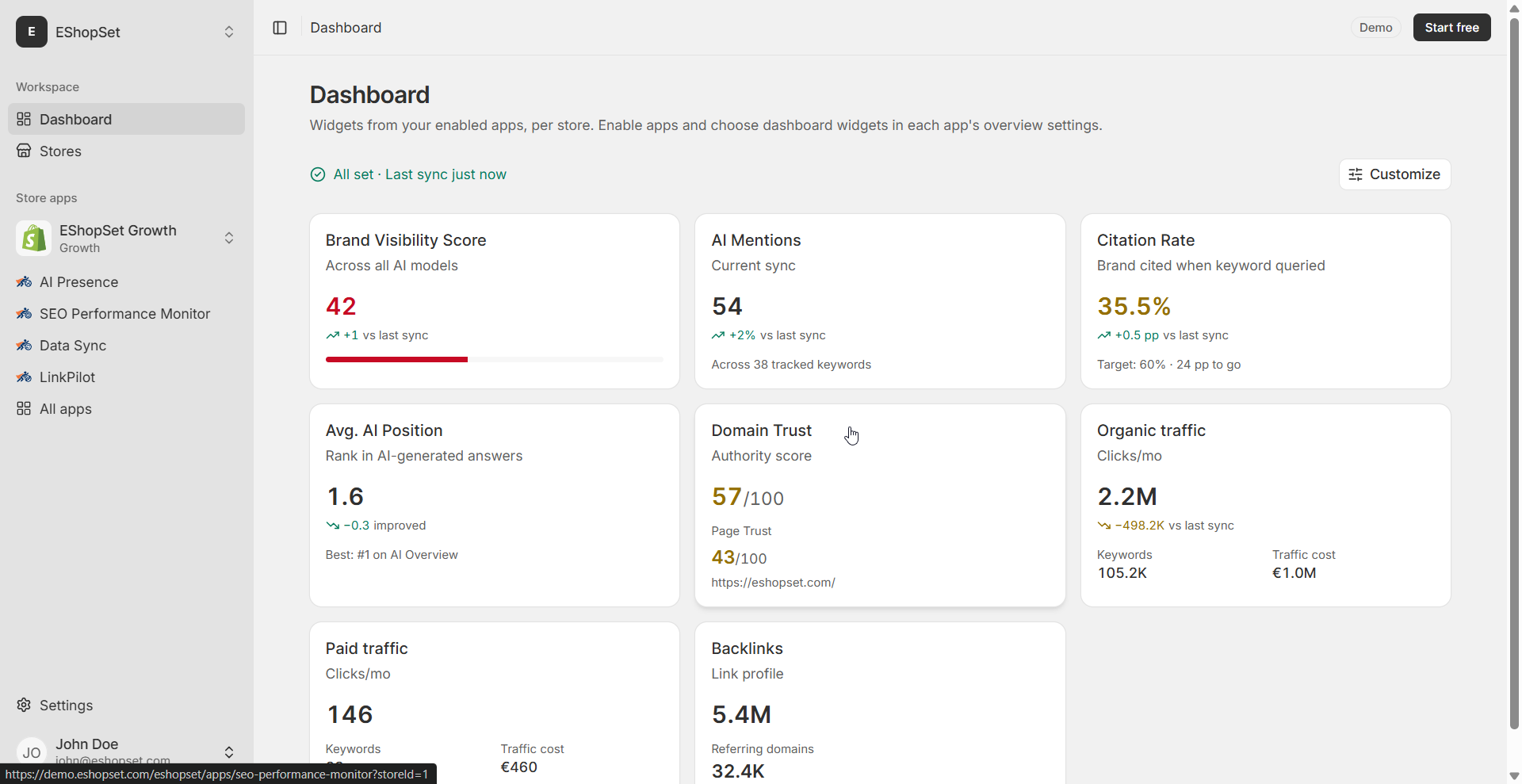
After addressing any potential keyword stuffing or doorway page issues, continuous monitoring is crucial. Our SEO Performance Monitor helps you track your Shopify organic keyword rankings and understand the impact of your SEO efforts. It provides insights into how your pages are performing, allowing you to quickly identify any drops in visibility that might indicate lingering issues or new algorithm changes. By staying informed, you can make data-driven decisions to refine your strategy and avoid future penalties.
2. Craft Authentic Content with AI Presence
Creating natural, engaging, and SEO-friendly content is paramount. Our AI Presence app can assist you in generating product descriptions, blog posts, and marketing copy that resonates with your audience and search engines alike. Instead of stuffing keywords, AI Presence helps you integrate relevant terms naturally, ensuring your content is informative, unique, and provides real value. It can also guide you in crafting concise, descriptive alt text that improves accessibility without resorting to spammy tactics.
3. Streamline Product Data with Sheet2Cart
For merchants managing large product catalogs, ensuring every product detail is SEO-optimized can be a daunting task. Sheet2Cart simplifies this by allowing you to bulk manage your product data using spreadsheets. You can easily Shopify match products by handle from Sheets to update SEO-critical fields like alt text, meta descriptions, and product descriptions in bulk. This ensures consistency and accuracy across your entire catalog, making it efficient to implement best practices and correct any legacy issues from previous SEO providers.
Actionable Steps for Shopify Merchants
If you suspect your store might be suffering from outdated or harmful SEO practices, here's a practical roadmap inspired by the community's advice:
- Conduct a Thorough Audit: Review all your alt text, meta descriptions, and page content. Look for repetitive phrases, unnatural keyword usage, or thin content.
- Prioritize Accessibility: Rewrite alt text to genuinely describe the image for screen readers. One natural phrase is sufficient.
- Evaluate Doorway Pages: For city/service pages, ensure each offers unique, valuable content. If they're just swapped city text, consolidate them into more comprehensive, useful pages.
- Document Everything: Before making changes, screenshot problematic areas. Keep a factual record of your findings.
- Monitor Google Search Console (GSC): Regularly check GSC for manual actions, indexed pages, queries, and 404s during and after your cleanup. This is your early warning system for potential issues.
- Focus on User Experience: Always ask: "Is this content helpful and engaging for my customers?" If the answer is no, it's likely not good for SEO either.
Ditching old, manipulative SEO tactics is not just about avoiding penalties; it's about building a strong, trustworthy online presence for your Shopify store. By embracing modern, ethical SEO practices and leveraging powerful tools like EShopSet's bundle of apps, you can achieve sustainable organic growth and connect more effectively with your target audience.