Should Your Shopify Store Accept Crypto Payments? A Merchant's Guide
Hey fellow Shopify merchants and store operators! We recently came across a really interesting discussion in an online community that struck a chord with many of us. The original poster was a small store owner, primarily serving UK and EU customers, who had received about a dozen inquiries over a few months asking if they accepted Bitcoin. Their core questions were spot on: Is it worth the setup effort for that volume? What about price volatility? Are the fees actually lower than cards? And how do chargebacks work?
These are exactly the kinds of practical questions that keep us up at night, right? So, let's dive into the community's collective wisdom and break down whether adding crypto payments is a smart move for your Shopify store, and how it fits into a broader strategy for growth and operational efficiency with tools like EShopSet.
The Demand Signal: A Dozen Asks – Is That Enough?
The original poster's first hurdle was gauging whether a dozen requests indicated enough demand to justify the effort. A couple of community members, including one who said a dozen requests was 'enough to test it,' leaned towards giving it a shot, especially if the setup was painless. Another respondent echoed this, suggesting it's certainly enough to at least test the demand without building anything overly complicated.
The consensus? Yes, a consistent trickle of requests, even if seemingly small, is often a good indicator to explore new payment options. It signals a segment of your customer base that prefers or is comfortable with this payment method. Catering to these preferences can enhance customer satisfaction and potentially broaden your market reach. A store that adapts to modern consumer preferences often builds a stronger brand reputation, which can indirectly contribute to a higher Shopify domain trust score in the eyes of both customers and search engines.
Navigating the Core Concerns: Volatility, Fees, and Chargebacks
These were the core concerns, and the community offered some fantastic clarity:
1. Tackling Price Volatility
This is often the biggest psychological barrier for merchants. How do you price a product in GBP or EUR if the payment you receive is constantly fluctuating in value? Fortunately, the community had clear answers:
- Instant Conversion: Many modern crypto payment processors (often available as Shopify apps or plugins) convert the cryptocurrency to your preferred fiat currency (like GBP or EUR) at the exact moment of payment. This means you receive the exact fiat amount for your sale, insulating you from market fluctuations. A community member specifically mentioned providers like BitPay and Elenpay as examples of services that handle this instant conversion.
- Stablecoins: Another effective strategy is to accept stablecoins, such as USDC. As one community member pointed out, stablecoins are designed to maintain a stable value, typically pegged to a fiat currency like the US dollar. If you accept stablecoins, what arrives is already a dollar-pegged amount, eliminating the need for immediate conversion to avoid volatility. Services like Stabledrop.me were mentioned as an easy way to integrate stablecoin payments.
- Custodial vs. Non-Custodial: A crucial consideration is whether the payment goes straight to a wallet you control (non-custodial) or if it sits in the provider's account first (custodial). While custodial solutions simplify management, non-custodial options offer full control over your funds, a factor a community member suggested might become more important in the future.
2. Understanding Fees
Are crypto fees actually lower than traditional card processing fees? The answer is nuanced, especially for UK and EU merchants.
- Comparison to Card Fees: While some regions, particularly the US, might see significant fee differences, a community member highlighted that card interchange fees are capped in the UK and EU. This means the gap between card fees and crypto gateway fees (often 1-2% plus a flat charge) is much smaller. For a small volume of transactions, fee savings alone are unlikely to be the primary driver for adopting crypto payments.
- All-in Costs: It's essential to compare the 'all-in' fees, including any conversion fees, network fees (like 'gas' fees), and administrative hassle, against your current card processing costs.
3. The Chargeback & Refund Landscape
One of the most distinct differences with crypto payments is the absence of traditional chargebacks.
- No Chargebacks: A confirmed cryptocurrency payment is generally irreversible and final. This eliminates the risk of fraudulent chargebacks that can plague traditional e-commerce.
- Manual Refunds: The flip side is that refunds are entirely manual. If a customer requires a refund, you'll need to process it yourself, typically by sending crypto back to their wallet. A community member strongly advised deciding upfront whether you refund the original fiat value or the equivalent amount in coins received, and clearly stating this in your refund policy before your first crypto transaction.
Implementation on Shopify: Plugin vs. Integration
For a dozen requests, the community consensus was clear: it's a 'plugin job, not an integration.' This means you don't need a complex, custom-built system. Shopify's robust app ecosystem makes it straightforward to add crypto payment gateways as an additional option at checkout, much like any other third-party payment provider.
This ease of setup means you can test the demand with minimal effort, allowing you to gauge customer adoption before committing to more significant changes.
Beyond Payments: A Holistic Approach to Store Growth with EShopSet
While integrating crypto payments addresses a specific customer need, it's just one piece of the puzzle for a thriving Shopify store. At EShopSet, we understand that daily operations require a comprehensive suite of tools. Here's how our apps complement a forward-thinking payment strategy:
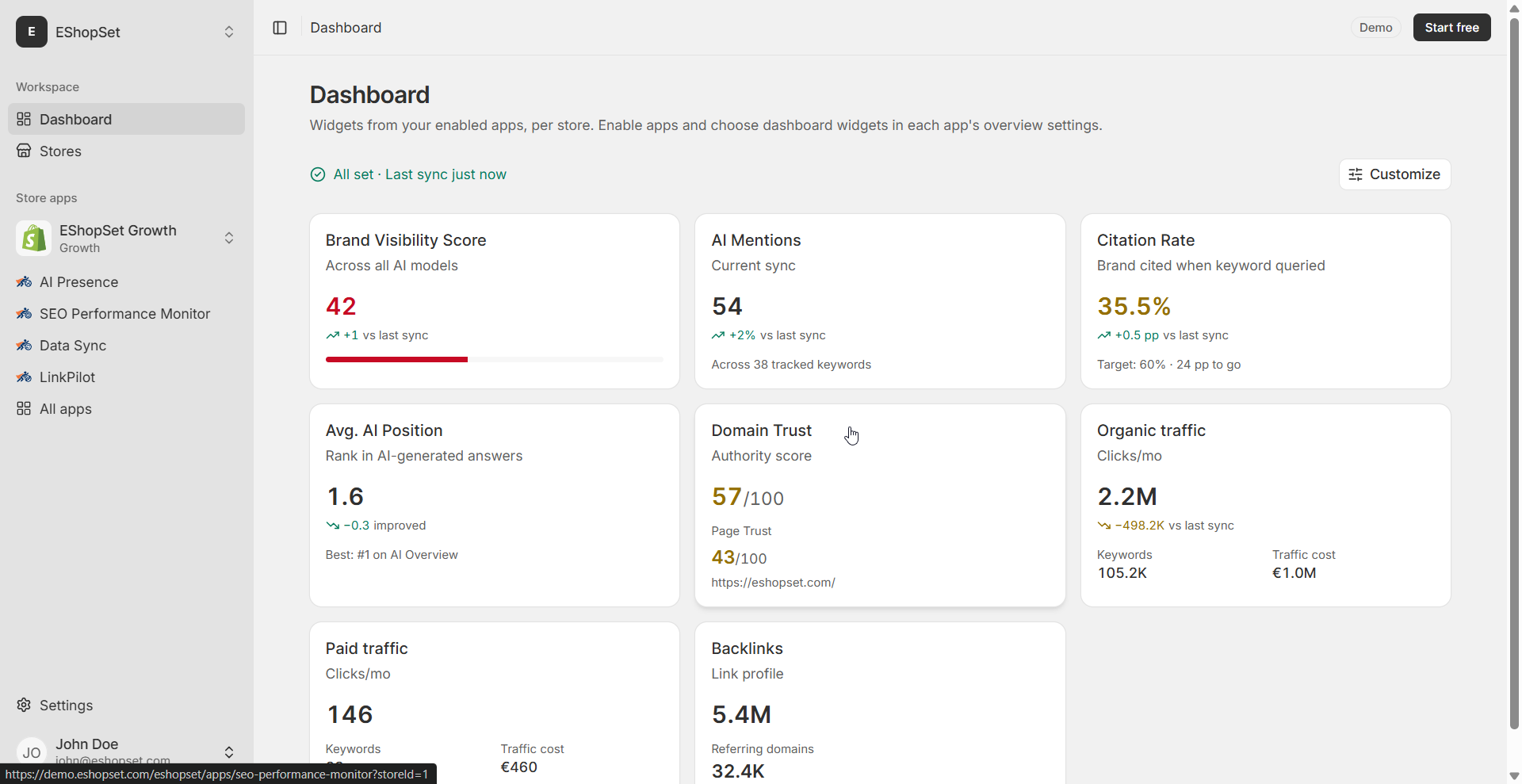
- SEO Performance Monitor: A modern, customer-centric store that offers diverse payment options contributes to a better user experience. Google and other search engines value sites that are user-friendly, secure, and offer convenience. A positive user experience, including flexible payment choices, can enhance your store's perceived authority and ultimately improve your Shopify domain trust score. Our SEO Performance Monitor helps you track and optimize your store's visibility, ensuring that your efforts in customer experience translate into higher rankings.
- AI Presence: Expanding your payment options can attract new customer segments. Our AI Presence app helps you understand and engage these diverse audiences through optimized content and communication. By leveraging AI, you can tailor your messaging to resonate with customers who appreciate modern payment solutions, driving deeper engagement and conversions.
- Sheet2Cart: Regardless of how customers pay, maintaining an accurate and up-to-date product catalog is paramount. If you're managing a large inventory or frequently updating product details, Sheet2Cart ensures seamless synchronization of your product data from spreadsheets to your Shopify store. This consistency is vital for customer trust and operational efficiency, especially if you're dealing with dynamic pricing or unique product offerings.
For growing merchants, considering an EShopSet Growth plan Shopify subscription can provide the integrated tools needed to manage these advanced operations, from optimizing SEO to streamlining catalog updates, ensuring your store is ready for the future of e-commerce.
Actionable Insights for Your Shopify Store
Before you dive in, consider these practical steps:
- Assess True Demand: Are customers abandoning carts because crypto isn't an option, or are they just casually asking? This distinction helps gauge the urgency and potential impact.
- Define Your Crypto Exposure: Decide whether you want to hold crypto (and accept the associated market risk) or convert it immediately to fiat. Your chosen payment gateway should support your preference.
- Choose a Reputable Provider: Research and select a crypto payment gateway that is reliable, secure, and offers the features you need (e.g., instant conversion, stablecoin support).
- Update Your Policies: Clearly articulate your refund policy for crypto payments. Transparency builds trust.
Embracing crypto payments can be a strategic move for Shopify merchants looking to cater to a modern, diverse customer base and enhance their store's reputation. While the volume might initially be small, the ability to offer flexible payment options contributes to a robust and future-proof e-commerce business. Combine this with EShopSet's powerful suite of apps for SEO, AI-driven customer engagement, and catalog management, and you're well-equipped to thrive in the evolving digital marketplace.