Shopify SEO: Mastering Search Intent for Higher Clicks and Conversions
Hey there, fellow Shopify merchants and store operators! Ever found yourself scratching your head, staring at your analytics, and seeing that frustrating combo: lots of impressions, but barely any clicks? It’s a common dilemma, and it was the exact challenge an original poster brought up in a recent community discussion I followed. They were trying to figure out if their pages needed more content or if they were simply targeting the wrong search intent.
It’s a crucial question, because as they wisely pointed out, if a keyword has an informational intent but your page is primarily commercial, simply adding another 1,000 words probably won't fix the underlying problem. It’s like trying to sell a hammer to someone who’s asking for instructions on how to build a house – you’re close, but not quite hitting the mark!
The Low Clicks, High Impressions Conundrum: Diagnosing the Root Cause
So, where do you start? One sharp community member immediately asked a clarifying question: are these impressions on page 10, or are they on page 1 or 2? This distinction is vital:
- If you’re ranking on page 1 or 2 with low clicks: This often points to a metadata problem. Your page is visible, but your title tag and meta description aren't compelling enough to entice users to click. They might not clearly communicate the value or relevance to the searcher's query. Your page might be appearing for the right keywords, but the snippet in the search results isn't selling the click.
- If you’re not ranking on page 1 or 2: Here, the problem is usually deeper. You need to focus on both search intent and topical completeness. Your page might not be relevant enough, or comprehensive enough, to compete for those top spots. This could mean your content doesn't fully address the user's query or isn't structured in a way that search engines deem authoritative for the topic.
Search Intent is King (and Queen!): Aligning Your Content with User Needs
This was a resounding theme throughout the discussion. Multiple respondents emphasized that search intent is king. As one community member succinctly put it, "If a person is searching to buy an iPhone, a blog won't rank and the other way around. Your pages need to match the search intent." This fundamental principle dictates whether your content will ever truly resonate with a searcher.
There are generally four main types of search intent:
- Informational: Users are looking for answers to questions, how-to guides, or general knowledge (e.g., "how to clean leather shoes").
- Navigational: Users are trying to find a specific website or page (e.g., "EShopSet login").
- Transactional/Commercial: Users are looking to buy something, comparing products, or seeking a specific service (e.g., "buy waterproof hiking boots").
- Commercial Investigation: Users are researching products or services with the intent to purchase soon, comparing features and reviews (e.g., "best noise-cancelling headphones reviews").
For your Shopify store, correctly identifying the intent behind a keyword is paramount. A product page should target transactional intent, while a blog post should target informational or commercial investigation intent. Mismatching these will almost guarantee low clicks, even if you rank well.
Content Quality Over Quantity: Competing for Top Spots
Once you've aligned your content with the correct search intent, the next step is to ensure its quality. A contributor in the thread highlighted the importance of competitive research: "Do competitive research on the top 3 search results, and compare the content. If your content does not compete, produce better content. Not necessarily MORE content, but BETTER content."
Better content means:
- Comprehensive: Does it fully answer the user's query?
- Authoritative: Is it trustworthy and accurate?
- Engaging: Is it easy to read and understand?
- Unique: Does it offer a fresh perspective or added value compared to competitors?
For product pages, this means rich descriptions, high-quality images, clear specifications, and customer reviews. For blog posts, it means well-researched articles that genuinely help or inform your audience.
Leveraging EShopSet Apps for Superior Shopify SEO
At EShopSet, we understand these challenges intimately. Our suite of Shopify apps is designed to empower merchants like you to tackle SEO, content, and data management with confidence.
1. SEO Performance Monitor: Your Eyes on Search Performance
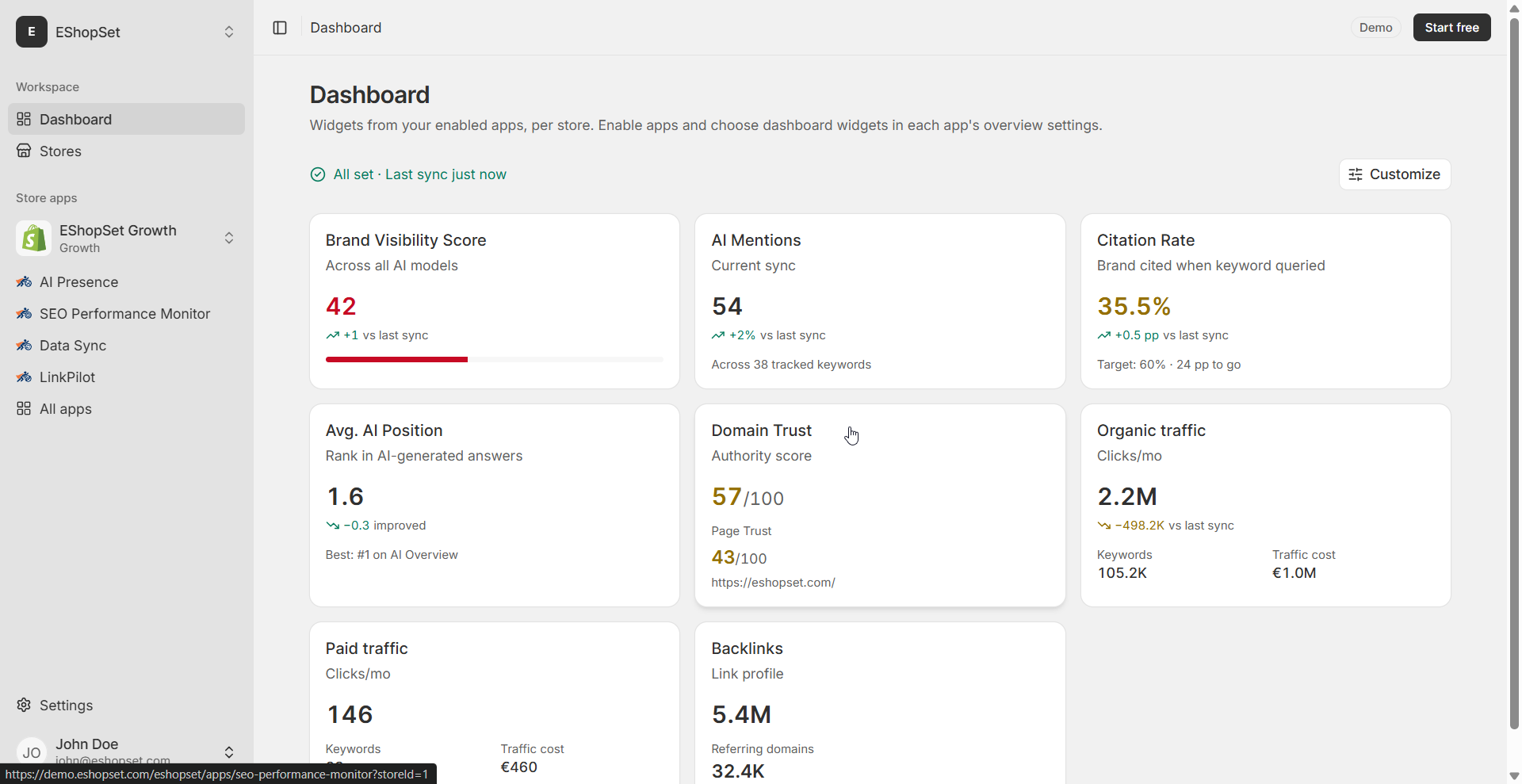
Our SEO Performance Monitor app is your go-to for understanding how your pages are performing in search. It helps you track impressions, clicks, and keyword rankings, making it easier to spot those "low clicks, high impressions" pages. With this data, you can quickly identify metadata problems and optimize your title tags and meta descriptions to be more compelling and intent-aligned. It provides the insights you need to make informed decisions about your Shopify SEO strategy.
2. AI Presence: Crafting Intent-Driven Content
Once you've identified the correct search intent, our AI Presence app steps in to help you create content that truly resonates. Whether you need compelling product descriptions that target transactional intent or informative blog posts that answer specific user queries, AI Presence can assist. It helps you generate high-quality, topically complete content that is designed to engage your audience and satisfy search engine algorithms, ensuring your pages are not just present, but powerful.
3. Sheet2Cart: Streamlining Product Data for SEO Richness
Accurate and comprehensive product data is the backbone of effective transactional SEO. Our Sheet2Cart app simplifies the process of managing your Shopify product catalog. When optimizing product pages for specific transactional intent, ensuring the product data is rich and accurate, and easily updated, is key. Merchants can use Sheet2Cart to efficiently update product details, add new variants, or enrich existing descriptions by performing a Shopify match products by SKU from Sheets operation. This ensures your product pages are always optimized and complete for search engines, providing all the necessary information to convert high-intent searchers into customers.
The Path to Higher Conversions
Ultimately, achieving higher clicks and conversions on your Shopify store boils down to a deep understanding of your audience's search intent and a commitment to delivering high-quality, relevant content. It's not just about adding more words; it's about adding the right words in the right place, backed by robust data management and continuous performance monitoring.
Ready to transform your Shopify SEO strategy? Explore the EShopSet bundle today and equip your store with the tools to dominate search results and drive meaningful engagement.