Reviving Underperforming Shopify Pages: A Merchant's Guide to SEO, AI, and Catalog Sync
Ever poured your heart into a Shopify product page or blog post, convinced it’s a masterpiece, only for it to stubbornly refuse to climb the search rankings? Or perhaps a page that was once a superstar starts to fade, competitors jump ahead, or traffic slowly dwindles? This isn't just you; it's a common dilemma that sparked a lively discussion in an online community recently, where merchants and SEO professionals shared their go-to moves when a page just isn't doing what they want.
The original poster perfectly captured this universal frustration: sometimes 'everything looks fine on paper but the page just doesn’t move.' Other times, a once-successful page starts slipping, competitors gain ground, or organic traffic slowly fades. It's a challenge every online retailer faces, highlighting the dynamic and often unpredictable nature of search engine optimization.
Beyond the Initial Frustration: A Strategic Approach
One community member, perhaps speaking for many, humorously suggested 'Crying and cursing' as a valid first step – and honestly, who hasn't been there? The emotional toll of an underperforming page can be real, especially after investing significant time and effort. But once the initial frustration subsides, the real work begins. The original poster noted that everyone seems to have a different approach: some wait it out, some tweak immediately, others dive into competitor analysis or historical data. The key is moving from reaction to a structured, data-driven strategy.
Deconstructing the Dilemma: Key Questions for Shopify Merchants
A thoughtful respondent in the thread jumped in with some pointed questions, framing the problem from several angles that are incredibly relevant for Shopify merchants and store operators:
- 'Are they pogo-sticking for certain queries?' This is crucial. 'Pogo-sticking' means users are quickly bouncing back to search results after landing on your page, indicating your content isn't meeting their intent. For a Shopify store, this could mean a product page is showing up for a search query that implies a different product, or a blog post isn't answering the user's question directly enough. Understanding user intent is paramount.
- 'Should you republish or tweak your title to exclude queries that don't match or have lower CTR?' Your page title and meta description are your storefront in search results. If they're not compelling or accurately reflecting the content, your click-through rate (CTR) will suffer. Sometimes, a subtle tweak can make all the difference.
- 'Do you need more topical authority?' Google favors sites that demonstrate comprehensive knowledge on a subject. If your page is isolated, it might struggle to rank. Building a cluster of related content around key themes can signal greater authority.
- 'What are your competitors doing?' Ignoring your competition is a missed opportunity. Analyzing their strategies, what they rank for, and how their content is structured can provide invaluable insights for your own optimization efforts.
EShopSet: Empowering Shopify Merchants to Conquer Underperformance
At EShopSet, we understand these challenges intimately. Our suite of Shopify apps is designed to provide merchants with the tools to proactively monitor, analyze, and optimize their online presence, turning underperforming pages into revenue drivers.
1. Pinpointing Problems with SEO Performance Monitor
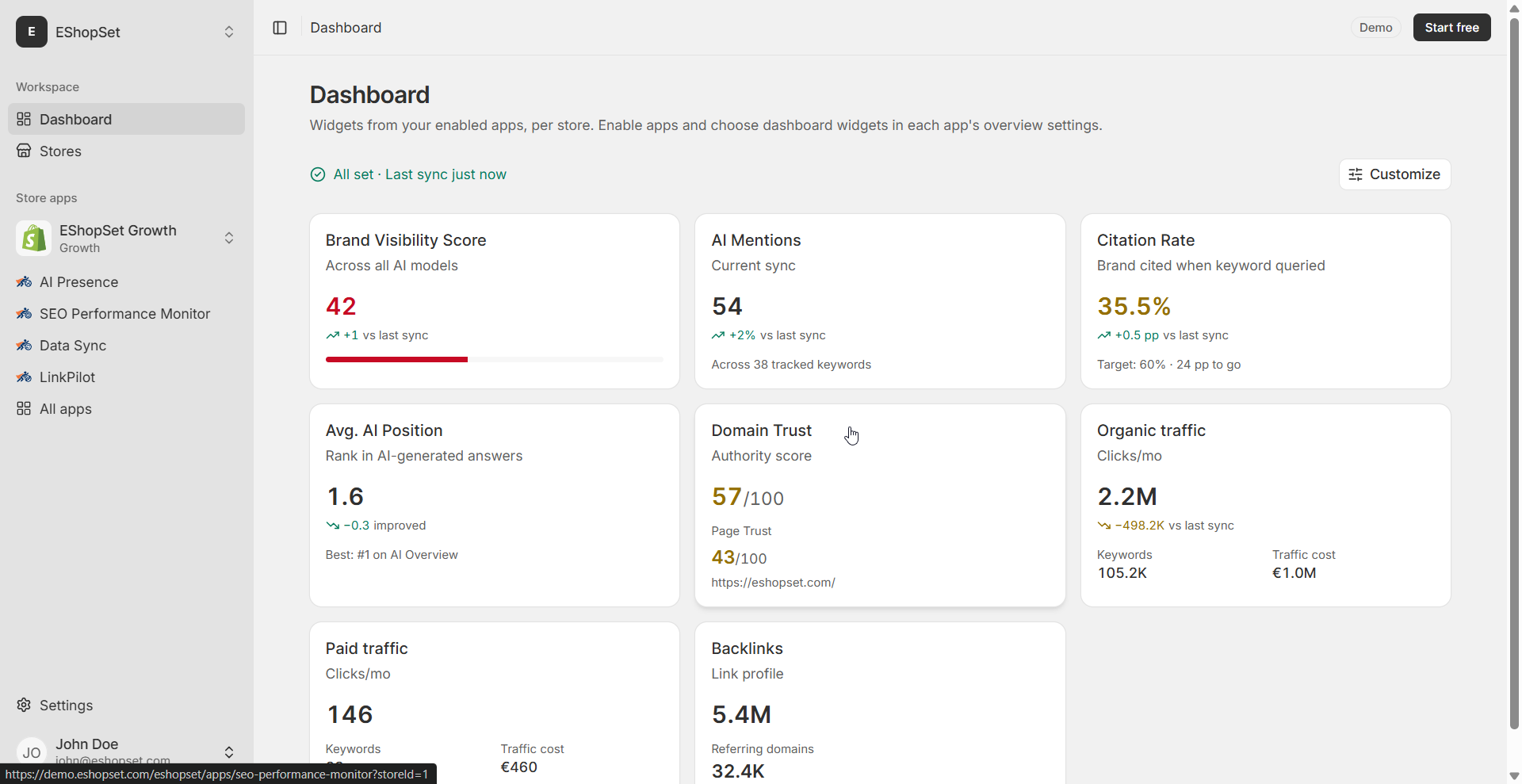
When a page isn't moving, or traffic starts to fade, the first step is always diagnosis. Our SEO Performance Monitor acts as your vigilant watchdog, providing critical insights into your store's search engine health. It helps you:
- Track Keyword Rankings: Understand exactly where your pages stand for target keywords.
- Monitor Competitor Performance: See what your rivals are doing, identify their ranking pages, and uncover opportunities.
- Identify Traffic Drops: Get alerts and detailed reports on pages experiencing a decline in organic traffic, allowing you to react swiftly.
- Analyze Search Console Data: Integrate with Google Search Console to visualize impressions, clicks, and CTR, helping you spot 'pogo-sticking' trends and underperforming titles.
With SEO Performance Monitor, you gain the clarity needed to answer questions like 'what changed?' and 'where should I look first?' It's an essential Shopify organic traffic monitor that provides the data to inform your next move.
2. Refining Content and Intent with AI Presence
Once you've identified an underperforming page, the next step often involves content refinement. This is where AI Presence becomes an invaluable asset for Shopify merchants:
- Optimize Titles and Descriptions: Use AI to generate compelling, high-CTR titles and meta descriptions that accurately reflect your content and entice users to click. This directly addresses the community member's point about tweaking titles.
- Enhance On-Page Content: Leverage AI to expand thin content, improve readability, and ensure your product descriptions and blog posts comprehensively address user intent, reducing bounce rates and 'pogo-sticking.'
- Build Topical Authority: AI can help you brainstorm and generate related content ideas, allowing you to build out content clusters that demonstrate your store's expertise in a particular niche.
AI Presence helps you craft content that not only ranks but also engages, ensuring your pages genuinely satisfy user queries.
3. Streamlining Product Data for SEO with Sheet2Cart
For many Shopify stores, especially those with large or frequently updated catalogs, product data management can be a hidden SEO challenge. Inaccurate, incomplete, or outdated product information can severely impact your search visibility. This is where Sheet2Cart shines:
- Effortless Catalog Updates: Seamlessly import and update product data from Google Sheets directly to your Shopify store. This ensures product titles, descriptions, images, and inventory are always fresh and accurate, which search engines love.
- Maintain Data Consistency: Eliminate manual errors and ensure uniformity across thousands of products, preventing duplicate content issues or conflicting information that can confuse search engines.
- SEO-Friendly Data Management: By simplifying the process of updating product details, Sheet2Cart empowers you to quickly implement SEO changes across your product catalog, from adding new keywords to refining product variants.
Efficient Shopify catalog sync from Google Sheets is not just about operational efficiency; it's a foundational element of strong product SEO.
A Strategic Framework for Shopify Merchants
When you encounter an underperforming page, consider this integrated approach:
- Monitor & Diagnose: Use SEO Performance Monitor to identify the problem (ranking drop, traffic decline, high bounce rate) and understand its scope.
- Analyze Intent & Content: Review the page's content, title, and meta description. Use AI Presence to refine these elements to better match user intent and improve CTR.
- Optimize Product Data: If it's a product page, ensure all product details are accurate, complete, and SEO-friendly using Sheet2Cart.
- Study Competitors: Leverage SEO Performance Monitor to see what competitors are doing successfully for similar queries.
- Iterate & Refine: Implement changes, monitor their impact with SEO Performance Monitor, and continue to refine your strategy.
Conclusion
The frustration of an underperforming page is real, but it doesn't have to be a dead end. By adopting a systematic approach and leveraging powerful tools like EShopSet's SEO Performance Monitor, AI Presence, and Sheet2Cart, Shopify merchants can transform these challenges into opportunities for growth. It's about moving beyond guesswork and embracing data-driven decisions to ensure every page on your store contributes to your overall success.