Beyond the License Fee: When Your Shopify Tech Stack Becomes a Bottleneck
Running a successful Shopify store means constantly optimizing, not just your products or marketing, but also the very tools you use to manage your daily operations. Sometimes, a tool that once seemed like the perfect fit can become a bottleneck, quietly costing you more in lost opportunities and operational friction than its actual subscription fee. This is a common dilemma, and recently, a really insightful discussion popped up in an ecommerce community that perfectly illustrates this point.
The original poster brought up a fascinating question: what's the actual threshold for moving a mid-market brand off a powerful, but potentially over-engineered, platform like Salesforce Marketing Cloud (SFMC)? They shared their frustration, noting that even when a brand only uses a fraction of SFMC's capabilities (like just Email Studio), the migration costs often seem to outweigh the license savings. This isn't just about SFMC; it's a universal challenge for any Shopify merchant evaluating their tech stack.
The Hidden Costs of 'Good Enough'
What truly tips the scales, according to the original poster, isn't just the license fee, but how much the marketing team can accomplish independently. When customer data is scattered across different 'data extensions' instead of a unified profile, even a simple customer segment requires a specialist to write complex queries. For a Shopify merchant, this translates to product data spread across multiple spreadsheets, customer segments that are hard to build, or SEO insights that require manual collation from disparate sources. This means campaigns get delayed, or worse, never even see the light of day because only one or two people on the team have the technical know-how.
The lost revenue from these 'never-built' campaigns is a silent killer for growth. As one community member aptly put it, the real threshold often lies in the opportunity cost – the revenue and margin lost to a queue of requested campaigns that never ship because the team can’t build or QA a segment without a specialist. This dependency on highly specialized skills or complex workflows can severely limit a Shopify store's agility and ability to react to market trends.
The Data Dilemma: Beyond the Six-Month Window
Another big pain point highlighted was engagement history. It’s often locked away in obscure data views, inaccessible through the regular interface, and typically only holds six months of data. Crucially, browse and purchase behavior isn't always included, requiring additional manual 'piping in' from the store. Imagine trying to make smart, data-driven decisions about customer retention, personalized offers, or even understanding your Shopify referring domains tracker performance when your historical data is incomplete or difficult to access.
A community member emphasized that this six-month data limit is more significant than it might seem. It forces engagement decisions to be based on a limited native history, and without integrated purchase data, the full customer journey remains opaque. This can lead to suboptimal marketing strategies, missed opportunities for targeted campaigns, and an incomplete picture of your store's overall performance.
Beyond License Fees: Quantifying True Value
The consensus from the community thread wasn't just about the raw cost of a license. Instead, it centered on a 'contribution-margin decision.' This means looking beyond just the subscription fee and considering the total cost of ownership, including migration, data cleanup, and the analyst time spent on maintenance or workarounds. If your team is constantly spending time on complex queries, manual data transfers, or waiting for specialists, that capacity has a significant cost that needs to be factored into the equation.
For a Shopify merchant, this translates into asking: Are your current tools truly enabling your team to launch campaigns, manage inventory, or optimize SEO efficiently? Or are they creating bottlenecks that prevent valuable initiatives from ever seeing the light of day? The value of lost campaign output, plus the administrative time spent on workarounds, often far outweighs the perceived savings of sticking with an inadequate or over-engineered solution.
The advice was clear: stay only if the campaigns you're currently blocked on don't have a clear measurable impact, or if you're truly leveraging the advanced features you're paying for (e.g., multi-brand management, complex B2B integrations). Otherwise, consider moving once the value of the lost output and admin time justifies the migration.
EShopSet's Solution for Shopify Merchants
At EShopSet, we understand these challenges intimately. Our bundle of Shopify apps is designed to simplify daily operations, address data silos, and empower merchants to achieve more without needing an army of specialists. We believe your tools should be an accelerator, not a bottleneck. You can explore our full suite of apps at eshopset.com/apps/.
Streamlined SEO with SEO Performance Monitor
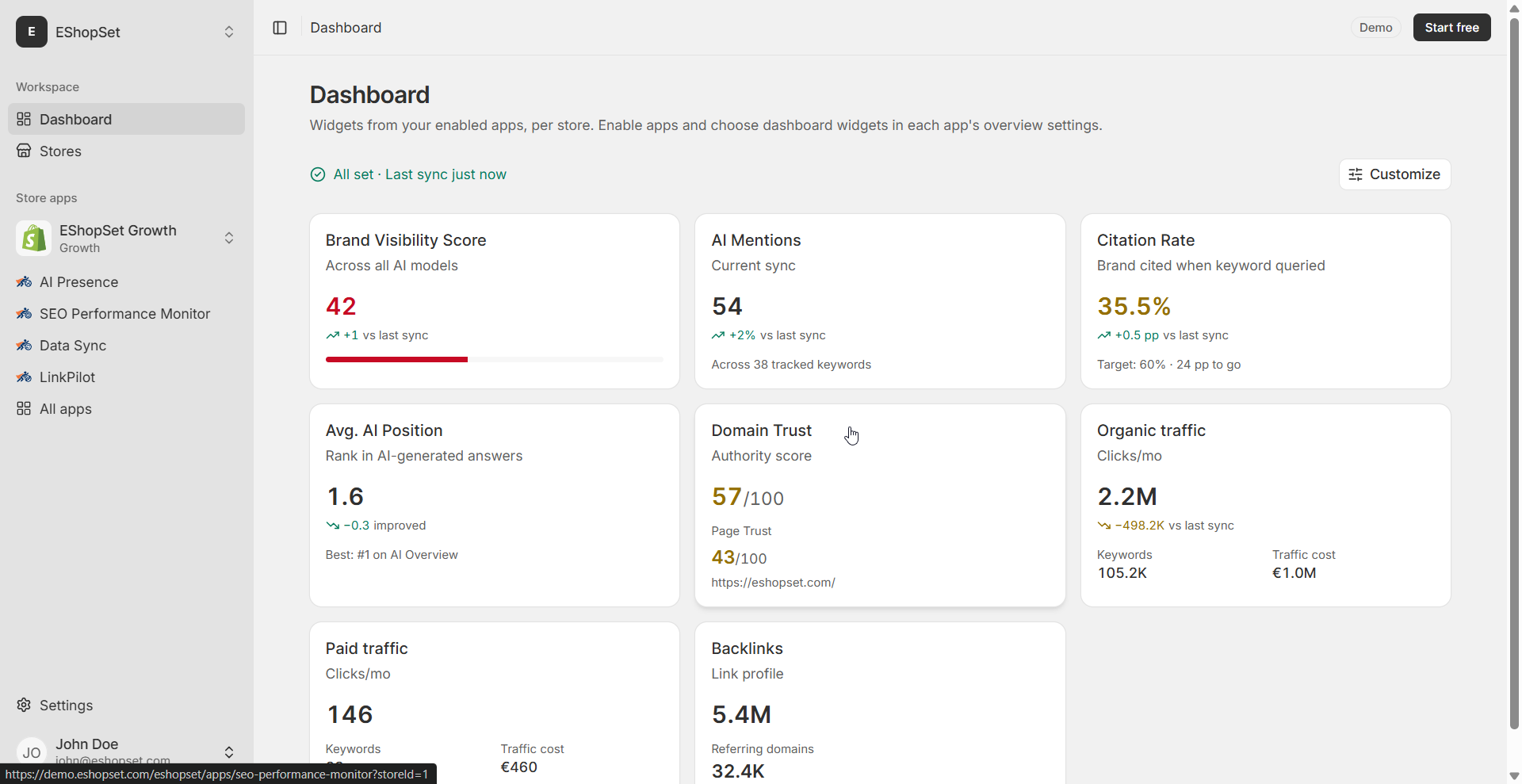
Imagine trying to track your Shopify referring domains tracker manually or relying on fragmented data views. Our SEO Performance Monitor provides a unified dashboard for critical SEO metrics, helping you understand your store's visibility and identify growth opportunities without wrestling with complex data exports or limited historical views. It ensures you have the comprehensive data needed to make informed SEO decisions.
Empowering Content Creation with AI Presence
The dilemma of 'campaigns that never get built' due to specialist bottlenecks is real. EShopSet's AI Presence app empowers you to generate compelling content and optimize your AI search visibility Shopify without needing an AI expert. It simplifies the creation of product descriptions, blog posts, and marketing copy, ensuring your store is always fresh and engaging, and your team can launch campaigns faster.
Effortless Product Management with Sheet2Cart
For merchants struggling with product data scattered across various spreadsheets or needing to 'pipe in' information, Sheet2Cart offers a seamless solution. It allows you to manage and sync your product catalog directly from a spreadsheet, acting as your ultimate Shopify product sync from spreadsheet tool. Say goodbye to manual updates and data inconsistencies, and hello to streamlined inventory and product information management.
Making the Right Decision for Your Shopify Store
The core takeaway from the community discussion, and a principle we champion at EShopSet, is that the true cost of a tool goes far beyond its license fee. It encompasses the efficiency it enables, the opportunities it unlocks, and the friction it eliminates. For Shopify merchants, evaluating your tech stack means:
- Assessing Team Autonomy: Can your team execute key tasks (like segmenting customers, updating products, or monitoring SEO) without constant reliance on specialists or complex workarounds?
- Quantifying Opportunity Cost: What revenue or growth are you missing out on because campaigns are delayed, data is inaccessible, or tasks are overly complex?
- Holistic Cost Analysis: Factor in not just license fees, but also the time spent on manual processes, training, and troubleshooting.
If your current tools are acting as a drag on your operations rather than an accelerator, it might be time to consider a change. Opt for solutions that integrate seamlessly, simplify complex tasks, and empower your team to focus on what truly drives growth for your Shopify store.