Shopify Domain Migration SEO: Why Google Stalls While Bing Soars, and How to Recover with EShopSet
Hey there, fellow Shopify merchants and store operators! Let's talk about something that can keep even the most seasoned among us up at night: moving your store to a new domain. It sounds straightforward on paper, right? Set up some redirects, tell Google, and boom – you're back in business. But as a recent community discussion highlighted, it's rarely that simple, especially when Google decides to take its sweet time.
The Head-Scratcher: Google's Sluggishness vs. Bing's Speed
We saw a fascinating case shared by a community member who moved their B2B SaaS site from one domain to another due to a forced rebrand. They did everything by the book: precise 1:1 301 redirects, Change of Address in Google Search Console, identical content and URL paths – you name it. Yet, six months later, Google traffic was still roughly 80% down from baseline, while Bing had fully recovered and was even outperforming its old numbers!
Imagine the frustration! Bing was back to 116% of its baseline in just three weeks, but Google was stubbornly stuck at 19%. Brand queries were fine, and specific long-tail keywords still ranked well, but crucial head terms plummeted from positions 5-9 down to 60+. This kind of disparity between search engines, especially with Google being the laggard, is a classic sign that something specific to Google's algorithms is at play.
What Was Checked (And Ruled Out)
The original poster was incredibly thorough, which is exactly what we'd advise for any Shopify store facing a similar challenge. They meticulously checked:
- Redirects: Confirmed 1:1 301s, single hop, covering all HTTP/HTTPS and apex/WWW variants.
- Change of Address: Activated on both old properties.
- Content: Identical to what ranked before.
- Crawling & Indexing: Most sitemap URLs crawled and indexed, new posts indexed quickly.
- Old Domain Status: All top URLs showed "Page with redirect," recrawled within 30 days.
- Technical SEO: Canonicals matched, no manual actions, no security issues.
- Backlinks: ~150 linking sites, no spam patterns, no links switched elsewhere.
- Previous Ownership: No leftover pages from previous owners in either index.
Despite this exhaustive list, Google remained unresponsive. This level of diligence underscores how complex and frustrating domain migrations can be, even for seasoned SEOs.
The Lingering Question: The Parked Domain's Past
The one significant factor that stood out to the original poster was the history of the new domain. According to Wayback Machine, the new domain had previously been a Sedo parking page and later redirected to a domain broker's sale page for several years. This led to a critical hypothesis: could Google still be associating older, negative signals with the long-dormant new domain?
This isn't an unheard-of scenario. A community member in the thread noted that they had no experience with parked domains, highlighting how niche and perplexing this issue can be. Google's algorithms are incredibly sophisticated, and sometimes, the historical baggage of a domain, even if it's just a parking page, can take a long time to shake off. It's like moving into a new house with a bad reputation – it takes time and consistent good behavior to change perceptions.
Actionable Steps for Shopify Merchants Facing Domain Migration Challenges
While the original poster's situation was unique due to the parked domain history, their meticulous process offers valuable lessons for any Shopify merchant considering or undergoing a domain move. Here's how you can approach it, leveraging tools like EShopSet:
1. Pre-Migration Planning & Audit
- Comprehensive Inventory: Document all current URLs, their rankings, and traffic. Identify your most valuable pages.
- Content Mapping: Plan your 1:1 redirects meticulously. Ensure every old URL has a corresponding new URL.
- Domain History Check: Before purchasing a new domain, research its past. Tools like Wayback Machine can reveal if it was previously used for spam, parked, or had other issues that could affect its reputation.
2. Execute with Precision
- 301 Redirects: Implement permanent 301 redirects for every old URL to its new counterpart. Ensure they are single-hop and cover all variations (HTTP/HTTPS, www/non-www).
- Google Search Console (GSC) Change of Address: Utilize GSC's Change of Address tool. This is Google's official way to notify them of a move.
- Sitemap Updates: Submit new sitemaps for your new domain and ensure your old sitemaps are removed or updated to reflect redirects.
3. Post-Migration Monitoring & Recovery with EShopSet
This is where continuous vigilance and powerful tools become indispensable. Even after doing everything right, you need to monitor your performance closely.
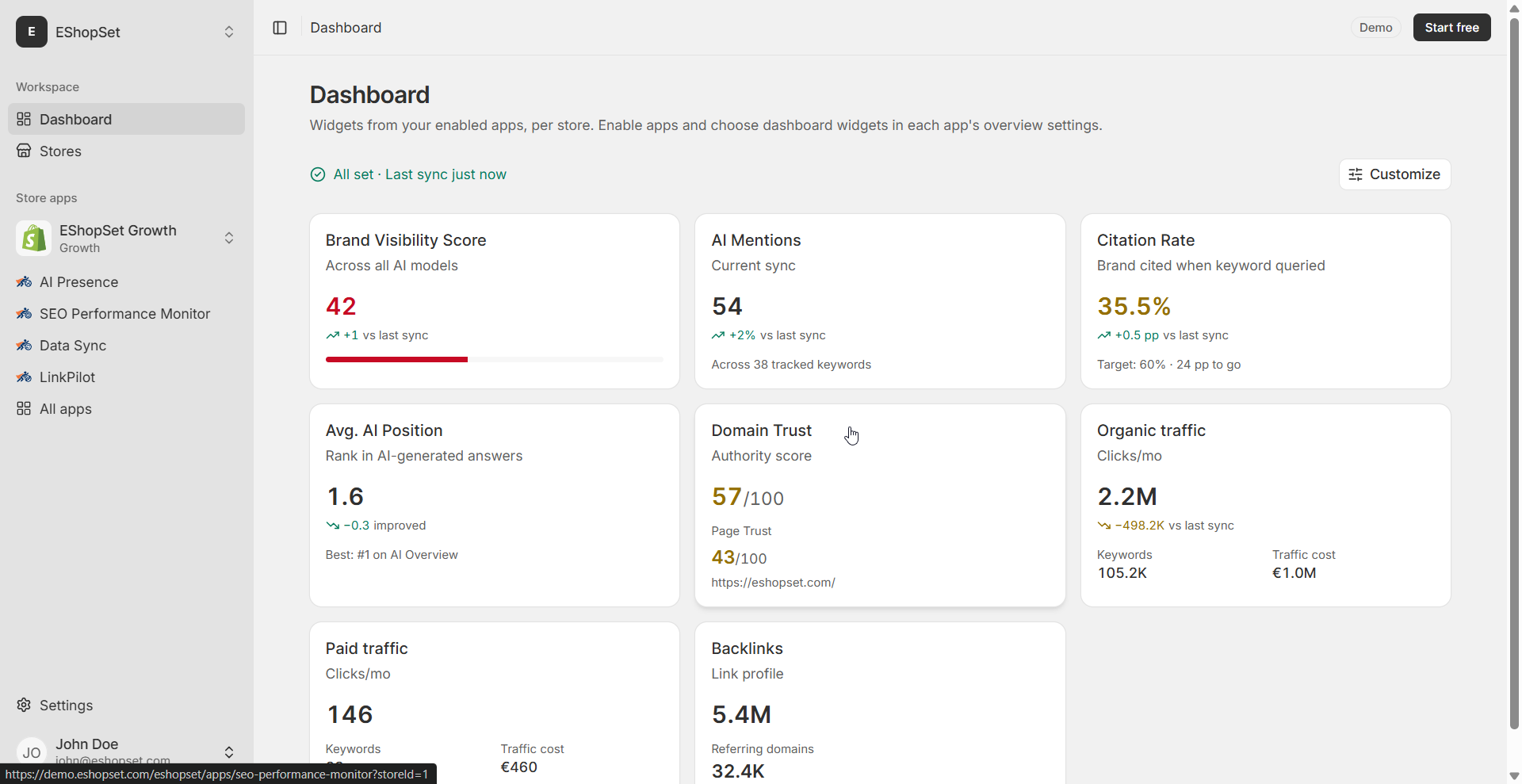
- SEO Performance Monitor: Our SEO Performance Monitor is built precisely for this – to give you real-time insights into your rankings, organic traffic, and crawl health, helping you quickly identify and address issues. Track keyword performance, monitor crawl errors, and see how Google is indexing your new pages. This is crucial for spotting discrepancies between search engines, just like in the community example.
- AI Presence: While SEO recovery can be slow, maintaining your brand's overall digital footprint is vital. Even if search engines are slow to catch up, a strong AI Presence on your Shopify store ensures your brand remains visible and engaging across other channels. Monitoring your AI presence score Shopify store-wide can help you understand how your brand is perceived and interacting with customers beyond traditional search, providing a safety net during SEO fluctuations.
- Sheet2Cart: For managing your product catalog during such a critical period, Sheet2Cart ensures your product data remains consistent and up-to-date. Any content discrepancies or missing product information can further confuse search engines and negatively impact user experience, making seamless catalog management essential.
4. Patience and Persistence
As the community thread demonstrates, Google's recovery can take months, especially if there are underlying historical domain issues or if the move coincides with major algorithm updates. Continue to produce high-quality content, build authoritative links, and engage with your audience. Consistent positive signals will eventually outweigh any historical baggage.
5. When to Seek Expert Help
If you've followed all best practices and are still seeing prolonged issues, it might be time to consult with SEO experts. For agencies looking to support their clients through complex migrations or improve their overall SEO and AI presence, we encourage you to refer Shopify merchants EShopSet to leverage our integrated solutions. Our platform is designed to provide the tools and insights necessary for robust daily operations and strategic growth.
Conclusion
A Shopify domain migration is a significant undertaking that requires meticulous planning, precise execution, and continuous monitoring. While Bing might be quick to adapt, Google's complex algorithms can sometimes be slow to process changes, especially when a domain's history comes into play. By arming yourself with the right strategies and tools like EShopSet's bundle of apps, you can navigate these challenges with confidence, ensuring your store not only recovers but thrives in its new digital home.