Beyond Broad Categories: Supercharge Your Shopify SEO with Intent-Driven Collections
Hey there, fellow Shopify merchants and store operators! Let's talk about something that often gets overlooked but holds immense power for your online store's visibility and sales: your category pages. We often pour our energy into product page descriptions and blog content, but what about the pages that guide customers through your entire catalog?
Recently, I stumbled upon a fantastic discussion in an ecommerce community that really hit home. The original poster kicked things off by challenging the common, simplistic approach to category structures: just grouping products by broad type. They argued that this misses a huge SEO opportunity because it doesn't align with how customers actually search.
Rethinking Your Category Structure for Real Customers
Think about it – when you're looking for something specific, do you always start with a generic term? Probably not. As the original poster pointed out, customers might search based on a whole host of criteria:
- Price: "running shoes under ₹3,000"
- Material: "organic cotton t-shirts"
- Size/Fit: "wide-fit running shoes"
- Problem/Use Case: "shoes for flat feet" or "skincare for sensitive skin"
- Style/Occasion: "boho summer dresses" or "gifts for new moms"
- Product Features: "waterproof hiking boots"
If your website only has a "Shoes" category, but customers are searching for "running shoes for women" or "wide-fit running shoes," you're making it harder for both humans and search engines to find exactly what they're looking for. You might have the perfect products, but if they're buried in a generic category, they're practically invisible.
This isn't about creating thousands of thin, keyword-stuffed pages. It's about creating valuable, intent-driven collection pages that genuinely serve a customer need and have real search demand. As a community member wisely noted, the sweet spot is where search intent is clear, you actually have enough relevant products, and the page deserves to exist for a human, not just a keyword.
The SEO Power of Specificity
Ecommerce SEO truly begins with understanding how customers search. Generic categories like "T-shirts" will always face immense competition. However, a category page optimized for "organic cotton graphic tees for men" targets a much more specific, often high-intent, audience. These specific queries, often called long-tail keywords, typically have lower search volume individually but collectively drive significant, highly qualified traffic.
When you create a dedicated page for a specific intent, you're signaling to search engines exactly what that page is about. This clarity helps search engines, and increasingly AI search systems, understand and surface your products more effectively. Without these targeted pages, you're leaving money on the table and making it harder for potential customers to discover your unique offerings.
How EShopSet Shopify Apps Elevate Your Category Strategy
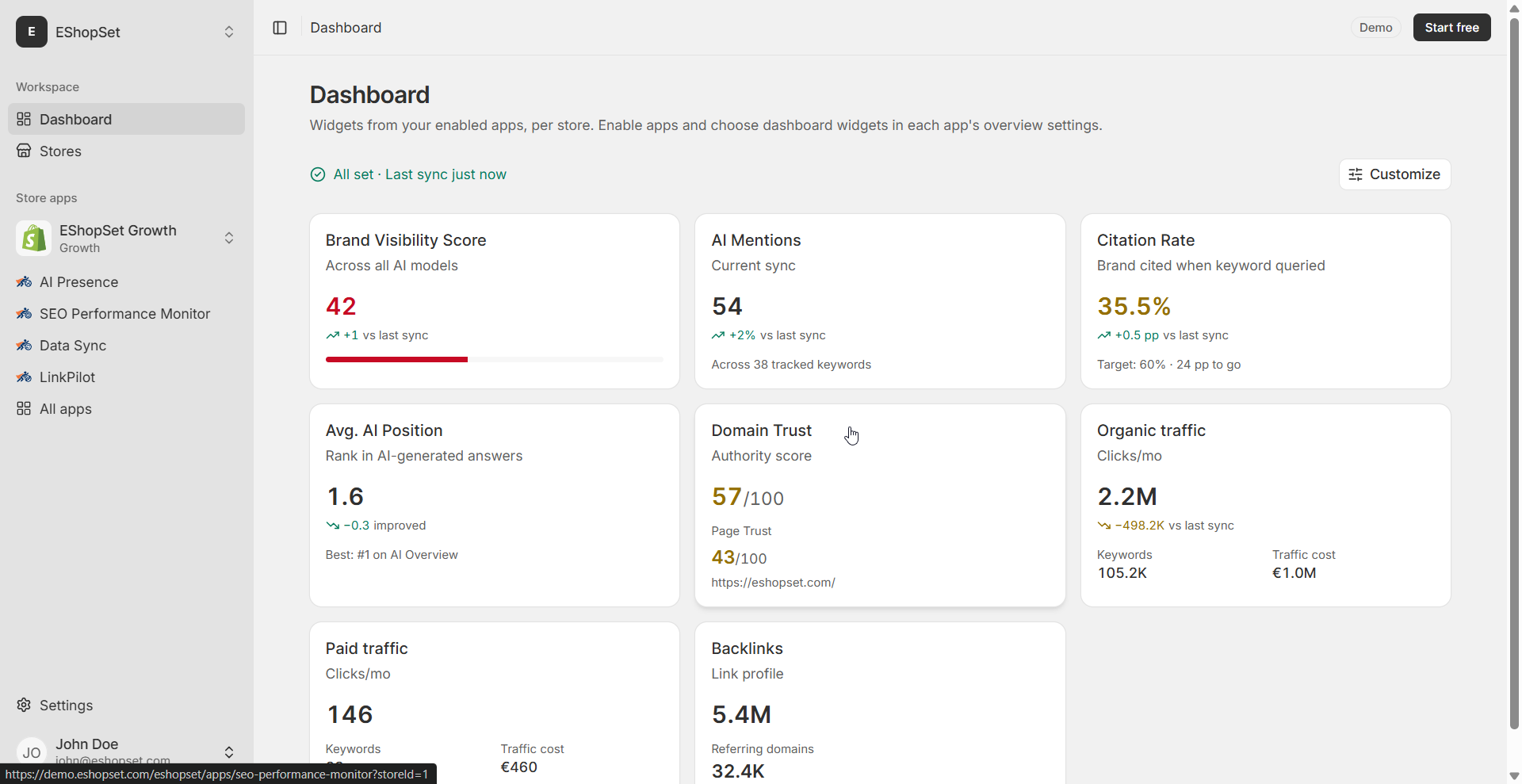
At EShopSet, we understand the daily operational challenges of Shopify merchants. Our bundle of EShopSet Shopify apps is designed to streamline your operations and maximize your online presence, especially when it comes to optimizing your category structure.
1. Identify Demand with SEO Performance Monitor
Before you create a new category page, you need to validate its potential. EShopSet's SEO Performance Monitor helps you analyze search trends and keyword demand. It allows you to:
- Discover long-tail keywords relevant to your products.
- Monitor competitor rankings for specific category-related terms.
- Track the performance of your existing and newly created category pages, ensuring they are ranking for their intended keywords and driving traffic.
This data-driven approach ensures that every new category page you create is based on genuine customer interest, avoiding the creation of "thin" content that offers little value.
2. Future-Proof for AI Discovery with AI Presence
The future of search is increasingly AI-driven. In an AI-powered shopping landscape, well-defined, intent-driven categories provide richer context for AI systems, including EShopSet's AI Presence. When your categories are structured logically and reflect customer intent, AI can:
- More accurately understand your product catalog.
- Surface relevant items in AI-powered search results and recommendations.
- Enhance the overall customer experience by guiding them to exactly what they need, even if their query is complex or conversational.
Strategic categorization helps your store stand out in an evolving digital marketplace.
3. Streamline Product Management with Sheet2Cart
Managing a more granular category structure often means more detailed product attributes and frequent updates. EShopSet's Sheet2Cart simplifies the bulk import and update of product data. Whether you're adding new products, updating inventory, or refining product tags and types to fit new categories, Sheet2Cart ensures that:
- Your products are accurately tagged and categorized.
- Populating new, intent-driven collections becomes effortless.
- Data consistency is maintained across your entire catalog, which is crucial for effective categorization and search engine understanding.
Actionable Steps for Shopify Merchants
Ready to transform your Shopify category pages?
- Conduct Thorough Keyword Research: Think like your customer. Use tools, including EShopSet's SEO Performance Monitor, to uncover specific search queries related to your products. Look for combinations of product type, features, use cases, and demographics.
- Map Customer Intent: Based on your research, identify meaningful search demands that your existing broad categories don't adequately address.
- Create Targeted Collections: Leverage Shopify's collection features to build new, specific category pages. Ensure each page has a clear purpose, relevant products, and unique, optimized content (title, meta description, introductory text).
- Optimize Product Data: Ensure your product descriptions, tags, and types are rich and consistent. Use Sheet2Cart to efficiently manage and update this data in bulk, ensuring products are correctly associated with their new, specific categories.
- Monitor and Refine: Launch your new categories and continuously monitor their performance using SEO Performance Monitor. Track traffic, rankings, and conversion rates. Be prepared to refine and adapt your strategy based on real-world data.
- Enhance AI Discoverability: By creating well-structured, keyword-rich categories, you're also feeding better information to AI systems, boosting your store's discoverability through tools like AI Presence.
Conclusion
Your category pages are far more than just organizational tools; they are powerful SEO assets and critical pathways for customer discovery. By shifting from broad, generic categories to intent-driven collections, you not only improve your store's visibility in traditional search engines but also future-proof your presence in an increasingly AI-centric shopping world. With the right strategy and the powerful EShopSet Shopify apps, you can unlock significant growth for your online store. Start optimizing your category pages today and watch your sales soar!