AI Shoppers vs. Real Customers: Navigating Shopify Theme Changes for Genuine Conversion Growth
Hey fellow Shopify merchants and store operators! The world of ecommerce is buzzing with AI innovations, and rightfully so. From automating customer service to generating product descriptions, AI promises to revolutionize how we run our online stores. A recent discussion in a popular ecommerce community really caught our eye, revolving around Shopify's new Sidekick feature, which uses AI-simulated shoppers to 'test' theme changes. The big question on everyone's mind: would you actually ship a theme change based on AI shoppers alone?
The Spark: Shopify's AI Sidekick and Simulated Shoppers
The original poster kicked off the conversation by explaining Shopify's new Sidekick feature. It drafts storefront changes and then puts them through their paces with AI-simulated shoppers. The goal? To identify changes expected to boost those crucial 'add-to-cart' numbers. Shopify explicitly states these aren't real A/B tests or real shoppers; you still review everything before it goes live.
The system, powered by something called SimGym, gives these simulated shoppers specific goals, from walking the entire purchase journey to looking for a particular product. It even flags where they get stuck, offering playback videos with markers. Sounds pretty futuristic, right?
But the original poster, drawing from their own extensive experience running hundreds of A/B tests with real traffic, raised some valid concerns. They pointed out how easy it is to misread real A/B test results, even with careful segmentation. Factors like traffic source (Google Search vs. Meta Ads) and the precise timing of a popup can drastically alter outcomes in ways a 'clean' simulation might miss. Their hypothesis: AI shoppers might be great at spotting obvious friction (like a broken button), but less so at understanding human reaction to a discount or a popup's timing. This set the stage for a lively discussion!
The Community's Verdict: Skepticism Meets Reality
The community's response was, shall we say, a healthy dose of skepticism. Many respondents echoed the original poster's sentiment, highlighting the vast difference between simulated behavior and the unpredictable nature of real human shoppers.
The Unpredictable Human Element
One community member articulated it perfectly, stating they don't trust simulated shoppers to catch the 'weird stuff real people do' – the hesitation, the tab hoarding, the phone call distraction, or the 'I'll buy this later' energy that often evaporates in seconds. A clean, simulated journey simply can't account for a real person's mood, external distractions, or the subtle psychological triggers that influence a purchase decision. AI shoppers don't care about shipping costs, return policies, or whether they trust your brand; real ones absolutely do.
AI Insights vs. Real-World Results
Another contributor shared a powerful anecdote: after investing significant effort in Conversion Rate Optimization (CRO) work that led to immediate, measurable improvements in real conversion rates, the AI feature surprisingly suggested that their older site was better for conversion. This direct contradiction between AI recommendations and actual, proven results underscores the limitations of simulation. Several other community members simply labeled the feature as 'terrible,' 'AI slop,' or 'nothing special,' reinforcing the general sentiment that while it might be 'free to try,' its practical value for critical decisions is questionable.
Where AI Shines (and Where It Doesn't) in Store Optimization
Based on the community's insights, it's clear that AI-driven simulations have a place, but it's not at the final decision-making table for critical theme changes. AI excels at identifying purely technical friction points:
- Broken buttons: A simulated shopper can easily detect a non-functional call-to-action.
- Confusing variant pickers: If a product option isn't selectable, AI can flag it.
- Missing information: A product page lacking crucial details for a purchase can be highlighted.
- Obvious navigation issues: Getting stuck in a loop or hitting a dead end.
However, AI struggles with the nuanced, human-centric aspects of online shopping:
- Emotional response: How a discount makes a shopper feel, or the irritation caused by a popup appearing 'half a second too soon.'
- Trust and brand perception: Factors like social proof, customer reviews, or a store's overall credibility.
- External factors: Shipping costs, delivery times, or competitive pricing that influence a real purchase decision.
- Intent and context: The varying motivations of visitors from different traffic sources (e.g., Google Search vs. social media ads).
Think of AI as a powerful diagnostic tool, an assistant that can point out potential technical flaws, but not a replacement for the complex art and science of understanding human behavior and real-world market dynamics.
Beyond Simulation: A Holistic Approach to Shopify Store Success
So, if AI simulations aren't the sole answer, what is? A truly successful Shopify store relies on a holistic strategy that combines AI's diagnostic capabilities with real data, human intuition, and robust tools designed for actual merchant operations. At EShopSet, we believe in empowering merchants with the insights and functionality needed to thrive in the real world.
Leveraging Real Data for True SEO Performance
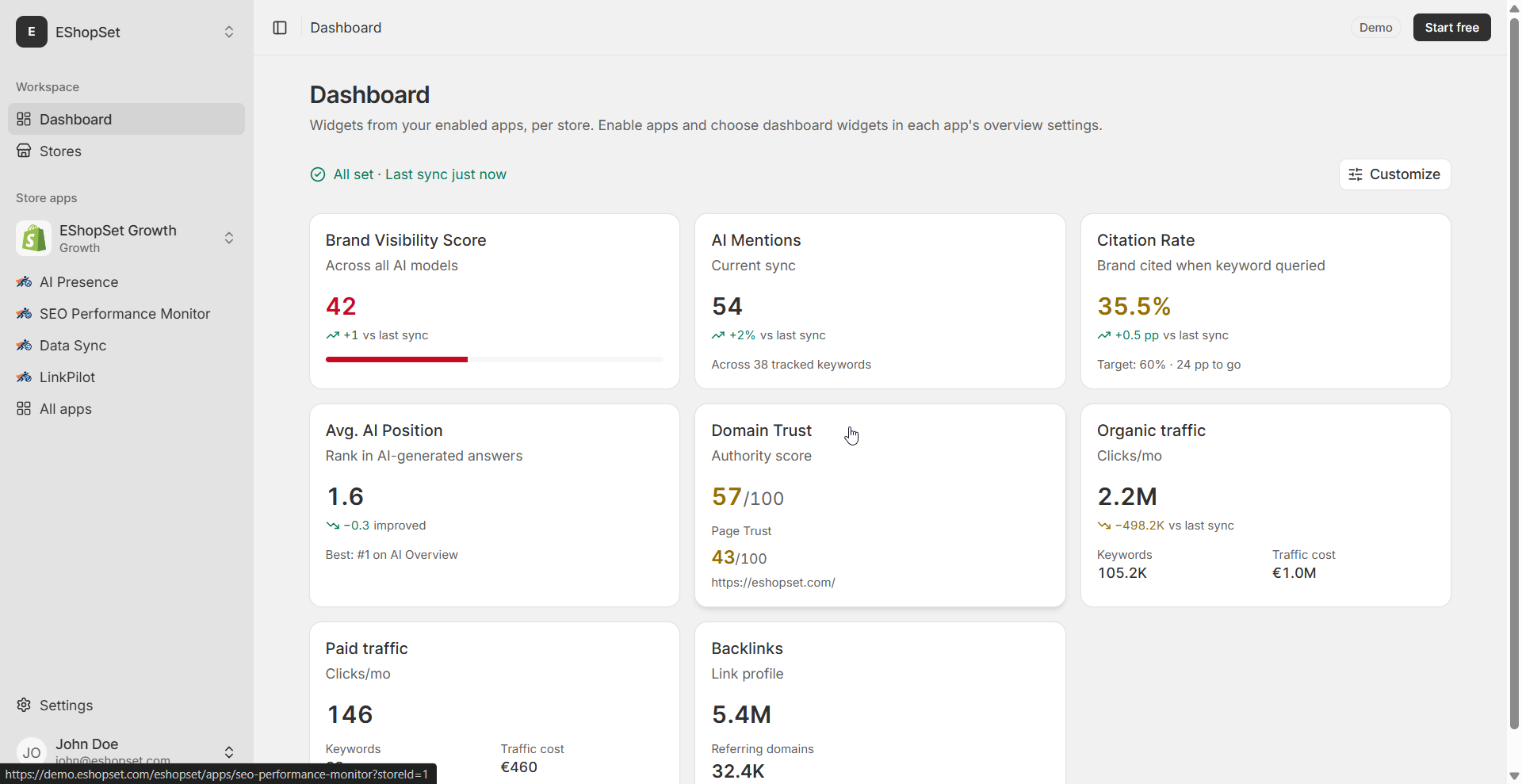
The original poster highlighted how different traffic sources yield different results. Understanding your real audience and how they find you is paramount. This is where tools like EShopSet's SEO Performance Monitor come into play. It helps you track your store's organic visibility, identify crucial keywords, and spot issues that impact your search engine rankings. For instance, it can help you uncover common problems like Shopify underlinked pages – pages that exist but aren't adequately linked internally, making them harder for search engines (and real shoppers) to discover. While AI might simulate a journey, only real SEO monitoring can show you how actual customers are interacting with your content and how well your store is performing in the competitive search landscape.
Crafting Compelling Content with AI, Validated by Humans
AI is an incredible tool for content generation. EShopSet's AI Presence app empowers you to quickly generate engaging product descriptions, marketing copy, and blog posts, saving you countless hours. However, as the community discussion shows, even the best AI-generated content needs human oversight and real-world validation. Use AI to draft, but always review, refine, and test its impact on your actual audience. Does the copy resonate? Does it build trust? These are questions only real customer engagement can answer.
The Foundation of Trust: Accurate Data Sync
Real shoppers expect accurate information. If your product listings are outdated, inventory counts are wrong, or pricing is inconsistent, trust erodes quickly. AI shoppers won't bat an eye at these discrepancies, but real customers will abandon their carts. EShopSet's Data Sync app ensures your product catalog, inventory, and pricing are always up-to-date across your Shopify store. This foundational accuracy is critical for building customer confidence and ensuring that any theme changes or marketing efforts are built upon reliable data.
The EShopSet Philosophy: Empowering Merchants with Real Insights
The takeaway from the community discussion is clear: AI is a powerful assistant, but it's not a magic bullet. For true conversion rate optimization and sustainable growth, you need to combine the diagnostic power of AI with real-world data, human intuition, and a suite of robust tools designed to manage your daily operations effectively. EShopSet's bundle of Shopify apps provides exactly this framework – helping you monitor SEO performance, generate compelling AI-driven content, and maintain impeccable data integrity, all crucial elements that simulated shoppers simply cannot fully evaluate.
Conclusion: Your Store, Your Strategy
While AI-simulated shoppers offer an intriguing glimpse into potential friction points, they are no substitute for the unpredictable, complex, and ultimately human reality of ecommerce. As a Shopify merchant or store operator, your best strategy involves leveraging AI for ideation and diagnostics, but always validating with real A/B tests, actual customer feedback, and comprehensive analytics. Empower your store with the tools that provide real insights and drive genuine growth. Explore the EShopSet app bundle today and take a holistic approach to optimizing your Shopify store's performance. Visit eshopset.com/apps to learn more.