Why Your Shopify Blog Posts Vanish from Search Results (and How to Fix It)
Ever poured your heart into a new Shopify blog post, seen it rank beautifully for a few days, only for it to completely disappear from search results? It's a frustrating experience many merchants face, and it's a topic that recently sparked a lively discussion in an online community we follow. Let's dive into why this might be happening and what you can do to keep your valuable content visible.
The original poster in the discussion described a classic case: new blog posts getting indexed and ranking well for about 4-5 days, then vanishing. The peculiar part? A site search (`site:yourdomain.com`) would still show the post, but with "Archive" in the title and a different URL, often an 'archive' or 'tag' URL instead of the original post URL. This subtle but critical detail hints at deeper indexing or canonicalization issues.
Understanding the "Google Testing" Phase
One community member offered a really insightful perspective: this pattern isn't necessarily a penalty, but rather Google "testing" your new content. New pages often get an initial burst of impressions and rankings as Google collects click data. If the engagement signals aren't strong enough, or if the content isn't deemed authoritative enough for the queries it briefly ranked for, it might settle lower or, in more severe cases, disappear if it's genuinely thinner than competing content.
Think of it like a trial period. Google wants to see how users interact with your content. If it doesn't deliver the right kind of engagement – users bouncing quickly, not clicking through, or finding better answers elsewhere – your page's temporary ranking position won't stick.
The Authority and Content Quality Connection
Another respondent echoed this, emphasizing that it's not a Google bug but "by design." The core issues often boil down to a lack of authority for the site or the specific content, combined with competing in a very competitive niche. If your site doesn't have enough established authority, Google will be hesitant to give your new content lasting top rankings, especially if there are more authoritative sources available.
This means you need to ask yourself:
- Is my content truly high-quality, comprehensive, and unique?
- Am I genuinely solving a user's problem or providing deep insight?
- Does my Shopify store have enough overall domain authority and trust signals?
Building authority takes time and consistent effort, through quality content, strong internal linking, and earning backlinks from reputable sources. Leveraging social networks and other platforms to gain initial traction and build brand presence, as one expert suggested, can also contribute to overall authority.
The Dreaded 'Archive' URL: A Technical SEO Red Flag
The detail about the content showing up under an "Archive" or "tag" URL (e.g., abc.com/blog/tag/x-y-z instead of abc.com/blog/x-y-z) is a major clue. This points directly to potential technical SEO issues, specifically canonicalization or duplicate content problems.
Here's what might be happening:
-
Duplicate Content: Your blog posts might be appearing on both their original URL and under tag or category archive pages. If Google sees multiple versions of the same (or very similar) content, it gets confused about which one to rank, often picking the one it deems most authoritative or even de-prioritizing all of them.
-
Incorrect Canonical Tags: Canonical tags (
) tell search engines which version of a page is the "master" version. If your Shopify theme or an app is incorrectly setting the canonical tag on your original blog post to point to an archive page, or if archive pages are canonicalizing to themselves when they shouldn't be indexed, it can divert ranking signals away from your primary content. -
Indexing Issues: It's possible that your tag/archive pages are being indexed when they shouldn't be, or that Google is simply preferring them over your actual blog post URLs for some reason.
Actionable Steps for Shopify Merchants
If your Shopify blog posts are suffering from this "now you see them, now you don't" phenomenon, here's your action plan:
-
Inspect URLs in Google Search Console (GSC): For a vanishing blog post, use the URL Inspection tool in GSC. This will tell you Google's view of the page, its indexing status, and importantly, the canonical URL Google selected. If it's picking the 'tag' URL over your original post, you've found a key problem.
-
Review Shopify Blog Settings: Check your Shopify theme settings and any SEO apps you use for how blog tags and categories are handled. Ensure that individual blog posts are properly canonicalized to themselves and that tag/category pages are either set to
noindex(if they offer little unique value) or correctly canonicalized to a primary version if they are designed to rank. -
Audit Content Quality and Depth: Be brutally honest. Is your content genuinely better than what's already ranking? Can you add more detail, unique insights, visuals, or examples? Aim for comprehensive, authoritative content that satisfies user intent.
-
Monitor Your Rankings Consistently: Don't wait for posts to disappear entirely. Implement a system for a daily Shopify SEO report. Keep an eye on impressions, average position, and clicks for your key content. Early detection of drops allows for quicker intervention.
-
Build Domain Authority: This is a long-term play. Focus on earning high-quality backlinks, fostering internal links between relevant blog posts and product pages, and building your brand's presence across various platforms.
EShopSet Team Comment
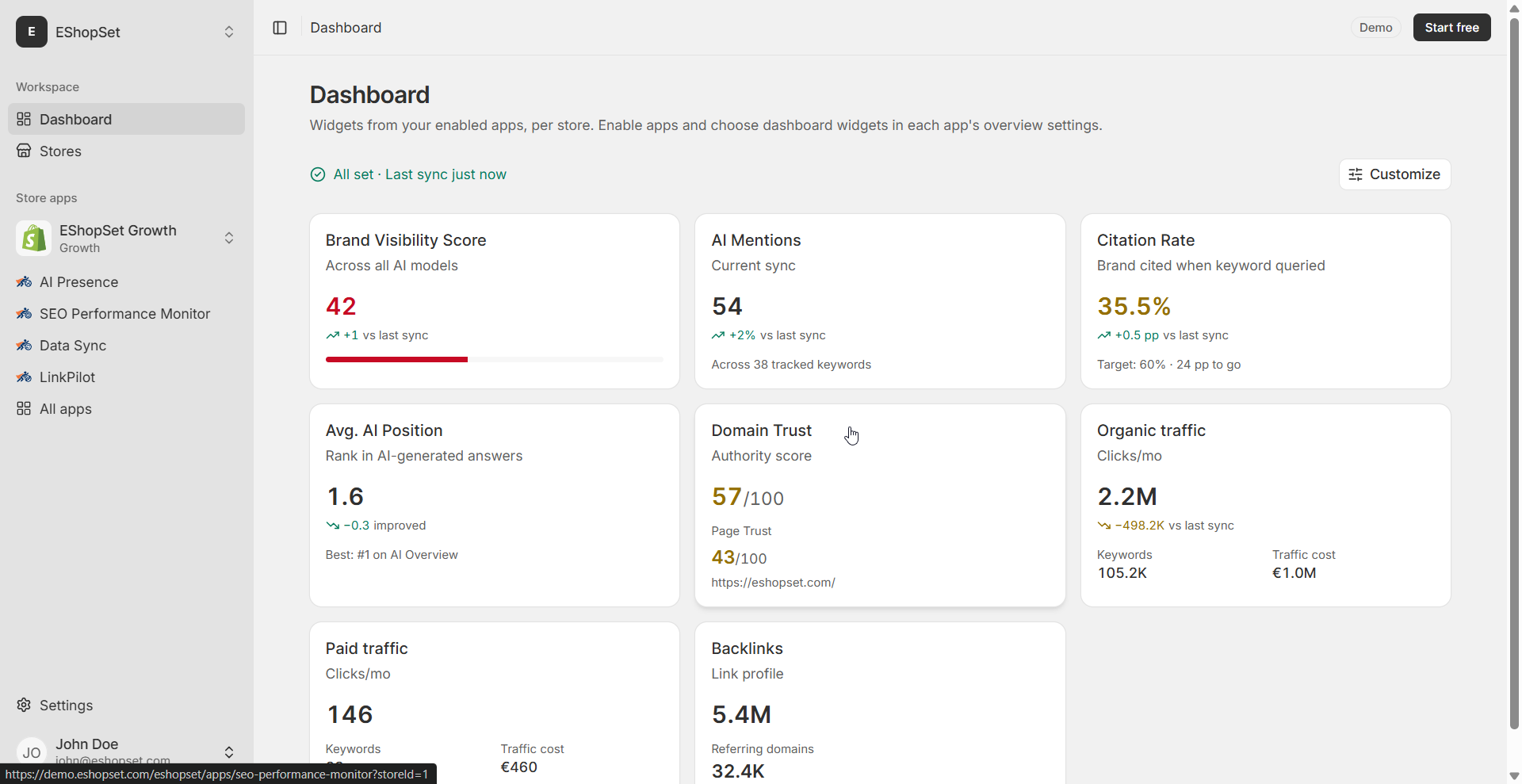
We agree wholeheartedly with the community insights: effective SEO for Shopify stores hinges on both technical correctness and high-quality, engaging content. EShopSet's SEO Performance Monitor is specifically designed to provide that crucial daily Shopify SEO report, alerting you to sudden ranking drops or indexing changes that indicate problems like those described. For crafting the authoritative content needed to build lasting presence and engagement, our AI Presence app can be a game-changer, helping you generate and optimize compelling copy that Google will reward.
In essence, the disappearing act of your blog posts is a call to action. It's a signal from Google that either your content isn't meeting expectations for user engagement and authority, or there's a technical hiccup confusing search engines. By addressing both your content strategy and technical SEO, you can ensure your hard work gets the lasting visibility it deserves, turning those fleeting rankings into consistent traffic for your Shopify store.