Shopify SEO & AI: Expert Takes on Meta Descriptions, Technical SEO, and LLM Reliability
Hey fellow Shopify store owners and operators! We've all been buzzing about AI lately, right? It feels like every other day there's a new tool or technique promising to revolutionize how we do business. Recently, I stumbled upon a really interesting community discussion that perfectly captures the mixed feelings and practical applications of AI in the SEO world. The original poster simply asked, "Do you use any AI skills to help you with SEO?" The responses were a fascinating blend of enthusiasm, caution, and outright skepticism.
AI's Strengths: Content & Ideation
One community member quickly jumped in with a "yes," and when pressed for details, shared some truly valuable insights. They primarily leverage AI to "generate numerous variations of meta titles and meta descriptions." This is a fantastic use case for Shopify merchants! Think about it: instead of wracking your brain for catchy, keyword-rich snippets for hundreds of product pages or blog posts, AI can give you a strong starting point. You can then "pick which ones you like and which would be the most accurate." This member also mentioned using AI for "spelling and grammar checks for new blog posts," saving valuable time and ensuring polished content before publishing. This is exactly where AI shines – as a creative assistant and a meticulous editor, helping you scale your content efforts.
The Technical SEO Tightrope: Where AI Falls Short
However, the conversation took a turn when another respondent highlighted AI's limitations, particularly in technical SEO. This expert noted that "AI not really helping me in tech seo, everything tech seo is well within simple bot automations." They recounted frustrating experiences where AI-generated reports made suggestions that were "very hit and miss." For example, AI would often flag "no schema on a page" when the schema was rendered dynamically, or claim the "website is slow" based solely on general PageSpeed metrics without understanding specific hosting or server configurations. It would even report "search engines are blocked" or "got rate limited with a 429" due to hosting provider policies designed to block spoofing, not legitimate crawlers. This is a critical point for Shopify merchants: while AI can suggest changes, it often lacks the nuanced understanding of your store's specific technical setup, dynamic content, and server responses. Relying solely on these generic AI reports can lead to wasted time or even incorrect optimizations.
The LLM Reliability Question
Adding another layer of complexity, a different community member urged caution, advising people to "avoid LLMs" due to concerns about them being "poisoned from ideological positions and badly tested ideas in Google's content." This brings up an important discussion around the reliability and bias of the data large language models (LLMs) are trained on. For Shopify merchants, this means being extra vigilant about the information AI provides, especially when it comes to strategic advice or factual content. Understanding the concept of a "Shopify LLM citation rate" – essentially, how accurately an LLM cites or references its information – becomes crucial. We need to critically evaluate AI output, cross-referencing against our own expertise and reliable sources to ensure we're not inadvertently implementing biased or outdated recommendations.
Striking the Right Balance for Your Shopify Store
So, where does this leave us, the busy Shopify store owners? It's clear that AI is not a magic bullet, but it's far from useless. The key is to leverage its strengths while being acutely aware of its weaknesses.
- Content Creation & Optimization: Use AI tools to brainstorm meta titles and descriptions, draft product descriptions, generate blog post ideas, and proofread content. This can significantly speed up your content pipeline.
- Initial Keyword Research: AI can help generate long-tail keyword ideas, but always validate them with dedicated SEO tools and real search data.
- Technical SEO Oversight: For complex technical SEO issues like schema markup, site speed, or crawlability, treat AI suggestions as starting points, not definitive commands. Always consult your analytics, GSC, and potentially a human technical SEO expert.
- Data Management: While AI helps with content, efficiently managing your product data is foundational. Tools that allow you to Shopify import products from Google Sheets or Shopify match products by handle from Sheets can ensure your catalog is always accurate and ready for any SEO-driven content generation.
The bottom line is that AI is a powerful co-pilot, not an autopilot. It can handle repetitive tasks and generate creative variations, freeing you up to focus on the strategic decisions that truly move the needle for your Shopify store.
EShopSet Team Comment
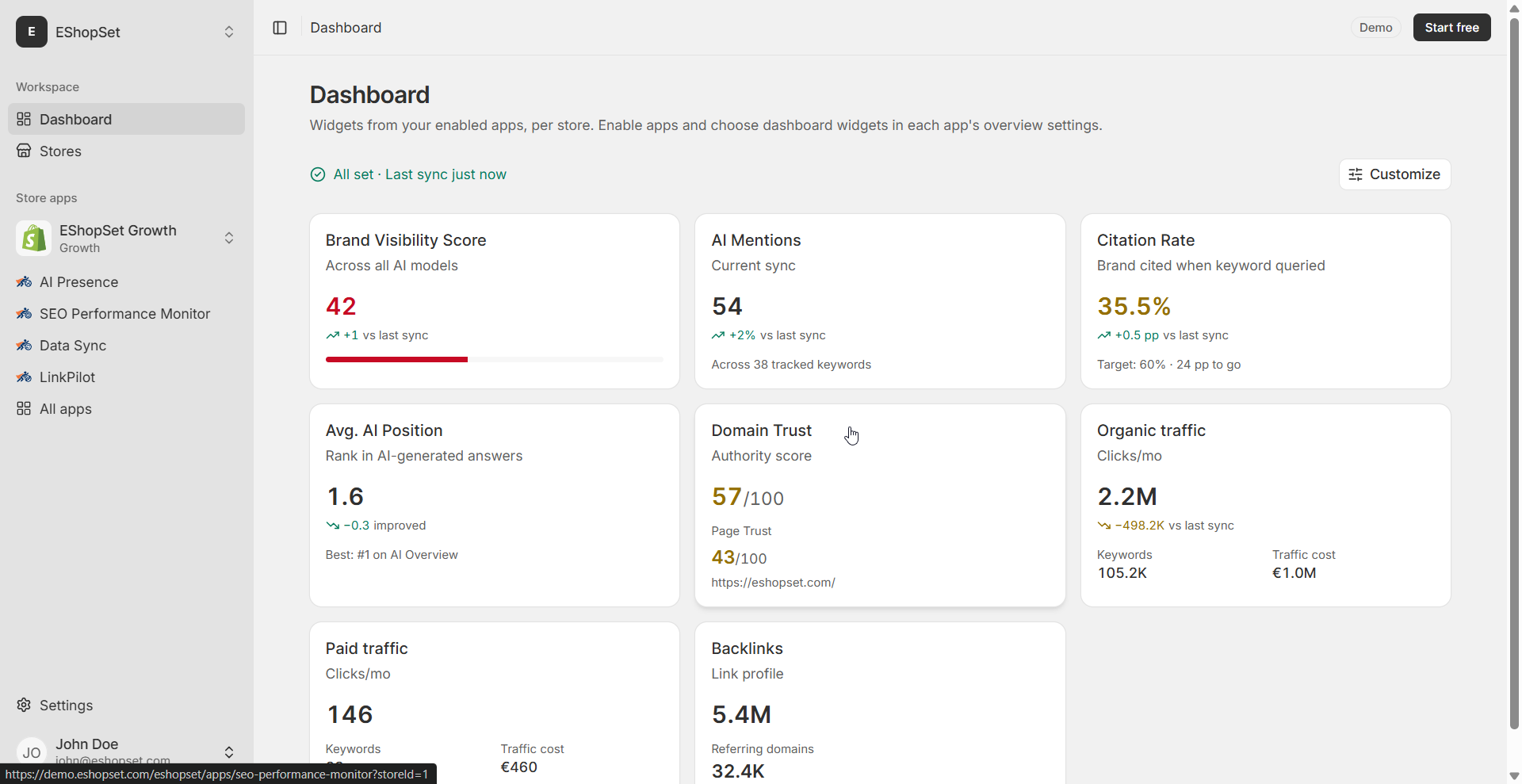
We at EShopSet completely resonate with this community discussion. AI is a game-changer for many merchant operations, but it demands smart application. For content generation and ideation, our AI Presence app is built to help you craft compelling product descriptions and meta tags efficiently, working hand-in-hand with your oversight. However, for deep technical SEO insights and real performance monitoring, AI alone isn't enough; that's precisely why SEO Performance Monitor delivers accurate, real-time data specific to your Shopify store, bypassing the generic, often misleading, AI reports. And for managing the backbone of your store, your product catalog, Sheet2Cart ensures seamless product updates and imports, giving your AI-generated content accurate data to work with.
Ultimately, the goal for any Shopify merchant is to drive traffic and sales. AI offers incredible potential to streamline and enhance your SEO efforts, but it requires a discerning eye and a strategic approach. By understanding its capabilities and limitations, you can make AI a valuable ally in your daily operations, ensuring your store stands out in the crowded ecommerce landscape.