Shopify Multi-Country SEO: Fixing Google's Canonical Confusion After a Relaunch
Hey Shopify merchants and store operators!
Ever found yourself scratching your head, staring at Google Search Console reports, wondering why Google isn't playing nice with your perfectly set up canonical tags? It's a frustrating situation, especially when you're running a multi-country store. I recently stumbled upon a community discussion that perfectly encapsulates this headache, and the insights shared are golden for anyone dealing with complex international SEO.
When Google Plays Hard to Get with Your Canonical Tags
The original poster shared a classic yet perplexing scenario. After migrating their e-commerce platform, their multi-country setup – using dedicated domains like .com, .at (Austria), and .ch (Switzerland) – started experiencing a severe issue. Google Search Console reported thousands of URLs on their Austrian domain (.at) as "Duplicate, Google chose different canonical than user", inexplicably pointing them to the corresponding Swiss URLs (.ch). The result? Significant de-indexing of their Austrian domain and a painful drop in Shopify organic traffic monitor insights for that market.
This wasn't just a minor glitch. They had a robust setup:
- Technical Foundations: Each page had a self-referencing
. They implemented reciprocalhreflangtags (de-DE,de-AT,de-CH) on category and product pages, correcthtml langattributes, and dedicated XML sitemaps per domain. Internal linking was strict, keeping each domain's links within its own boundaries. Even structured data (Organization/WebSite) reflected local company entities. - Content & Metadata: They localized H1s, Title Tags, and Meta Descriptions, explicitly including country names. They even tested distinct category texts and removed some on the
.atdomain to force content variation.
What truly baffled them was Google ignoring distinct currency signals (EUR for .at vs. CHF for .ch). Prices and currency symbols were clearly different in the rendered HTML. Interestingly, other search engines like Bing had no trouble indexing and separating the domains correctly.
Community Weighs In: Unraveling the Mystery
The community quickly jumped in with some astute observations and advice. One respondent immediately honed in on the currency difference, noting that once Google sets a canonical to .ch, it might inherit transactional code, especially if present in Schema markup. This hinted at a deeper signal confusion.
Another insightful community member suggested a crucial diagnostic step: stop making superficial content changes for a moment. Instead, focus on isolating the "canonical cluster" Google is actually building. Their advice was to take 10 affected .at URLs and meticulously compare their full rendered signals against their .ch equivalents. This means checking everything: canonical tags, hreflang return links, redirects, internal links, and any alternate URLs exposed by the new platform. The goal is to see if the problem concentrates in one template or page type.
They emphasized that while currency is a localization signal, it might not be strong enough to keep two "near-identical regional pages in separate canonical clusters." Since the issue started with the relaunch, the expert suggested looking for "one consistent cross-domain signal introduced by the migration" rather than just adding more unique copy.
A third contributor reinforced the need for a perfectly reciprocal hreflang cluster. They noted that if Google keeps choosing a different canonical, it often perceives the pages as too similar despite the tags. This is a critical point: hreflang is a signal, but content similarity can sometimes override it in Google's eyes.
Actionable Takeaways for Your Shopify Store
So, what can Shopify merchants learn from this discussion when facing similar challenges with Shopify paid vs organic traffic and canonicalization?
- Audit Your Rendered HTML & Signals: Don't just trust your code. Use Google Search Console's URL Inspection tool to see how Google renders your pages. Look for subtle differences or unexpected signals that might be pointing to the wrong domain. This includes canonicals,
hreflang, redirects, and internal links. - Scrutinize Post-Migration Changes: A platform relaunch is a common trigger for these issues. Dig deep into any new modules, plugins, or default settings introduced by the migration. Could there be hidden cross-domain links, misconfigured alternate URLs, or an overarching setting causing the confusion?
- Perfect Your Hreflang Implementation: Ensure every
hreflangtag has a corresponding return link on the target page. Even a tiny break in reciprocity can confuse Google. Think of it as a two-way street; if one side is blocked, the traffic flow breaks down. - Review Structured Data for Localization: The original poster mentioned an initial error with
Organizationstructured data. Even after fixing, persistent signals could linger. Ensure yourOrganizationandWebSiteschema accurately reflect the local entity and country for each domain. Check for currency in your product schema. - Content Uniqueness Beyond Currency: While currency is a strong signal, if product descriptions, images, and other core content are too similar across regions, Google might still consolidate. Consider adding more distinct localized content where feasible, beyond just simple text tweaks.
- Monitor Relentlessly: SEO issues, especially canonical ones, take time to resolve. You need a robust way to track changes in indexing, rankings, and traffic.
EShopSet Team Comment
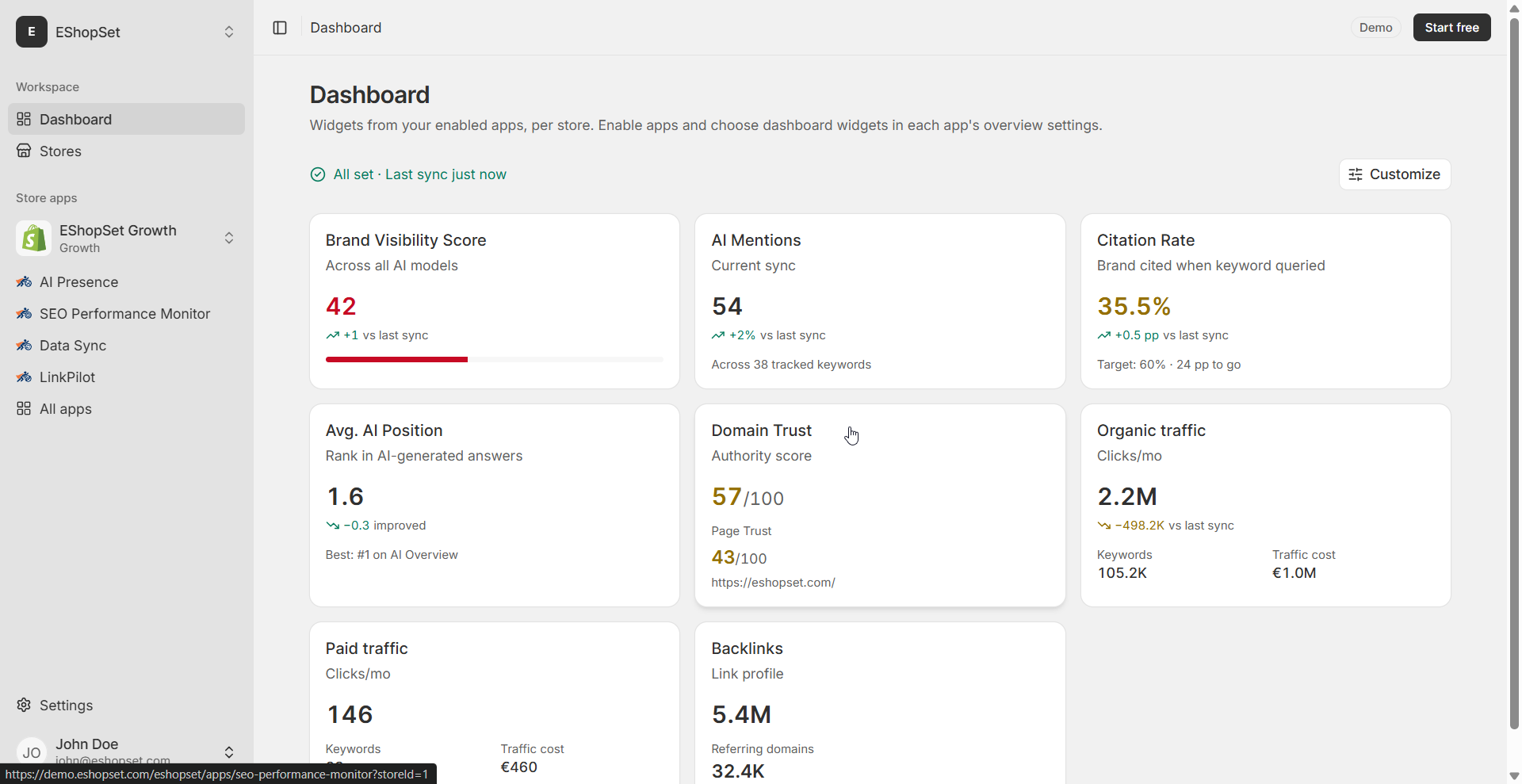
This discussion perfectly highlights the complex dance between what you tell Google and what it perceives. We agree with the community's emphasis on deep technical audits of rendered signals and perfect hreflang reciprocity. For Shopify merchants, our SEO Performance Monitor is crucial here, providing insights into indexing status, traffic drops, and canonical issues, helping you track Google's perception over time. Additionally, AI Presence can assist in generating truly unique and localized content variations, while Sheet2Cart ensures consistent and accurate product data, including prices and structured data, across all your international storefronts.
Tackling canonical issues, especially after a major platform change, requires patience and a systematic approach. It’s not always about throwing more content at the problem, but about understanding the subtle signals Google is picking up. By diligently auditing your technical setup and continuously monitoring your performance, you can guide Google back to the correct indexing path and recover that valuable organic traffic. Keep digging, keep testing, and don't give up!