Seamless Shopify Domain Change: Your Essential SEO Survival Guide
Hey there, fellow Shopify merchants and store operators! We recently saw a fantastic discussion pop up in a community forum about a pretty nerve-wracking topic: changing your website domain. The original poster was looking for advice on navigating this significant shift, and it sparked a really insightful conversation that's packed with practical tips for anyone considering a domain move for their Shopify store.
Let's be honest, changing your domain feels like moving house for your entire online presence. It's exciting, but also fraught with potential pitfalls, especially when it comes to SEO. The good news is, with a careful plan and the right tools, you can minimize the impact and even come out stronger.
Why a Domain Change is an SEO Minefield (and How to Navigate It)
When you change your domain, you're essentially telling search engines that your entire website has moved. Without proper guidance, they'll see your new domain as a completely new site, losing all the authority, rankings, and backlinks you've worked so hard to build. Community members universally agreed that the biggest danger lies in losing your established search engine visibility.
The Unsung Hero: 301 Redirects
If there was one piece of advice echoed louder than any other, it was the absolute necessity of implementing 301 redirects. As one respondent emphatically put it, "301s are your lifeblood during a domain change."
- What they are: A 301 redirect is a permanent redirect from one URL to another. It tells search engines (and users) that a page has permanently moved to a new location. Crucially, it passes most of the 'link equity' (SEO value) from the old URL to the new one.
- How to implement on Shopify: Shopify makes this relatively straightforward. You'll want to map every old URL to its corresponding new URL. Go to your Shopify admin, navigate to Online Store > Navigation > URL Redirects. You can add them one by one or import them in bulk if you have many. Don't just redirect your old domain's homepage to your new domain's homepage; make sure every product page, collection page, blog post, and static page has a direct redirect. This is non-negotiable!
Telling Google: Your Google Search Console Checklist
After setting up your 301s, your next critical step is to inform Google directly. Several community members highlighted these steps:
- Add New Property: Add your new domain as a new property in Google Search Console (GSC).
- Submit New Sitemap: Once the new property is verified, submit your updated sitemap for the new domain. This helps Google discover all your new URLs quickly.
- Use the Change of Address Tool: This is a crucial feature within GSC. From your old domain's property in GSC, use the "Change of Address" tool (Settings > Change of Address) to officially notify Google of your move. This sends a strong signal to Google to transfer ranking signals from the old domain to the new one.
Beyond the Basics: Internal Links and Backlinks
While 301s and GSC are foundational, the discussion also touched on other vital areas:
- Update Internal Links: After your domain switch, ensure all internal links within your Shopify store (e.g., in blog posts, product descriptions, navigation menus) point to the new domain's URLs. This helps search engines crawl your new site efficiently and prevents internal redirect chains.
- Monitor Backlinks: This is a big one. While 301s pass link equity, it's still ideal to get actual referring domains to update their links to your new domain. A community member suggested using a Shopify referring domains tracker to identify your most valuable backlinks and then reaching out to those webmasters to request an update. This can be a manual process but is worth it for high-authority links.
- Expect a Dip (and Plan for Recovery): Almost everyone agreed that a temporary dip in traffic and rankings is common after a domain migration. It takes time for Google to fully process the change and re-evaluate your new site. The key is consistent monitoring and patience.
EShopSet Team Comment
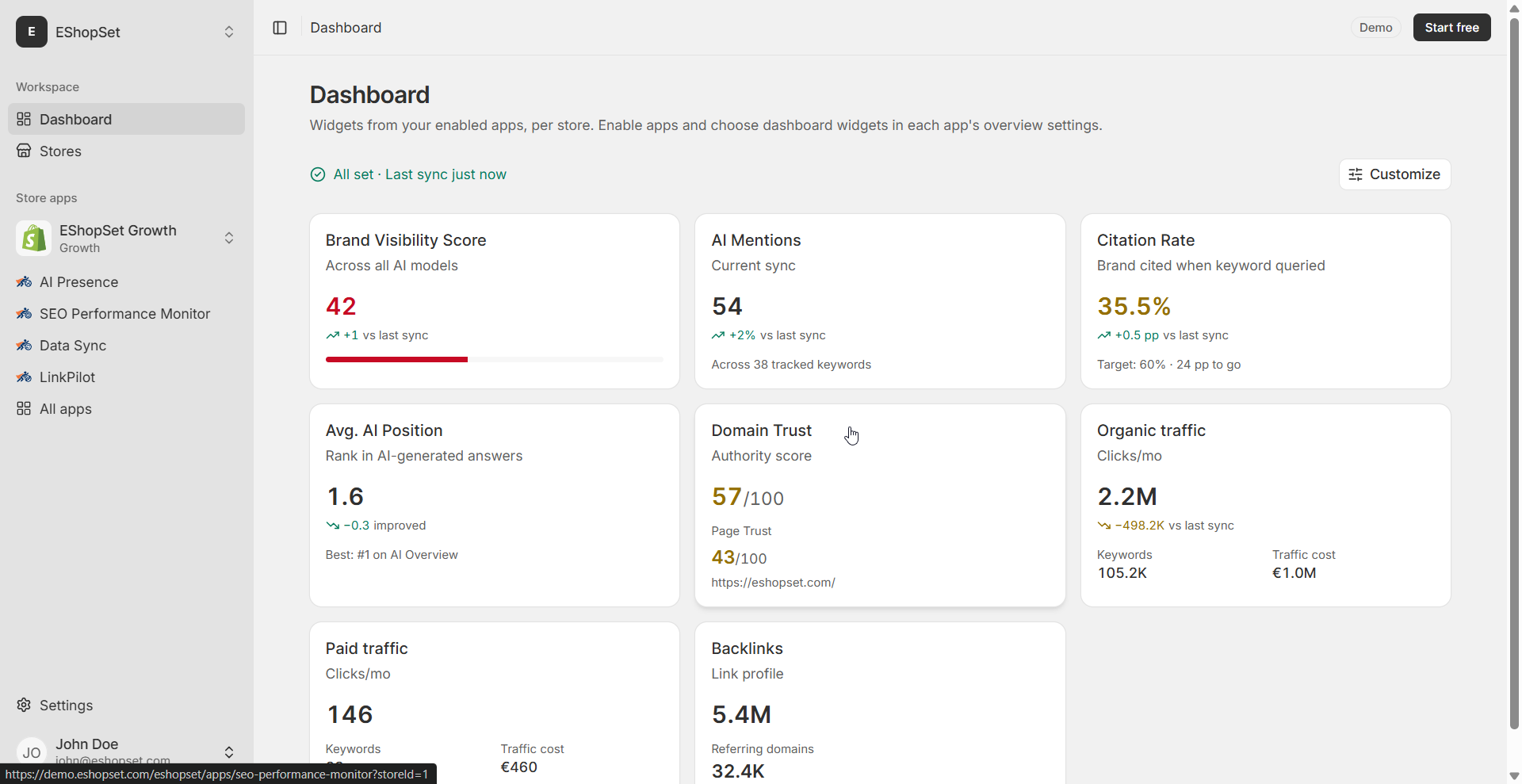
The community's advice on domain changes hits the nail on the head – meticulous planning and robust monitoring are non-negotiable. For Shopify merchants, ensuring a smooth transition means having the right tools at your fingertips. Our SEO Performance Monitor would be invaluable here, helping you track keyword rankings, traffic, and crawl errors post-migration to quickly identify and address any issues. For updating product data or other bulk content if absolute URLs were used, Sheet2Cart could be a lifesaver for quickly updating and syncing your catalog. Finally, AI Presence can ensure your newly migrated site content remains optimized and consistent, helping search engines understand your new domain's value faster.
Final Thoughts: Plan, Execute, Monitor
A domain change for your Shopify store is a significant undertaking, but it doesn't have to be a catastrophe for your SEO. By diligently implementing 301 redirects, communicating clearly with Google via Search Console, updating your internal links, and actively monitoring your performance, you can navigate this challenge successfully. Remember, patience is key, and having a reliable Shopify SEO app for merchants to track your progress will be your best friend during this transition. Good luck with your move!