Decoding Shopify's Shop App: Unpacking 1200% Sales Spikes and Merchant Insights
Is Shopify's Shop App the Next Big Sales Channel? What Merchants Are Saying
Lately, there's been a buzz in the Shopify community about the Shop app, especially concerning its potential to drive sales. We recently saw a discussion where an original poster shared an astounding 1,200% increase in sales value attributed to the Shop app, sparking a lively debate among fellow merchants. This kind of jump naturally raises questions: Is it a fluke, the result of diligent SEO work, or a sign of Shopify's dedicated efforts to enhance product discovery within the app?
Understanding the Shop App: More Than Just Tracking
Many merchants, initially, were like one community member who questioned the Shop app's purpose, wary of anything that felt 'sketchy' at checkout. The original poster clarified that while it started as a tracking app, it has evolved significantly. Now, it's designed to manage more of the customer flow and, crucially, send customers to your store, often for 'free' (organically).
Another respondent elaborated, describing the Shop app as Shopify's own marketplace. It allows all Shopify stores to list their catalog, making products searchable directly within the app. It also handles customer reviews and some automated functions like abandoned cart reminders. The general consensus, as one member put it, is that 'it never hurts to have your listings available on another feed. Especially with zero effort getting them on there.'
Geographic Nuances and Buyer Protection Concerns
However, the experience isn't uniform. A UK-based merchant noted that despite their store being US-registered, they hadn't seen much UK traffic via Shop, suggesting it might be primarily a US-centric phenomenon. This highlights the importance of understanding your target market's engagement with the app.
A significant point of concern raised by another community member revolved around buyer protection. They recounted a negative experience where they were ghosted by a seller and found Shop's customer service unhelpful, stating that Shop offers 'no sort of consumer protection at all' and directs buyers to pursue chargebacks. This is a critical consideration for both buyers and sellers, as a perception of unreliability could deter future engagement.
Digging into the Data: Beyond the Headline Percentage
The initial 1,200% sales increase, while exciting, prompted some excellent advice on data interpretation. As one astute respondent pointed out, going from 2 orders to 26 is technically a 1,200% increase but tells a very different story than 200 to 2,600 orders. They urged a closer look at:
- Raw Numbers: What were the actual orders/revenue before vs. after?
- Customer Origin: Are these genuinely new customers or repeat buyers? The original poster later confirmed their spike was indeed from new customers, indicating a successful new acquisition channel.
- Conversion Rate vs. Traffic: Is the increase primarily from more traffic, or a higher conversion rate on existing traffic? The original poster observed a 200% increase in sales volume (based on traffic) alongside the 1,200% sales value increase, skewed by a couple of large orders.
- Consistency: Is the lift consistent over several weeks, or just a one-off spike?
- Attribution: How much is due to the Shop app versus other efforts like SEO or seasonal demand?
This kind of rigorous data analysis is crucial for any merchant looking to understand their growth drivers and effectively plan for future strategies, especially when considering an EShopSet Growth plan Shopify offers for scaling operations.
Shop App Ads: A Hidden Gem?
Beyond organic discovery, the discussion also touched on Shop app ads. Several merchants shared surprisingly positive experiences:
- One merchant reported a 6x ROAS (Return on Ad Spend) with a cost-per-acquisition (CPA) model where they only pay if someone buys. They found the setup 'dead simple,' though advertising only a subset of their catalog proved challenging.
- Another mentioned receiving free credits and getting one sale, even without spending much budget.
The original poster, who previously relied solely on organic traffic, was intrigued by the simplicity and effectiveness of these ads, considering them for the upcoming holiday season.
The Role of SEO in Shop App Visibility
Crucially, the original poster believed their ongoing SEO work played a significant role in their Shop app success. They noted that 'Shop needs to use something to determine what products deserve to be pushed organically.' This highlights a vital point: optimizing your product listings with relevant keywords, high-quality images, and compelling descriptions doesn't just benefit your main Shopify store; it also enhances your visibility within the Shop app's marketplace. Ensuring your product data is top-notch is key to being discovered, whether through Google or an embedded Shopify Admin apps marketplace like Shop.
EShopSet Team Comment
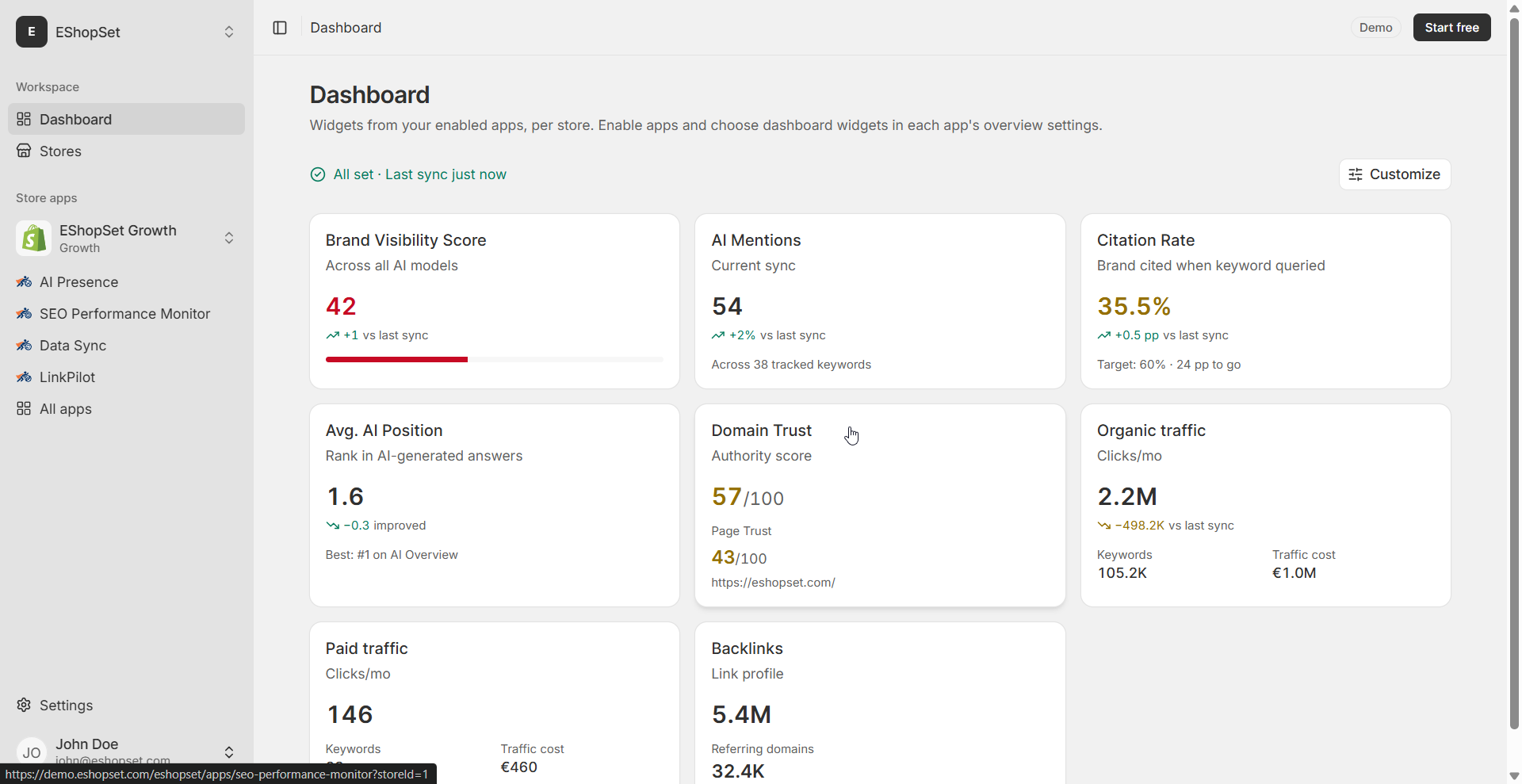
The community discussion around the Shop app is a fantastic example of merchants proactively exploring new growth avenues. We agree that organic visibility, driven by strong SEO, is paramount for success on any platform, including the Shop app. Leveraging tools like our SEO Performance Monitor can directly contribute to improving the signals Shop uses for product discovery. For managing and optimizing your catalog for these diverse channels, Sheet2Cart offers unparalleled efficiency, ensuring your product data is always accurate and compelling. While the Shop app presents both opportunities and challenges, a data-driven approach combined with robust operational tools is the best path forward.
Ultimately, the Shop app, despite its caveats around buyer protection and geographic reach, offers a compelling, low-effort channel for new customer acquisition, especially when paired with solid SEO foundations and potentially cost-effective ad campaigns. For Shopify merchants and store operators, keeping an eye on your analytics, understanding the nuances of new channels, and continuously optimizing your product presence are non-negotiable for sustained growth.