Beyond 'It's Not Working': Streamlining Shopify Support for Seamless Operations
Ever received that dreaded email, "It's not working," and then found yourself trapped in an endless back-and-forth, trying to decipher what's actually going on? If you're running a Shopify store and using various apps, or even if you're providing an app to merchants, you know this pain all too well. It's a universal challenge in the digital world, and it recently sparked a lively discussion in an online community of ecommerce professionals.
The original poster perfectly captured the frustration: "We sell a SaaS tool for Shopify stores. When customers hit a bug or can't figure something out, they email us 'it's not working.' Then starts the endless back and forth. By email #8 we finally understand the problem and fix it in 2 minutes. The actual issue resolution takes no time. The diagnosis takes forever because we can't see what they're seeing." Sound familiar?
The "It's Not Working" Dilemma: Why It Happens & Why It Hurts
As a Shopify merchant, you're juggling a lot: managing your catalog, optimizing for search engines, staying on top of inventory, and ensuring a smooth customer experience. When an app you rely on for, say, your Shopify SEO app for merchants or product syncing, suddenly seems "broken," it's natural to send a quick, albeit vague, email. You're busy! But for the support team on the other end, it's a detective game. As one community member put it, "Half our support tickets are just a detective game to figure out what the customer is actually seeing." This leads to:
- Lost Time: For both you and the support team. Every email exchange is time away from managing your store or developing your product.
- Frustration: On both sides, leading to poor customer experience. Merchants get impatient, and support teams feel ineffective.
- Potential Uninstalls & Bad Reviews: As another respondent highlighted, "They can often result in uninstalls or bad reviews." This directly impacts your store's reputation and app vendor's success.
Solutions from the Community: From Reactive to Proactive
The community thread offered a spectrum of solutions, moving from immediate, reactive fixes to more strategic, proactive approaches. Initially, many suggested tools for real-time screen sharing, like Google Meets or Teams, or specialized cobrowse add-ons that allow support to "see their tab from the chat" without requiring a download. While effective for diagnosis, these are still reactive measures, kicking in only after a problem has been reported.
A more insightful direction came from a community member who emphasized prevention: "I've dealt with these types of emails. They can often result in uninstalls or bad reviews. What I have done to remedy this is adding an onboarding wizards that guide them through the configuration in an effort to avoid the 'it's not working' part." This highlights the critical role of intuitive design and clear guidance. They also suggested:
- Focused Videos: Short, digestible tutorials that address common setup questions.
- Structured Contact Forms: Forms that prompt users for essential details like page URLs, browser information, and specific steps taken, reducing the back-and-forth.
Another compelling idea involved leveraging AI. One respondent proposed building a custom AI tool, trained on the app's knowledge base, to process customer questions and screenshots. "If it needs more data, make sure to give it the tools to ask for (and store) more until it's resolved. Prob takes care of 90% of issues." This points towards a future where AI assists in diagnosing and even resolving issues, freeing up human support for more complex cases.
EShopSet's Approach: Building Clarity into Your Daily Operations
At EShopSet, we understand that the best support experience is one where you rarely need support at all. Our bundle of Shopify apps – SEO Performance Monitor, AI Presence, and Sheet2Cart – is designed with clarity, intuitive interfaces, and robust logging to minimize the "it's not working" dilemma for Shopify merchants and store operators.
1. SEO Performance Monitor: Demystifying Your Search Rank
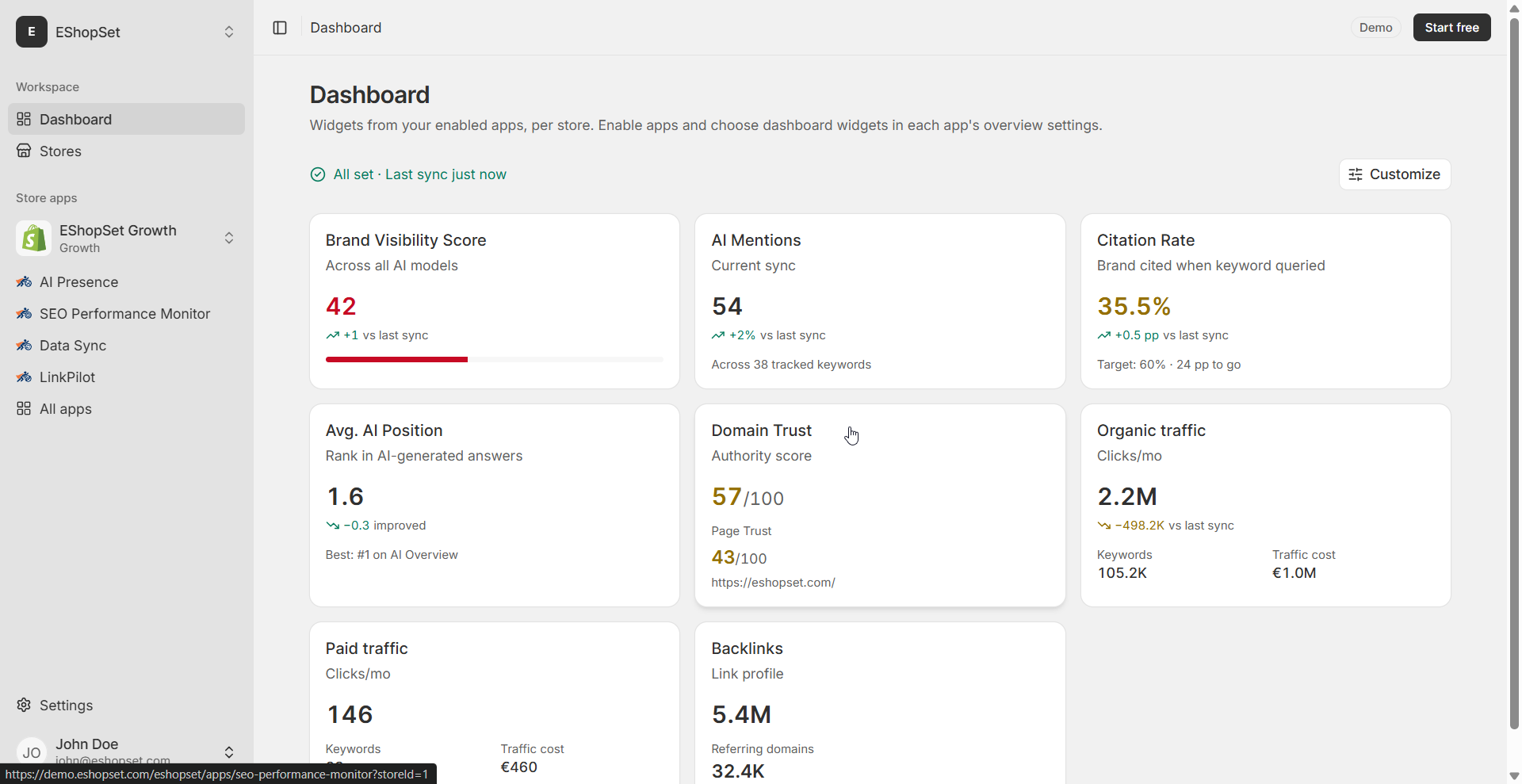
When it comes to SEO, confusion can quickly lead to frustration. Our Shopify SEO app for merchants provides clear, actionable insights into your store's search performance. Instead of wondering why your rankings aren't improving, you get detailed reports, keyword tracking, and competitor analysis. The app's Overview, Settings, and Logs sections are designed to be transparent, showing you exactly what's happening and where to make adjustments. This proactive data presentation means fewer vague questions and more informed decisions, directly impacting your store's AI search visibility Shopify.
2. AI Presence: Simplifying Complex AI for Merchants
AI can be powerful, but also daunting. EShopSet's AI Presence app aims to make advanced AI capabilities accessible for every Shopify merchant. By simplifying complex processes and providing clear feedback within the app's interface, we reduce the likelihood of users encountering unexpected behavior or feeling lost. The app's design guides you through setting up and leveraging AI for your store, ensuring you understand the outcomes and can troubleshoot effectively if something doesn't meet expectations.
3. Sheet2Cart: Precision in Product Management
Managing your product catalog is a cornerstone of ecommerce, and errors here can be catastrophic. Sheet2Cart is built for precision. When you need to Shopify match products by SKU from Sheets, our app provides clear mapping tools, validation checks, and detailed logs for every import. If a product update fails or an item doesn't appear as expected, the logs provide immediate, specific feedback, enabling you or our support team to pinpoint the exact issue without endless email exchanges. This transparency is crucial for maintaining accurate inventory and product details.
Best Practices for Merchants: Getting the Support You Need, Faster
While EShopSet strives to make our apps as intuitive as possible, sometimes questions or issues still arise. When they do, here's how you, as a Shopify merchant, can help expedite resolution:
- Be Specific: Instead of "it's not working," try "The 'Monitor Keyword' button in SEO Performance Monitor isn't responding when I click it on the 'Overview' page."
- Provide Context: What were you trying to achieve? What steps did you take before the issue occurred?
- Include Screenshots or Screen Recordings: A picture (or video) is worth a thousand emails. Tools like Loom or even your phone's screen recording feature can be invaluable.
- Mention Your Environment: What browser are you using (Chrome, Firefox, Safari)? Are you on a desktop or mobile device?
- Check In-App Logs: Many apps, including EShopSet's, provide detailed logs. Referencing these can give support teams a crucial head start.
Conclusion: A Shared Responsibility for Seamless Operations
The "it's not working" dilemma is a universal challenge, but it's one that can be significantly mitigated through a combination of thoughtful app design and clear communication. For Shopify merchants, choosing apps like those in the EShopSet bundle, which prioritize intuitive interfaces, comprehensive logging, and transparent operations, is a proactive step towards smoother daily operations. By embracing tools that offer clarity in areas like SEO performance, AI utilization, and product data management, you empower yourself to resolve issues faster and focus on what truly matters: growing your Shopify store.
And when support is needed, remember that providing detailed, specific information is your most powerful tool. Together, merchants and app developers can transform the support experience from a frustrating detective game into an efficient path to resolution.