Unlocking Organic Growth: Smart SEO for Your Small Shopify Store
Running a small Shopify store means every investment counts. Recently, we stumbled upon a super relatable discussion where an online pet store owner, doing low five figures a month, shared a common pain point: a customer couldn't find them on Google. That experience, as the original poster put it, sent them into a 'late-night SEO spiral' wondering if it was even worth investing in for a tiny brand.
It's a question many of you probably ask: with limited resources, should you pour money into SEO, or stick to what's working with social media and paid ads? Let's break down the community's insights and see what makes sense for a growing Shopify business.
The Big Question: To SEO or Not to SEO?
The overwhelming consensus from the expert community was a resounding yes, SEO is worth it – but with a crucial caveat: how you invest matters immensely. Several respondents, including an SEO agency owner, advised against hiring a full-service agency too early. At low five-figure monthly revenue, typical agency retainers ($1,500 - $5,000+) can eat up your margins before you see the 4-6 months it usually takes for SEO efforts to show significant traffic gains.
Instead, the advice leaned heavily towards a smart, foundational, and often DIY approach in the early stages. This empowers you to build a robust online presence without the immediate financial strain of a large agency.
Start with the Low-Hanging Fruit: Technical SEO Basics
The customer's comment – 'you basically don't exist there' – points to fundamental issues, not necessarily needing a full-blown content strategy. As one community member aptly put it, if someone can't find you when searching your exact brand name, that's the first fix. Here's what the experts recommended:
- Check Your Indexing: Do a quick Google search for
. If few or no pages show up, you likely have an indexing problem. This is a technical fix, not a content problem.site:yourdomain.com - Set Up Google Search Console: This free tool from Google is essential. Submit your XML sitemap to ensure Google knows all your pages exist. Check for any 'noindex' tags that might be preventing your pages from appearing in search results (a common issue with new themes or 'coming soon' settings).
- Optimize for Your Brand Name: Ensure your homepage's Title Tag and H1 heading explicitly contain your exact brand name. If you're not ranking #1 for your own brand, this is a critical, often simple, fix.
- Establish a Google Business Profile: Even if you're an online-only store, a Google Business Profile helps establish your brand's legitimacy and can appear in branded searches. You can hide your physical address if you don't have one.
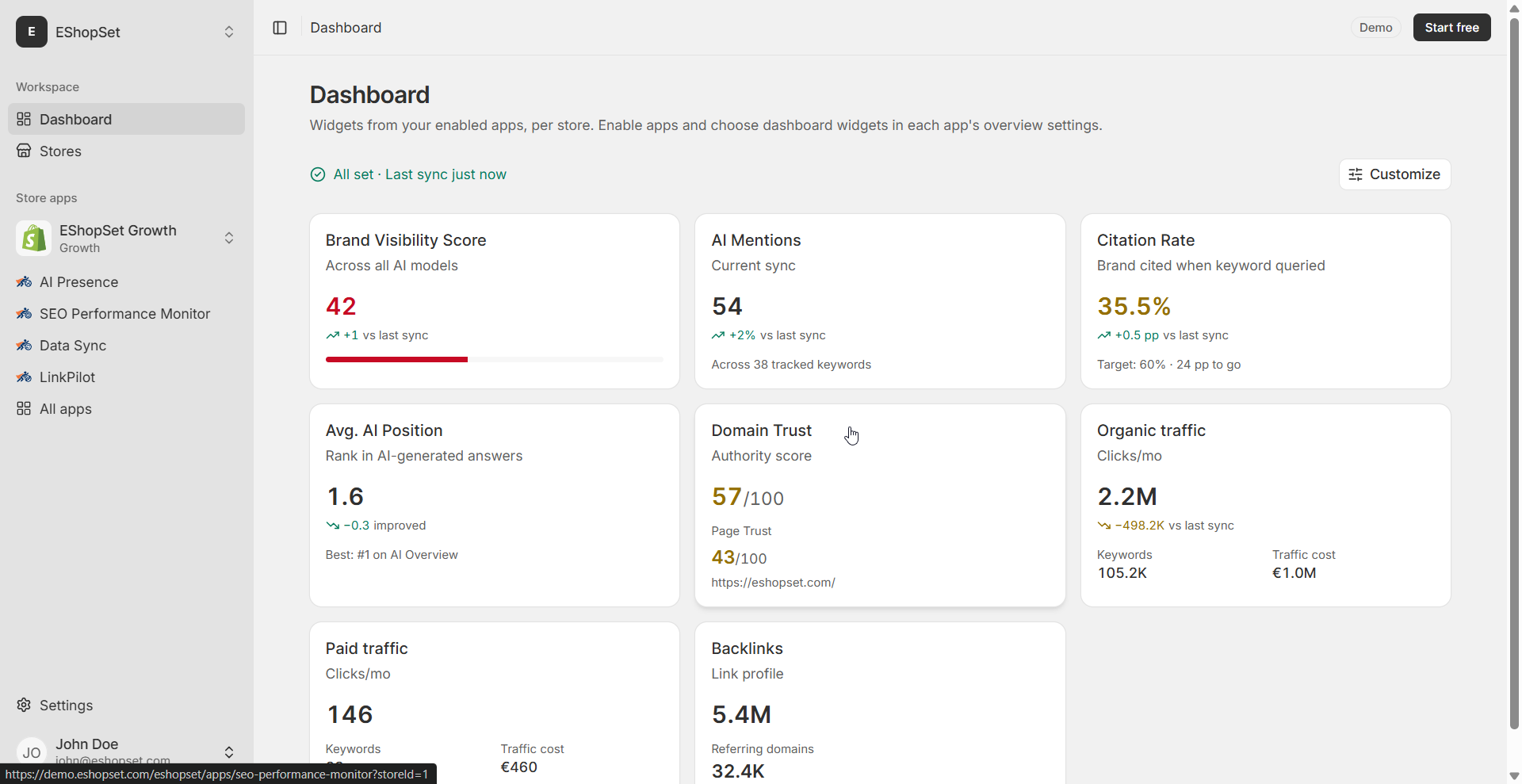
For Shopify merchants, keeping tabs on these technical essentials can feel daunting. That's where tools like EShopSet's Shopify SEO Performance Monitor come in. It helps you track your indexing status, monitor rankings for your brand terms, and identify technical SEO issues directly from your Shopify admin, giving you agency-level insights without the agency price tag. This helps ensure your site is solid before you invest further.
Beyond the Basics: Content & Product Optimization
Once your technical foundation is solid, the next step is to optimize your content. The community suggested focusing on:
- Product and Collection Pages: Move beyond manufacturer descriptions. Write real, specific, unique descriptions for your products and collections. Structure collections around how people actually search (e.g., "grain-free dog food," "slow feeder bowls").
- Buying Guides: For niches like pet supplies, "Best [X] for [specific dog/cat situation]" content is highly effective. These guides catch potential customers right before they make a purchase.
- On-Page Fundamentals: Ensure unique title tags and meta descriptions for every page, relevant alt text for images, and fast-loading images to improve user experience and search engine crawlability.
Creating unique, high-quality content can be time-consuming. EShopSet's AI Presence can be a game-changer here. It leverages advanced AI to help you generate compelling product descriptions, engaging buying guides, and optimized meta descriptions quickly. While AI assists, it's crucial to ensure the output is accurate and authoritative. We emphasize a strong Shopify LLM citation rate within our AI models to ensure the content generated is factual and trustworthy, providing a solid base for your SEO efforts.
The DIY vs. Paid Ads Debate: A Complementary Approach
The original poster also asked about focusing on paid ads/social instead of SEO. The general sentiment was that they solve different problems and are complementary. Paid ads offer immediate traffic that stops the day you stop paying. SEO, however, compounds over time, building an asset that continues to generate organic traffic long after the initial effort. For a small store, a balanced approach is often best: maintain your social media and word-of-mouth efforts, fix foundational SEO yourself, and then consider scaling what's working with targeted ads.
Operational Efficiency for SEO Success
Effective SEO isn't just about keywords and content; it's also about consistent, accurate product data. If your product catalog isn't well-maintained, your SEO efforts will suffer. Imagine trying to rank for a product that isn't accurately described or is out of stock.
This is where EShopSet's Sheet2Cart becomes invaluable. It allows you to manage your Shopify product data directly from Google Sheets, enabling a daily Google Sheets Shopify sync. This ensures your product titles, descriptions, inventory, and pricing are always up-to-date across your store, which is critical for search engine accuracy and customer experience. Streamlining your data management frees up time to focus on strategic SEO and marketing.
Measuring Success: Beyond Rankings
Finally, remember to track organic revenue, not just rankings and traffic. While traffic and rankings are indicators, ultimately, your goal is to drive sales. Use tools like Google Analytics in conjunction with your Shopify SEO Performance Monitor to understand how your SEO efforts translate into actual conversions and revenue.
Empowering Your Shopify Store
The journey of growing a small Shopify store is challenging, but with the right strategy and tools, you can achieve significant organic growth. The community's advice is clear: start with the basics, prioritize technical health, create valuable content, and leverage efficient tools. EShopSet's bundle of apps – SEO Performance Monitor, AI Presence, and Sheet2Cart – is designed to empower Shopify merchants like you to tackle daily operations, streamline your workflow, and build a strong, visible online presence without needing to hire an expensive agency from day one. Invest smartly, and watch your tiny brand grow into a thriving e-commerce success.