Unlocking Rich Results: Strategic Schema for Shopify SEO Success
Hey there, fellow Shopify store operators! We've all been there, scratching our heads over the ever-evolving world of SEO. Recently, I stumbled upon a fantastic community discussion that really hit home for anyone trying to get a leg up in Google's search results. The original poster asked a brilliant question that many of us ponder: "Which type of schema can add more value to Google search engine?"
Their initial thought, which is a solid baseline, was to implement schema based on content relevancy. And you know what? That's fundamentally correct. But as the conversation unfolded, some truly insightful points emerged about how certain schema types can create a much bigger splash.
Schema: The Indirect Ranking Powerhouse
Let's clear up a common misconception right away. As one community member aptly put it, valid structured data doesn't directly make Google rank a page higher. Google itself has stated this repeatedly. So, the original poster's understanding that schema doesn't directly prioritize results in SERP was spot on.
However, that's not the full story. Schema's real power lies in its indirect influence. It helps Google interpret entities on your pages, giving the search engine a clearer context about your content. More importantly, it can make your page eligible for those eye-catching rich results – think star ratings, product prices, and availability directly in the search results.
And this is where the magic happens for your Shopify store. Rich results significantly influence your Click-Through Rate (CTR). If your listing stands out with stars, prices, or other snippets, users are more likely to click on it. This increased CTR sends positive behavioral signals to Google (sometimes referred to as NavBoost), which can, over time, indirectly contribute to better visibility.
The Schema Types That Truly Move the Needle for Shopify Merchants
So, if 'content relevancy' is the guiding principle, which specific schema types should Shopify merchants prioritize to unlock these valuable rich results and boost their CTR? A community expert broke it down perfectly:
- Product Schema: This is non-negotiable for any e-commerce store. It allows Google to display critical information like price, availability (in stock/sold out), and aggregate ratings directly in the SERP. For Shopify stores, ensuring your product pages are correctly marked up with
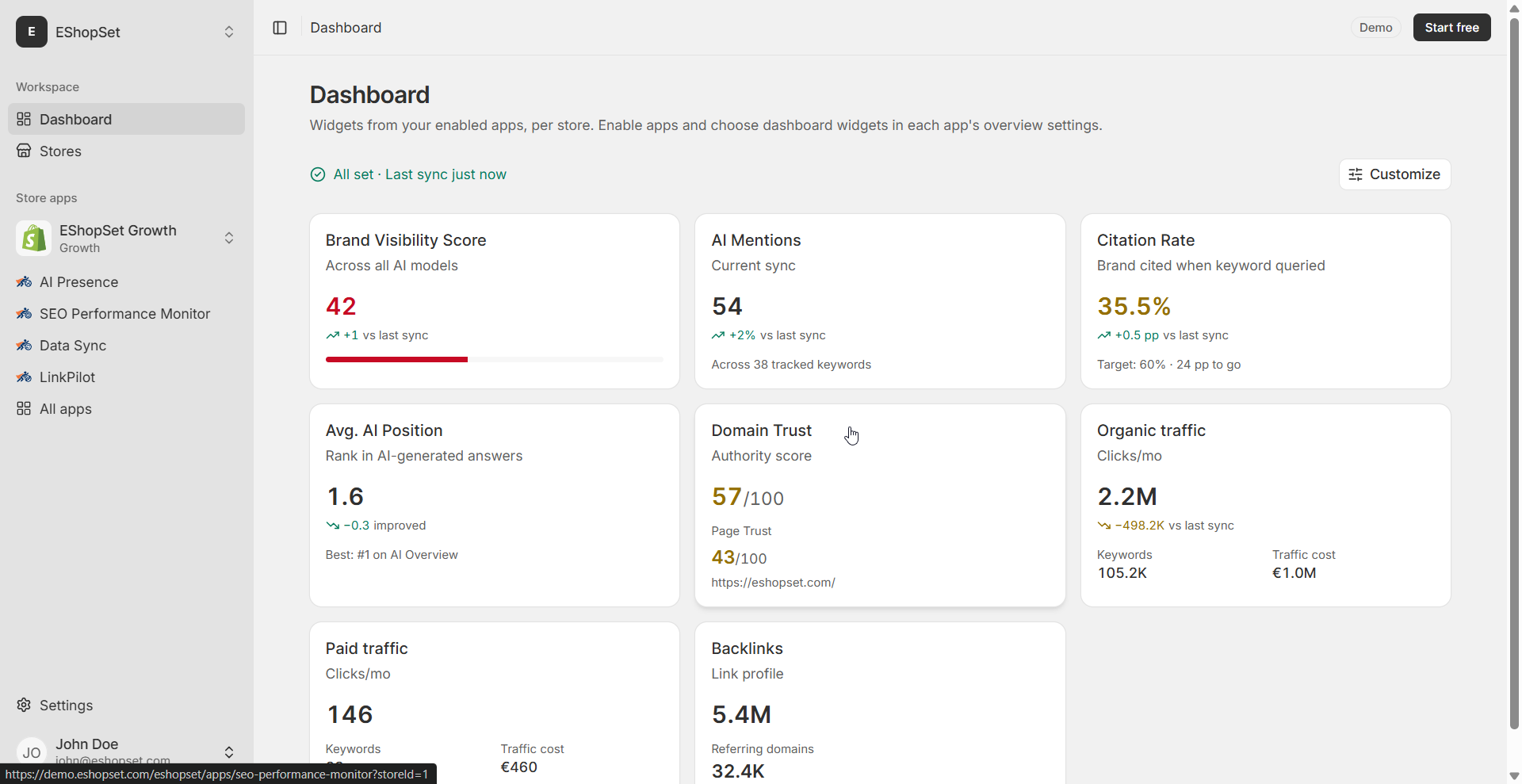
Productschema is paramount. This not only helps Google understand your offerings but also provides immediate value to potential customers right from the search results. EShopSet's SEO Performance Monitor can help you track the validity and performance of your product schema, ensuring your rich results are appearing as intended. - Review / AggregateRating Schema: Star ratings are visual gold in the SERP. They immediately catch the eye and build trust. Implementing
RevieworAggregateRatingschema for your products can lead to a measurable CTR lift. Social proof is powerful, and displaying it directly in search results is a huge advantage. - FAQ / Q&A Schema: While one community member noted recent discussions about its direct impact on AI visibility,
FAQPageschema remains valuable for entity disambiguation and can still generate expanded snippets in some search results. For Shopify stores, using this on product pages for common questions or on dedicated FAQ pages can provide Google with clear, structured answers, potentially feeding into various search features. Our AI Presence app can assist in generating comprehensive FAQ content that is then ripe for schema markup. - Article / BlogPosting Schema: If your Shopify store has a blog (and it should!), marking up your articles with
ArticleorBlogPostingschema, especially when combined withPersonschema for authors (contributing to E-E-A-T signals), can be highly beneficial. This is particularly important for 'Your Money Your Life' (YMYL) topics where expertise and authority are crucial.
The core takeaway from the discussion is this: the schema types that unlock a visual SERP feature are the ones that add the most value, because they change user behavior before the click. So, while "implement based on content relevancy" is correct as a principle, the follow-up question should always be: does this schema type make my result look different in the SERP? If yes, prioritize it.
Practical Steps for Shopify Merchants
Implementing effective schema isn't just about knowing which types to use; it's about execution and maintenance. Here's how you can ensure your Shopify store is leveraging schema to its fullest potential:
- Audit Your Existing Schema: Use Google's Rich Results Test tool to check if your current pages are eligible for rich results and to identify any errors.
- Prioritize Product and Review Schema: For e-commerce, these are your biggest wins. Ensure every product page has accurate
ProductandAggregateRating(if applicable) schema. - Leverage Your Product Data: Accurate and comprehensive product data is the foundation for effective schema. If you manage your product catalog using external tools or spreadsheets, ensuring the data is clean before it enters Shopify is crucial. With Sheet2Cart, you can efficiently handle your Shopify Google Sheets product import, ensuring that all necessary fields for schema (price, availability, SKU, description) are correctly mapped and updated. This streamlines the process of maintaining rich result eligibility across your entire catalog.
- Generate Schema-Friendly Content: Use tools like AI Presence to create detailed product descriptions, engaging blog posts, or comprehensive FAQs. Well-structured content is easier to mark up with schema, making it more digestible for search engines.
- Monitor and Adapt: SEO is not a 'set it and forget it' game. Regularly monitor your rich result performance using tools like EShopSet's SEO Performance Monitor and Google Search Console. Google frequently updates its guidelines and supported rich result types, so staying informed and adapting your strategy is key.
Schema's Enduring Relevance
While a community member suggested that schema might be "somewhat outdated" because LLMs are smart enough to understand content without it, this perspective misses a critical point for e-commerce. While search engines are indeed more sophisticated, schema provides explicit signals that leave no room for ambiguity. More importantly, it's the gateway to rich results, which fundamentally change how your listing appears in the SERP. This visual distinction and the resulting CTR boost are tangible benefits that even the smartest LLMs cannot replicate through inference alone.
In conclusion, for Shopify merchants and store operators, strategic schema implementation is far from outdated. It's a vital component of a robust SEO strategy that directly impacts visibility, click-through rates, and ultimately, sales. By focusing on schema types that unlock rich results and leveraging powerful tools like EShopSet's bundle of apps, you can ensure your store stands out in the competitive digital landscape.