Beyond the Numbers: Decoding Website Speed Scores for Your Shopify Store
Ever felt like you're chasing ghosts when it comes to your Shopify store's website speed scores? You run a test on PageSpeed Insights, then GTmetrix, then Pingdom, and suddenly you've got three different numbers and a fresh wave of confusion. It's a common headache for many store operators, and it was the hot topic in a recent community discussion that really hit home for us here at EShopSet.
The original poster in that discussion perfectly articulated the frustration: scores jumping around, different recommendations, and the constant need to explain to stakeholders that a '67' isn't necessarily a death sentence for their site. What truly matters is the actual user experience and Google's Core Web Vitals, not just a fluctuating number from a diagnostic tool.
The Score Trap: Why Numbers Lie (Sometimes)
So, why the wild discrepancies? As one insightful community member pointed out, there isn't one single score you can trust 'totally' because these tools aren't running the exact same tests. Some tools provide 'lab data' – a simulated test under controlled conditions – while others incorporate 'field data' – real user experience data collected from Chrome users (CrUX). It's like comparing a car's performance on a test track to its performance in rush hour traffic; both are valid, but they measure different things.
Tools like Lighthouse (which powers PageSpeed Insights) give you a snapshot of performance under ideal conditions. They're fantastic for diagnosing specific issues like slow server response times, unoptimized images, or render-blocking resources. However, they don't always reflect what your actual customers are experiencing. That's where Core Web Vitals come in – they are Google's way of measuring real-world user experience based on metrics like Largest Contentful Paint (LCP), First Input Delay (FID), and Cumulative Layout Shift (CLS).
Shifting Focus: From Scores to Real Performance
The consensus from the community discussion was clear: treat the composite score as a diagnostic starting point, not the main Key Performance Indicator (KPI). Instead, elevate Core Web Vitals and real user data to your primary focus. As one respondent suggested, use CrUX/PSI p75 Core Web Vitals as the user-facing KPI. This means looking at what 75% of your users are experiencing, which gives a much more accurate picture of your site's health than a lab score alone.
For diagnostic purposes, running tools like Lighthouse or GTmetrix under fixed conditions a few times and comparing the median can help. But don't get hung up on the 0-100 number. Instead, dive into the waterfall charts and specific recommendations to identify the bottlenecks. Is it a heavy third-party app? Unoptimized product images? Bloated CSS? These are the actionable insights that truly move the needle for your Shopify store's speed and, by extension, your SEO performance.
Managing Expectations: Communicating Speed Goals
Another crucial takeaway, especially for those working with clients or managing internal expectations, is to set the measurement rules upfront. If someone is fixated on a specific score, agree on the exact tool, URL, and test conditions before any work begins. This proactive approach, as highlighted by a community member, prevents endless debates when a different tool or location yields a different number.
The goal should be to commit to improving the underlying metrics and identified bottlenecks, rather than guaranteeing an arbitrary score like '95/100 everywhere.' Once you have controlled 'before and after' data, combined with stable field data from Core Web Vitals, it becomes much easier to steer the conversation away from a single, often misleading, score and towards tangible improvements in user experience and SEO.
Actionable Steps for Shopify Merchants
For you, the Shopify merchant or store operator, here's how to apply these insights to your daily operations:
- Understand Your Data Sources: Know the difference between 'lab' (simulated) and 'field' (real user) data. Both are valuable, but for different purposes.
- Prioritize Core Web Vitals: Make LCP, FID, and CLS your primary speed metrics. Google prioritizes them for search rankings, and so should you.
- Use Diagnostic Tools Wisely: Don't just look at the overall score. Dig into the details provided by tools like PageSpeed Insights or GTmetrix to find specific areas for improvement, such as image optimization, lazy loading, or reducing JavaScript.
- Set Clear Goals: Focus on improving specific metrics and addressing identified bottlenecks. Communicate these goals clearly if you're working with developers or agencies.
EShopSet Team Comment
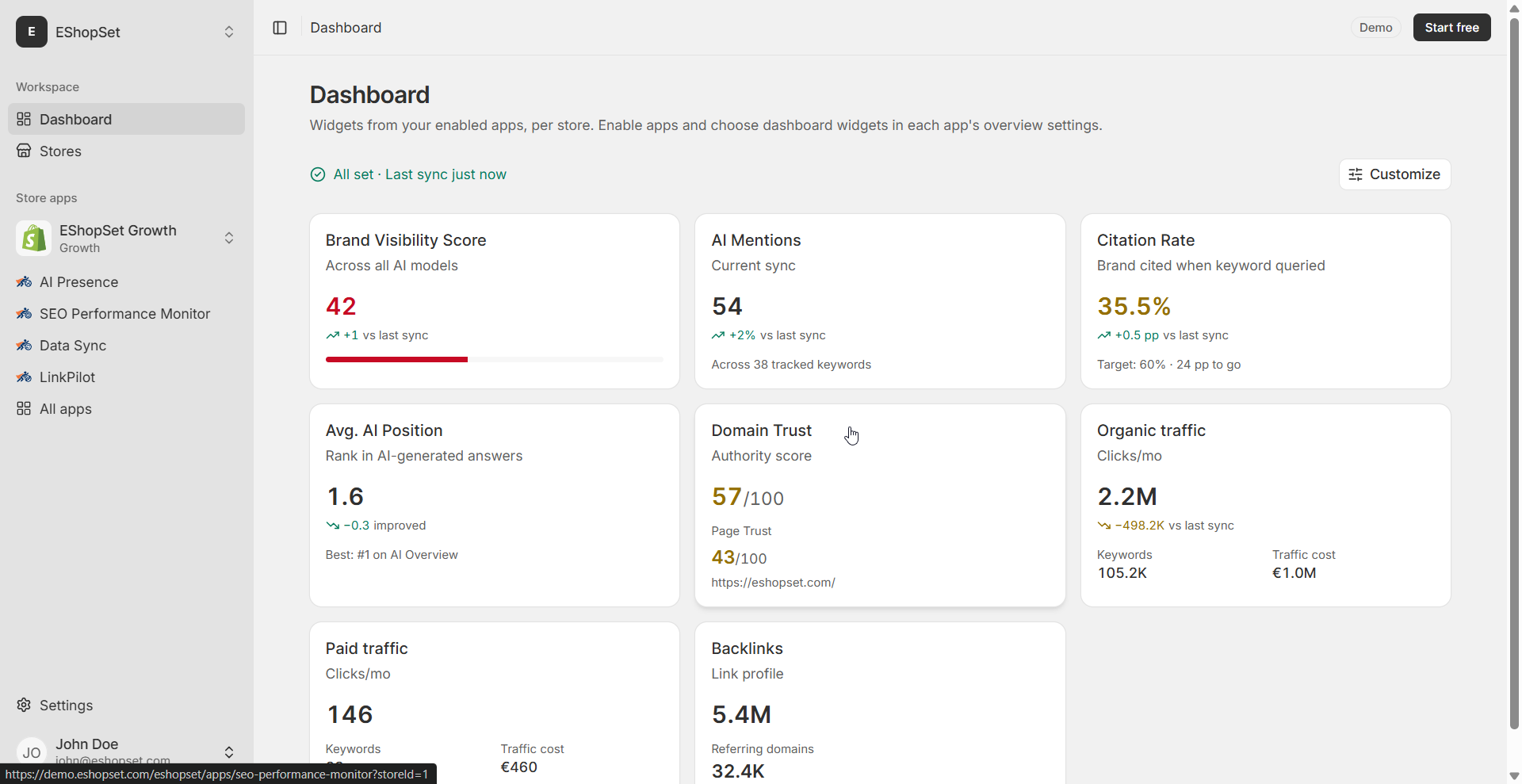
We completely agree with the community's perspective on moving beyond vanity scores. At EShopSet, our goal is to empower Shopify merchants with practical tools. Our SEO Performance Monitor is built precisely for this, tracking your actual SEO health, including crucial Core Web Vitals and real-world performance trends, providing clear insights beyond fluctuating diagnostic scores. This allows you to focus on meaningful optimizations that genuinely improve user experience and search engine visibility, while AI Presence ensures your content is optimized for discovery and engagement.
Ultimately, a fast Shopify store isn't about hitting a perfect 100 on every tool; it's about delivering a seamless, enjoyable experience for your customers. By focusing on Core Web Vitals and using diagnostic tools for what they're best at – identifying specific issues – you can make real, impactful improvements that benefit both your users and your bottom line.