Shopify Sitemap Strategy: Indexing Thousands of Products Without Overwhelm
Running a Shopify store means constantly thinking about how customers find your amazing products. And let’s be honest, Google is usually the first place they look! A common question we hear, and one that recently sparked a lively discussion in an expert community, revolves around sitemaps: specifically, what happens when you have thousands of URLs but Google only seems to index a fraction of them?
The original poster in a tech SEO forum shared a classic dilemma: a site with 10,000 legitimate, internally linked URLs, but only about 5,000 showing up in Google's index. Their core question was whether to keep all 10,000 URLs in the sitemap or remove those not yet indexed. It’s a question that gets right to the heart of how Google discovers and values your content, and it’s especially pertinent for Shopify merchants managing extensive product catalogs.
Sitemap Consensus: List Everything You Want Indexed
The expert community quickly chimed in, and a strong consensus emerged: your sitemap should contain every URL you want Google to index. Multiple respondents emphasized this point, viewing the sitemap not as a guarantee, but as a clear signal of your site's structure and what you consider important and canonical. One community member put it simply: the sitemap is a statement about what you consider canonical, not just a request queue.
This means if you have 10,000 unique product pages, category pages, blog posts, and other content you deem valuable and indexable, they should all be in your sitemap. Removing URLs just because they aren't currently indexed can actually hinder Google's ability to discover them in the future. The sitemap serves as a comprehensive map for search engines, guiding them to all the corners of your store you wish them to explore.
Debunking Crawl Budget Myths for Shopify Stores
What about "crawl budget"? Some might worry that listing too many URLs, especially if many aren't indexed, could waste Google's crawl budget. However, for most Shopify stores, even with thousands of products, this isn't typically a primary concern. As one expert noted, "Crawl budget issues wouldn't be part of this discussion with a site this small unless for some niche circumstances." Google is pretty efficient, and unless you have millions of pages or severe technical issues, your sitemap itself isn't likely to be the bottleneck for indexing.
Instead of worrying about the sheer number of URLs in your sitemap, focus on the quality and accessibility of those pages. Ensure they are well-linked internally, load quickly, and offer unique, valuable content to your customers. These factors have a far greater impact on indexing than the size of your sitemap.
The Nuance of Google Search Console Reporting
A crucial insight came from a respondent who highlighted the potential discrepancies in Google Search Console (GSC) reporting. They observed that GSC's sitemaps report might show "0 indexed" for submitted URLs, while individual URL inspections revealed many of those pages were indeed indexed. This suggests that the "indexed" column in the sitemaps report isn't always a real-time or completely accurate reflection of coverage.
This underscores the importance of not acting solely on aggregate GSC data. Instead, consider spot-checking individual URLs using the URL Inspection tool. This can reveal specific indexing issues or confirm that pages are indexed despite what an overview report might suggest. It's a reminder that SEO is often about digging deeper than surface-level metrics.
EShopSet's Role in Mastering Your Shopify Store's Indexing
For Shopify merchants and store operators dealing with the complexities of large product catalogs and SEO, managing sitemaps and indexing can be a daunting task. This is where EShopSet Shopify apps come into play, offering a powerful bundle to streamline daily operations and enhance your online presence.
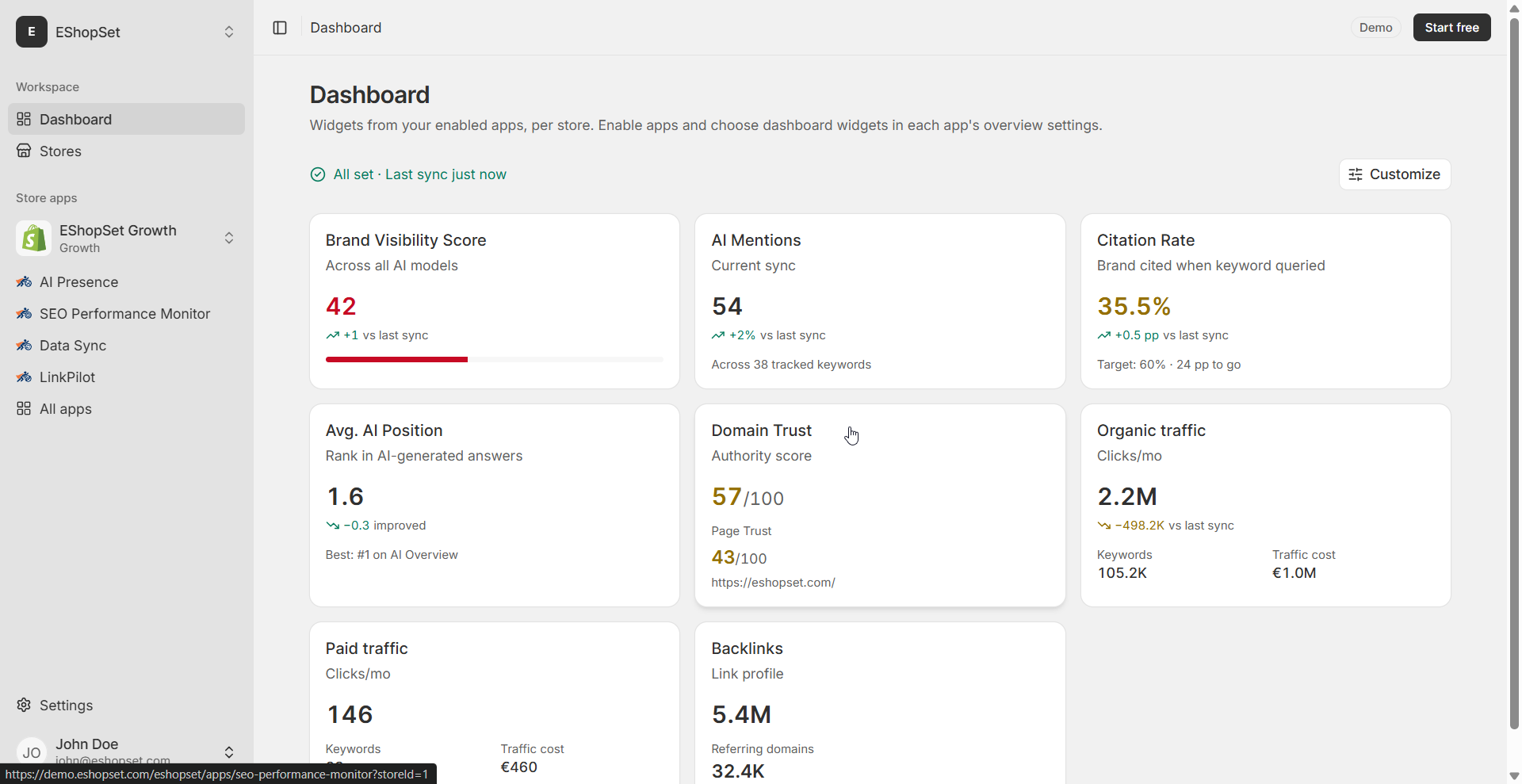
1. SEO Performance Monitor: Your Indexing Watchdog
Understanding which of your 10,000 URLs are indexed and why others aren't is critical. Our SEO Performance Monitor app provides the insights you need. It helps you:
- Track Indexing Status: Get a clearer picture of your pages' indexing status beyond general GSC reports.
- Identify Canonical Issues: Ensure your canonical tags are correctly implemented, signaling to Google your preferred version of a page.
- Monitor Collection SEO: Keep a close eye on Shopify collection SEO tracking, ensuring your vital category pages are optimized and indexed.
This app acts as your vigilant SEO assistant, helping you proactively address issues that might prevent your valuable product pages from appearing in search results.
2. Sheet2Cart: Seamless Product Data Management
For stores with thousands of products, keeping product information accurate and up-to-date is a monumental task. Inaccurate or outdated product data can lead to poor user experience and even de-indexing by Google. Sheet2Cart simplifies this process by allowing you to manage your entire product catalog from a spreadsheet.
- Efficient Updates: Easily update thousands of product details, inventory levels, and pricing.
- Consistent Data: Ensure consistency across all your product pages, crucial for Google to understand and value your content.
- Fresh Content for Crawlers: With hourly Shopify product sync from Sheets, your store's content remains fresh and accurate, encouraging Google to crawl and re-index your pages more frequently.
This ensures that the 10,000 URLs in your sitemap lead to current and high-quality product information.
3. AI Presence: Quality Content at Scale
Some community members raised concerns about "scaled content abuse" when adding many pages at once. It's important to clarify: Google does not penalize sites purely for publishing or submitting a large volume of legitimate pages. The issue arises when content is mass-produced and lacks quality, uniqueness, or value.
AI Presence helps you avoid this pitfall by assisting in the creation of unique, engaging, and high-quality content for your product descriptions, meta descriptions, and other on-page elements. By leveraging AI responsibly, you can:
- Generate Unique Descriptions: Create distinct product descriptions for even similar items, reducing duplicate content concerns.
- Enhance SEO Copy: Optimize your content for relevant keywords, improving its chances of ranking.
- Maintain Quality at Scale: Ensure that even with a large catalog, each page offers value to both users and search engines.
This ensures that your thousands of URLs are not just numerous, but also rich in content that Google will want to index.
Actionable Takeaways for Shopify Merchants
To summarize the expert advice and leverage the power of EShopSet:
- Keep All Canonical URLs in Your Sitemap: Your sitemap is a declaration of intent. Include every legitimate, indexable page.
- Focus on Content Quality and Internal Linking: High-quality, unique content and a robust internal linking structure are paramount for indexing.
- Monitor GSC with a Critical Eye: Use Google Search Console, but understand its reporting nuances. Supplement with individual URL inspections.
- Leverage EShopSet Shopify Apps: Utilize SEO Performance Monitor for tracking, Sheet2Cart for efficient product data management and AI Presence for quality content generation to ensure your entire catalog gets the attention it deserves from Google.
By adopting a strategic approach to your Shopify sitemap and leveraging the right tools, you can confidently guide Google to index your entire valuable product catalog, driving more organic traffic and sales to your store.