Mastering AI-Driven Discovery: Optimizing Your Shopify Store for the New Search Era
Hey everyone! It’s a wild time to be running an online store, isn't it? The world of search and discovery is constantly evolving, and AI is definitely shaking things up. I recently stumbled upon a really interesting discussion in a merchant community that got me thinking, and I wanted to share some insights with you all. The original poster kicked things off by asking about using ads in ChatGPT and enhancing a store's 'GEO' – essentially, SEO but for AI search – to get AI models to recommend their products.
It's a hot topic, and the community had some fantastic points. Let's dive into what we learned.
ChatGPT Ads: Too Early to Call?
When it comes to direct advertising within platforms like ChatGPT, the general consensus among merchants and experts is that it's still very early days. One respondent mentioned they'd been testing new ChatGPT ads for Shopify clients but found them to be 'a bit hit-or-miss,' feeling more like a 'brand play than a direct ROAS channel.' Another community member shared that they tried ChatGPT ads for a couple of weeks but 'it didn’t really make a difference' for their store.
An expert weighing in on the discussion advised that anyone claiming definitive performance data right now is likely 'selling something.' They suggested it's 'worth watching, not worth budget yet.' So, while the idea is intriguing, it seems most merchants and experts are advising caution and a 'wait and see' approach before allocating significant ad spend here. Focus on building a robust foundation first.
Decoding 'GEO': Optimizing for AI Recommendations
This is where the conversation really got interesting, and where the actionable insights for Shopify merchants truly shine. While one community member initially argued that 'enhanced their Store's GEO' isn't really possible beyond traditional SEO, many others strongly disagreed, offering concrete strategies that align perfectly with modern e-commerce best practices.
What AI Models Really Look For
One astute respondent suggested a brilliant experiment: 'Ask ChatGPT to recommend a product in your niche, then ask why it chose that product, then ask why it recommended that over your product.' The answers, they noted, are often illuminating. AI models favor:
- Structured Content: Clearly organized information on product pages.
- Target Audience Clarity: Knowing exactly who a product is for.
- Feature Comparisons: How a product stacks up against others in your lineup (e.g., good, better, best).
- Hard Number Descriptors: Specific, quantifiable facts ('holds 120lbs') over vague marketing copy ('extra strong').
These insights underscore that while the term 'GEO' might be new, the underlying principles are deeply rooted in making your store highly readable and understandable, not just for human visitors but for AI crawlers and language models.
Actionable Strategies for Shopify Merchants
1. Enhance Crawlability and Content Structure
AI models, much like traditional search engines, need to be able to access and understand your content. A community member highlighted a critical point: 'Most of them do NOT run JavaScript.' This means if your product name, price, and key differentiators are only loaded via JavaScript, AI crawlers might miss them. You need to ensure these facts are present in the raw HTML source of your pages.
- Technical SEO Foundation: Ensure your product and category pages are crawlable and contain the right content. This includes proper use of headings, meta descriptions, and alt text.
- Structured Data (Schema Markup): While not explicitly mentioned in the thread, implementing schema markup for products (e.g., Product, Offer, AggregateRating) makes it much easier for AI to parse and understand your product details.
- Content Quality: Publish structured, authoritative content on your blog that establishes your store as a knowledge leader in your niche. This helps AI models view you as a credible source.
For Shopify merchants, monitoring your store's technical health and ensuring optimal crawlability is paramount. Tools like EShopSet's SEO Performance Monitor can help you identify and address critical SEO issues that might be hindering AI discovery, ensuring your content is visible to all types of crawlers.
2. Prioritize Data-Rich Product Descriptions
As one respondent noted, AI agents 'like structured content on the product page, it likes knowing exactly who this product is for, it likes knowing how it compares to other products in your lineup... it likes hard number descriptors over marketing copy.' This means moving beyond generic marketing fluff to provide detailed, specific, and comparable product information.
- Detailed Specifications: Include dimensions, materials, weight, capacity, and other quantifiable attributes.
- Use Cases: Clearly describe who the product is for and how it solves a problem or fulfills a need.
- Comparison Tables: If you have multiple versions of a product, a clear comparison table can help AI understand the differences.
Managing extensive product data can be a challenge, especially for stores with large catalogs or frequent updates. This is where EShopSet's Sheet2Cart app becomes invaluable. It allows you to efficiently manage and update your Shopify product data directly from Google Sheets. Need to add a new specification across hundreds of products? With Sheet2Cart, you can easily Shopify import products from Google Sheets, ensuring all your product listings are consistently rich with the structured, factual data that AI models crave.
3. Cultivate External Mentions and Authority
AI models don't just look at your own site; they seek consensus from independent sources. 'When someone asks ChatGPT or Perplexity to recommend products in a category, the answer leans on third-party sources: "best X" roundups, review sites, Reddit threads.' Models interpret 'repeated consistent mentions across independent places as consensus.'
- PR and Outreach: Engage in public relations efforts to get your products featured in relevant blogs, publications, and directories.
- Review Management: Actively encourage and manage customer reviews on your site and third-party platforms.
- Community Engagement: Participate in relevant online communities (like Reddit and Quora) where your brand or products might be discussed.
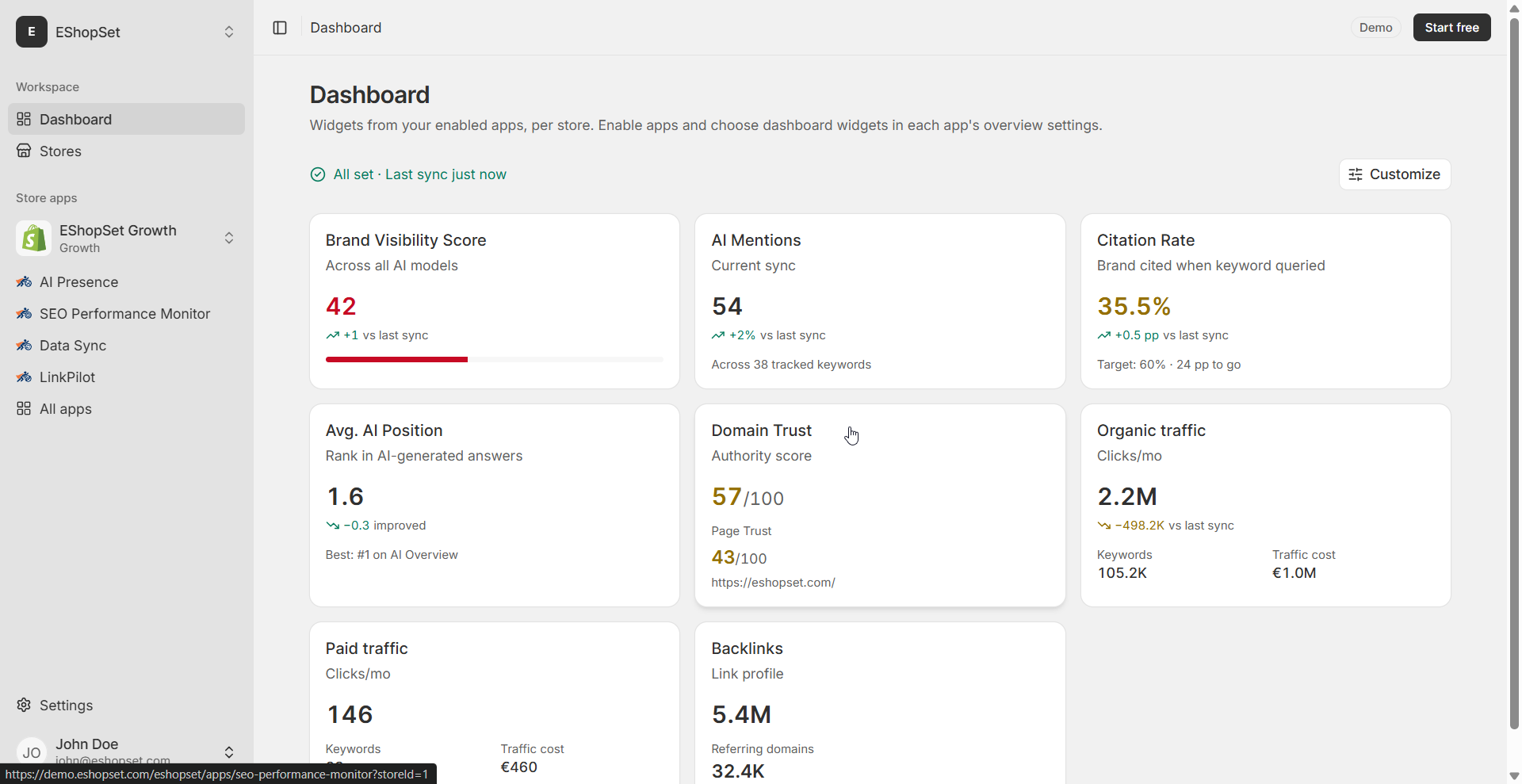
Monitoring where your brand is mentioned and understanding the context of those mentions is crucial. EShopSet's AI Presence app helps you track when AI models mention your brand and analyze what prompts competitors are winning. This intelligence allows you to refine your content strategy and identify new outreach opportunities, ensuring your brand is positioned as an authority in the eyes of AI.
Measuring Your AI Presence
You don't need expensive tools to start. As one expert suggested, you can measure your AI presence for free:
- Write down 10 questions a customer might ask an AI in your category.
- Run these questions monthly in popular AI models like ChatGPT and Perplexity.
- Log two columns: 'were you mentioned,' and 'was what it said accurate.'
This crude but effective method provides a real trendline, allowing you to see if your efforts are paying off and if the information AI models provide about your store is correct.
EShopSet: Your Partner in the AI-Driven E-commerce Landscape
The shift towards AI-driven discovery is undeniable. While the channel is real, the products sold around it are mostly ahead of the evidence. However, by focusing on fundamental improvements to your store's data and online presence, you can gain a significant edge.
EShopSet provides a powerful bundle of Shopify apps designed to help you navigate this new era:
- SEO Performance Monitor: Ensure your store is technically sound and crawlable, forming the bedrock for any AI optimization.
- AI Presence: Monitor your brand's mentions in AI contexts and understand how to position your products for recommendations.
- Sheet2Cart: Streamline your product data management, making it easy to maintain the structured, detailed information that AI models prioritize. Efficiently Shopify import products from Google Sheets to keep your catalog AI-ready.
By integrating these tools into your daily operations, you're not just reacting to changes; you're proactively shaping your store's future in an AI-powered world. The early movers in 'boring categories' are already winning recommendations. Will you be next?